Screen Memories: Teenage Sex and Death at Camp Miasma, A Wedding, Night Nurse
This is a free post from Larry Fitzmaurice's Last Donut of the Night newsletter. Paid subscribers get one or two email-only Baker's Dozens every week featuring music I've been listening to and some critical observations around it, along with a Screen Memories column every one or two weeks where I write about stuff I watched lately.
And in less than two weeks, this column will also be largely paywalled—so if you like what you see, I highly encourage you to take advantage of the "birthday layoff" sale I'm running. We're talking 39% off the first six months of a monthly subscription, or the same discount off of a year of the annual subscription. You can grab the monthly sale ($1.83/month) here, and the annual sale ($18.30) here. You won't regret it, and you'll be keeping this 100% independent publication alive and well, too.
OK, without further ado:
The Appointment [Lindsey C. Vickers; 1981]
Shout out to Jam City's Jack Latham for recommending this one to me (side note, keep an eye out for a newsletter interview with him next month!)...I can only describe this one as "existential cosmic horror," even as it feels of a piece with a lot of British folk horror that was emerging around its time (to wit: the lead actor here, Edward Woodward, was also the lead in the O.G. Wicker Man), I don't have three hours to go back and check but I wouldn't be surprised if this one wasn't mentioned in passing in the excellent 2021 doc Woodlands Dark and Days Bewitched: A History of Folk Horror. The Appointment was originally made for the BBC as part of an intended series of horror films that never came to be, it was more or less lost media before BFI gave it a proper release in 2022, I tracked it down by grabbing a seven-day free trial to BFI Player Classics but you can definitely find it elsewhere online as well...director Lindsey C. Vickers apparently said during production that the aim was to "frighten by suggestion rather than overstatement" and I dare say he pulled it off, it's so rare that something captures the nature itself of dreams (and nightmares!), it's definitely the kind of film that I'd encourage going in as blind as possible before watching. (If you needed any further of a hard sell, Charli XCX likes this one as well.)
The Hamptons [Barbara Kopple; 2002]
Another recommendation from a recent interview subject, this one came straight from comedian and Blue Heron actor Amy Zimmer (you can read that chat here), it's streaming on Le Cinéma Club for the rest of the week and is hard to find elsewhere, so watch it while you can. No surprise that the documentarian behind Harlan County, USA would head to the Hamptons and return with an incisive cross-section of labor and class inequities, along with more than a few proto-reality TV moments (although maybe that's because there is literally a Summer House plotline that runs through it)...along with a lot of surprising celebrity cameos and an up-close-and-personal focus on the aftermath of the Lizzie Grubman crash, The Hamptons also functions as an accidental 9/11 text in several ways, perhaps the most notable way being that it literally ends on September 12, 2001. (There is also a moment in which Julian Schnabel, filmed on September 10, 2001, basically predicts 9/11. Who said the art world lacks perceptive depth?) All in all, extremely engrossing stuff, as well as a fascinating time capsule of how the rich were endlessly catered to before things truly got worse.
Teenage Sex and Death at Camp Miasma [Jane Schoenbrun; 2026]
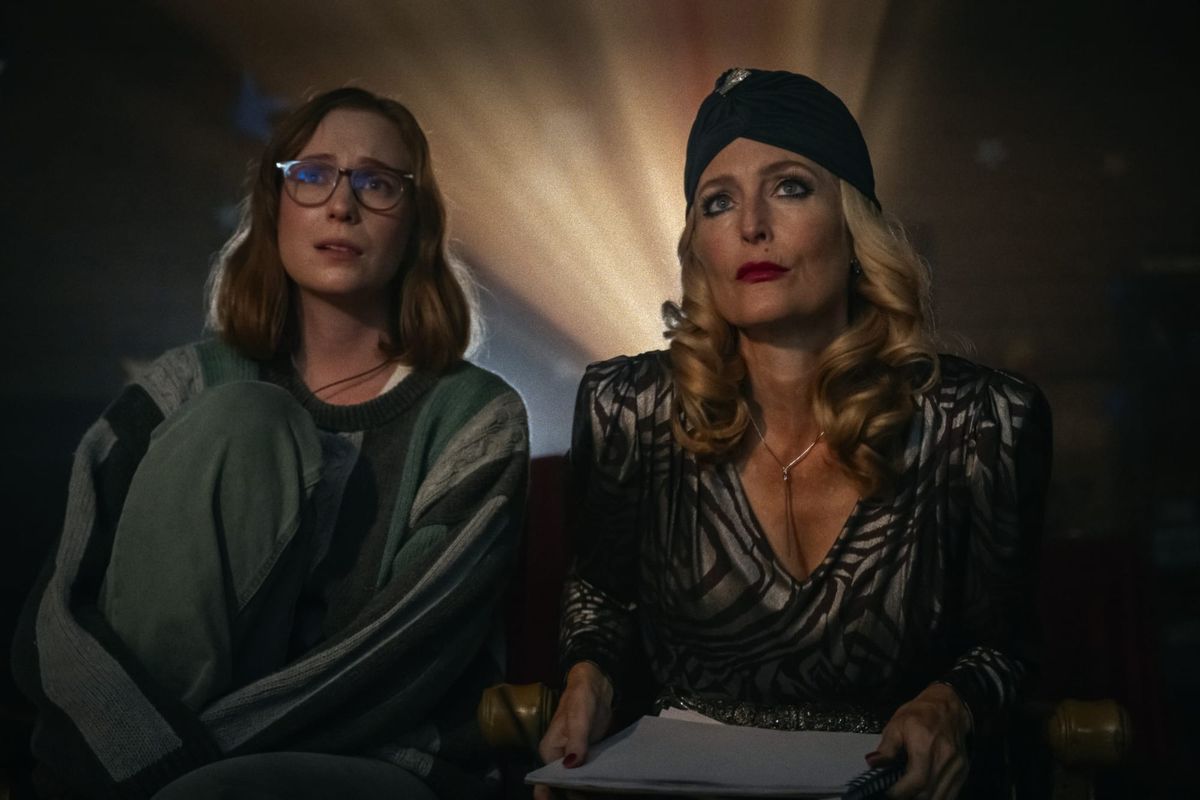
You know the discourse is toxic when it has people posting "We all need to get to a point where we're nicer to each other again"...excuse the wild parallel drawn here, but the vape-plumes of irate chatter that intermittently surround Schoenbrun's work are not unlike those that have surrounded Rachel Sennott (please note I am not drawing a parallel when it comes to levels of ability and talent here), the connecting thread being that a lot of the negativity driven towards both and others seems borne out of a generational "Why them and not me?" frustration, a tacit acknowledgment that it's harder to squeeze through the keyhole of success in the entertainment industry than ever before so, if these people have done it, something must be wrong with them and they must be hurled onto the pyre as a result. I don't love this phenomenon, but in the end we are talking about (in the scope of the world, anyway) a relatively small group of extremely online people with varying degrees of mental illness, what else should we actually expect? Onto the film itself, I'm in "liked but didn't love" territory with this one, I think Schoenbrun is an undeniably talented filmmaker but this is a good case of some elements simply working better than others across the board, although it's also clearly a YMMV situation as all the IRL people I talk to have different POVs regarding what worked and what didn't...I thought the film's central message surrounding the healing of sexual trauma was very effective but found myself a little exhausted by the many meta-textual discursions regarding nostalgia and sequel-itis, I would actually go as far as to say that Camp Miasma should be the final word on the latter topic because I'm just not sure what else there is to say about it at this point. The film's two most explicitly meme-y moments—the "A Long December" sequence and the slasher homage that closes out its final third—were not to my liking and felt tailor-made for the YouTube Shorts crowd, and in general I found that the film-within-a-film portion more or less brought the pacing to an absolute halt, I do not need a thinly-veiled Sleepaway Camp parody embedded within a film that explicitly talks about Sleepaway Camp. My biggest issue with Camp Miasma, however, was the god-awful cover of R.E.M.'s "Nightswimming" from Okay Kaya that plays over the opening credits...above all else I think Schoenbrun has proved themselves as possessing a solid sense of taste (I mean, this film brought Paul Buchanan out of the shadows again!), I can only assume that there must be some sort of blackmail involved to intro your film with such an absolute massacring of a classic song. In the end, I'm grateful to be given something of a rich text to pick apart and analyze, it's certainly preferable to having nothing to talk about at all...in the realm of sneaky cameos it was a treat to see Louise Weard pop up in this one, keep an eye out for an interview with her in the newsletter soon.
Our Hero, Balthazar [Oscar Boyson; 2026]
Perhaps we'll look back at 2026 as the year that it was considered acceptable to approach school shootings as a satirical well from which to draw from, rather than a variant of tragedy so unfathomable that we dare not speak its name...if this phenomenon can be identified as such, it's undoubtedly because mass shootings have generally become as much of an American way of life as sports betting, child abuse, and credit card debt. The Drama is, much like Showgirls, a classic example of "European filmmaker showing us what America looks like to them" (and is also much more about MeToo than it is school shootings, but maybe I'll get to that some other time), whereas the call is very much coming from inside the 50-state'd house in Our Hero, Balthazar courtesy of first-time director Oscar Boyson (who also was co-founder of the seemingly-in-limbo and formerly Safdies-led production house Elara Pictures). There's some Eddington, Jr. vibes here as another film reading consciously from The Book of Rittenhouse, but I'd say Our Hero, Balthazar is actually bleaker than Aster's ominous meditation on American hypocrisy and sexual abuse (I wrote about the latter and severely underdiscussed aspect of that film here)...if I had to level one criticism towards this good-time-of-a-bad-time film, it's that the POV shifts result in something of an incomplete characterization of both protagonists, although Asa Butterfield's powerhouse performance (I wasn't a Sex Education viewer but am nonetheless surprised he had this in him) certainly made up for any attendant narrative shortcomings.
Night Nurse [Georgia Bernstein; 2026]
While watching this I kept thinking about Roger Ebert's review of Crash (the Cronenberg one, obvs) as a film about a fetish that doesn't actually exist...of course, this is no Crash (what is?), and I will say that I spent a good deal of Night Nurse experiencing fits of boredom in the patience of its operation. That said! This came together for me quite nicely at the end, even if I felt the journey was a little hard-won...I did appreciate Bernstein's overall sense of composition and thought this movie looked quite good, I'm highly interested in seeing if she gets to cook up something next because even though I didn't 100% connect with this one I did find it intriguing and provocative in its own way.
A Wedding [Robert Altman; 1978]
Way too much of a banger for a movie that emerged out of a literal joke that Robert Altman told on the set of 3 Women...it's somewhat surprising to me that this was middlingly received at the time but, after something like 3 Women, I guess anything would seem slight by comparison. Incredible performance from Carol Burnett here even if I kept waiting for her to tug at her ear, lots of fun comedic scenery-chewing in general with not a single minute wasted, perhaps Altman is just one of those people for me whose I have a hard time finding fault with but I found this to be fantastic and up there with some of his best overall, it is what it is.
Ape [Joel Potrykus; 2012]
Joel Potrykus' work is often and distinctly Gen X-flavored, but with the essential understanding that being a down-and-out loser is, in fact, eternal; despite the mannerisms of his film's characters and some of their specific predilections (the Godsmack sequence in Vulcanizadora certainly stands out), there's something timeless to the (figuratively and literally) grungy corners of America that he's so good at capturing. After having seen much of his work that followed, Potrykus' debut Ape is a very solid in-chrysalis form of his micro-budget and maximum-pain approach. It also serves as a great intro to actor and frequent Potrykus collaborator Joshua Burge, who has the perfect combination of "great face" and "great voice" and is allowed to be a little funnier here than his more menacing appearances in other Potrykus films. I only have one more Potrykus film to check off my list (The Anarchist's Cookbook) but I remain very fascinated by his work and hope to get a chance to interview him (maybe for this newsletter!) one day.
The History of Concrete [John Wilson; 2026]
I will write more about this in a future column when it's out for all to see, but I saw a press screening of this yesterday and thought it was excellent, plenty to chew on as you'd expect from a feature-length John Wilson shindig, as well as more than a few surprising moments and truly unexpected cameos...if you liked How To you'll love this, and that's all I'll say on it for now.