Amy Zimmer on Blue Heron, NYU, Being Funny, and Finding Ways to Stay Warm
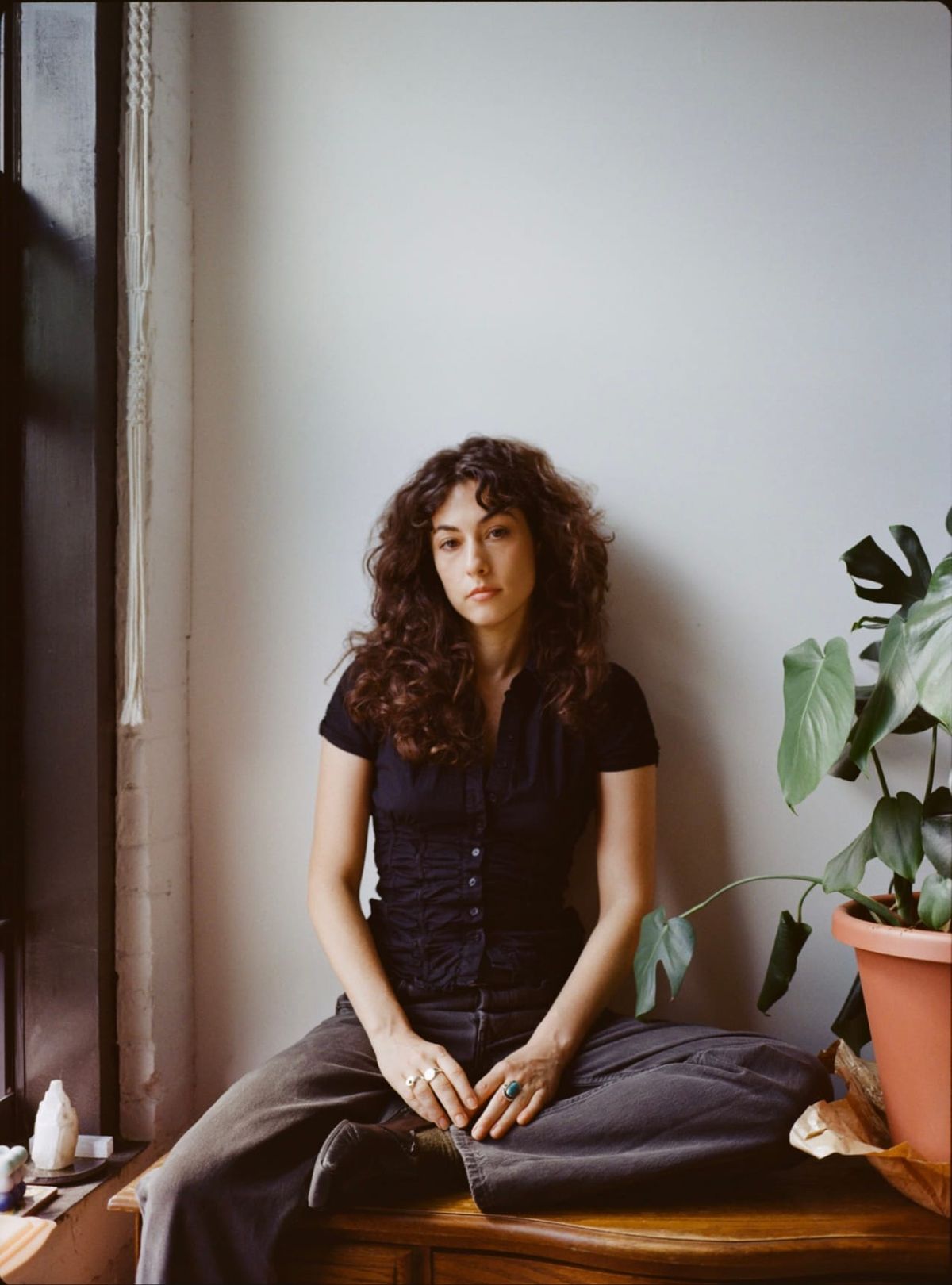
This is a free post from Larry Fitzmaurice's Last Donut of the Night newsletter. Paid subscribers get one or two email-only Baker's Dozens every week featuring music I've been listening to and some critical observations around it, along with a Screen Memories column every one or two weeks where I write about stuff I watched lately.
And there's about two weeks left for the "birthday layoff" sale I'm running (because it was recently my birthday, and I was recently laid off). We're talking 39% off the first six months of a monthly subscription, or the same discount off of a year of the annual subscription. You can grab the monthly sale ($1.83/month) here, and the annual sale ($18.30) here. You won't regret it, and you'll be keeping this 100% independent publication alive and well, too.
Here's what is cooking today: Comedian and actor Amy Zimmer is having quite a year, along with her appearance in extremely funny stuff like fellow comedian (and newsletter alum) Jack Bensinger's "Peripheral Vision" sketch she has a standout role in one of 2026's best films, Sophy Romvari's astounding Blue Heron. I hit up Amy last month to see if she'd be down to talk about everything she's accomplished thus far in her impressive career, and earlier this week we gabbed for an hour about what she's been up to, her unique POV on the world at large, and much more. It was a great convo that I'm happy to share with you today, check it out:
Let's talk about growing up in Tampa.
Most Floridians will say it's a unique place to grow up in. Central Florida feels like its own specific environment. Most people know Miami or the Keys, but central Florida is this weird place. Tampa and St. Petersburg used to be the focus group hubs of the '90s. A lot of chain restaurants get their start in that area because they're like, "How do we test on this swath of people that echo the demographic we're trying to advertise to?" That's a big part of growing up in Tampa. There's not a lot of people who are native to Florida—my parents are from Long Island and Chicago. It's a weird hodgepodge. There's a lot of out-of-towners and snowbirds. You feel like you're from a place that's a non-place.
Did you do any focus group stuff?
No, but I clocked a lot of hours at Outback Steakhouse, which should count for something.
You worked at Outback?
No, I just ate the bloomin' onions.
Did you ever work any service or retail jobs?
I've worked catering and retail. I worked this job for a while in New York where I was catering to a lot of photo shoots—delivering these Extremely elaborate, healthy chia-seed puddings to Victoria's Secret photoshoots and driving this very broken, white sprinter van filled with carafes of coffee that were toppling over all the time.
How long were you in Florida for?
I was born and raised in Florida through high school, and then I came to New York for college at NYU, and I've stayed in New York since then.
I went to NYU too. What school did you go to?
I went to CAS, and then I transferred to Gallatin. When I was in school, there were the first whisperings of being digitally native, and I was interested in being a writer. I panicked halfway through, because I was really scared about graduating and trying to be a writer. There were all these technological considerations that I was interested in, and I couldn't really major in fiction writing anyway, so I pivoted to Gallatin, where I studied artificial intelligence in am academic sense, and how narrative was being formed through technology. It sounds very obvious now, but at the time there were early convos tied to how the internet was progressing that.
I went to Gallatin too.
You did?
I did. It's funny, because I went there specifically to study culture writing, and I was really taken aback on arrival that, despite the freedom in terms of study that Gallatin offered, it was really just a lot of rich kids from L.A. who were killing time. But it sounds like you made good use of the individualized study approach, which is somewhat rare.
I think it's because I barely knew about its reputation. For my colloquium, I was talking about language and technology, and one of my professors from the linguistics department was actively researching this stuff. He asked if consciousness happened inside a vacuum, or if it was continuous—a question about a Roger Penrose book that I put on my list. Afterwards, I asked other people how theirs went, and they were like, "They asked me what love is," and I was like, "What?"
When I did this pivot, I was enrolling in a lot of linguistics courses and serious theoretical courses to bolster [my concentration]. I tried to get into this one class and wrote a letter to the professor about why I really wanted to do it and why I felt I had the capabilities for it—because it was quite challenging for a humanities major—and he emailed me back immediately and said, "Amy, why do you want to take the class?" Before I could even plead my case, he replied again and said, "I don't think you're right for this course." I was like, "Damn, you don't even know me."
I had that happen a lot, too. I tried to take a lot of music industry classes, and every single time they'd be like, "No, fuck you." I feel like the professors in other schools were like, "These piece of shit Gallatin kids—we're not going to deal with them."
Yeah, I did feel like that was the vibe. Only once I was in it, did I realize that everybody was like, "Yeah, you could do whatever." I was like, "Not to me!" I was taking it seriously.
I actually also talked about this with David Wain, Ken Marino, and Craig Wedren recently, because they went to NYU as well. Going to NYU is such a specific thing in terms of college experiences. How was it for you?
For some reason, I was extremely motivated to be in the city, despite not having any experience. I just wanted to to try to get up there as soon as possible. I had all these Floridian aspirations, and then I got there and it was a huge adjustment. I didn't understand how to layer until six months ago. It's a school loaded with a lot of meaning in the city, and an interesting place to be determining how you want to proceed with your life. I also think it breeds a lot of entrepreneurial people, for better for worse. I have mixed feelings about it, but I had classes that definitely changed my life. I imagine I owe something to it, although I don't do anything associated with what I studied.
Yeah, I was gonna ask you if you found ways to apply your concentration to what you do in the long term.
When I was in school, I wanted to write novels. What I learned was that technology was changing in the middle of me being interested in that. I'm extremely interested in the formalities of narrative, language, people, and dialogue—all the complex intricacies you can get with literature. But I realized it was changing. I don't want to say "dying," because publishing seems to be changing once again. But I was interested in seeing how technology was changing my life, as well as the way people took in stories—and I saw an opportunity to understand how the new technology was informing that. What's stayed with me throughout all of this is that the form dictates what people perceive about people and story in general. The internet has informed how people metabolize narrative, which is still really what I'm obsessed with—even though I have my own relationship with the internet. The linearity of storytelling is super interesting to me.
How would you characterize your relationship with the internet at this point?
My relationship with it is at its best when I'm in-and-out with it. Other people have different boundaries with it, butI get the most out of it when I'm sharing something for the point of enjoying it—something that's making me laugh or whatever. Feeling irreverence and spontaneity is something I always want to have, and I can only feel that way if I step back from it, come back, and have this dance with it. There's that idea—it's a Mark Fisher idea, of course—that the phone should now be considered its own portal to a type of reality, and that we're now coming out of that reality instead of entering it from the reality of normal life. The phone is the predominant reality, and everything else is a tangent. That's how it feels the more you spend time on the internet. Does that make sense?
That makes too much sense! I'm somebody who pretty much enjoys being online, but I also understand that there's lots of perils to it.
I get so much joy out of it when I just have fun—but it feels increasingly harder to, like, just have fun. It also feels like there's been maybe 15 to 20 internets since I've been online, so I feel like I'm always discerning which one I'm using, or which one I'm interested in.
That's real. Let's talk about transition into the performing arts. Walk me through how you made that leap.
Yeah, what is up with that? [Laughs] I got out of school, and I was tutoring and writing articles for very defunct arts and culture magazines. I was trying to get published—short stories, novels and stuff—And my interest in all these ideas about form led me to writing this play, a comedy that I'd never staged because I had no experience. I took it to a couple of friends who had more experience than me, and they were like, "First of all, it's going to cost X amount of money"—which I had no idea about. "Second of all, if it's a comedy, maybe you should get up on stage, tell a joke, see what that would be like, and then figure out how to tell actors to perform your comedy."
So I started doing open mics and fell in with this alternative scene that was around in the late 2010s, which are a lot of my really good friends. I continued to perform in comedy for a while, and from there I'd get asked to act in people's shorts or act in this or that. It all started accumulating, COVID happened—that was a whole other thing—and I made a couple shorts that were commissioned by Adult Swim. I'd just finished one of them when I got a call to be in Theda Hammel's Stress Positions, which was definitely the most I'd ever been in a movie.
From there, I was still performing and doing little projects, and I got involved with Blue Heron when I was performing in New York. One of the producers saw me at a friend's night where I performed a monologue, and they were casting adult Sasha and said, "What about her?" I met with Sophy the next day and got involved with Blue Heron, which was a big change. and totally unexpected.
When it comes to comedy, what's funny to you?
I laugh a lot, and I love it when people are driven towards results in which they suddenly don't know why they've done it. It's a very particular thing, but that really makes me laugh. I have a very silly sense of humor. I like anything that's completely ridiculous—weird turns of phrase, strange predicaments. I love playing with the language of now—the bizarre Uber Eats language that we're all forced into. I love riffing on, you know, med spas opening inside a Netflix subscription or something. Stuff like that is crazy to me.
As for comedians, I'm a huge huge fan of Albert Brooks, Garry Shandling, Maria Bamford, Zach Galifianakis. I love Stuart Lee, and Elaine May, of course. I love anybody who's really funny and formally interesting. It doesn't have to be a prerequisite, but I just think that's so cool when people pull that off, and that's why I like all those people.
I talked about this with Edy Modica recently—tell me about disastrous gigs you've had.
Oh, my God. I love Edy. Have you seen her special?
Yeah, it's brilliant.
It's really good. Edy's incredible. I could go on a rant about how brilliant Edie is, but she was probably present to some of my disastrous things. There's one that pops into my mind instantly, where I was performing my set—and, to be fair, talk about "formally interesting," my stand-up was pretty formally interesting at points. Sometimes, I look back and I'm like, "Huh, so that was a joke that I wrote." I remember I did a set, and it didn't go so well, and at the end of it, this very nicely-scarfed woman came up to me and said, "I just want you to know, I'm in awe of your vulnerability." And I was like, "Awesome, so I bombed."
I remember my friend once got me a gig where we got to write internal training videos for this company that were funny, like The Office. We did stuff that we felt was really funny, and then ultimately they just wanted to improvise for some reason. I mean, it's a paycheck. It was really amazing to be a fly on the wall while executives are zip-zop-zopping.
And the check cleared in the end, it sounds like—which is all that matters.
Exactly. Shout out Raytheon. No, I'm just kidding.
You did a showcase with Patti Harrison recently. Talk to me a little bit about working with her.
She's unbelievably difficult and foul-mouthed, and she has a rancid mind. Patti's one of my oldest friends from that alternative scene. I remember seeing her perform for the first time and having it feel like this bizarre, almost romantic meet-cute. She was performing at the Annoyance Theatre in New York, and she had an absolutely insane bait-and-switch where she talked about her parents being locked in a basement. It was so funny and crazy. I felt immediate kinship with her, and we've been friends since then.
We did a show together a couple months ago, and it was really fun. We did some improvising, but we also put together various scripts and sketches we'd written together, which was really fun. Everyone's doing stand-up and crowd work, and I love both, but I love a good insane sketch. That's definitely my bread and butter. It's just so much fun, and so stupid. We'll get on a Zoom and be like, "So what are we gonna do for the show?" And then we're just making each other cry-laugh with the the dumbest shit you can imagine—which is what what life is about, to me.
You've also done quite a bit of improv over the years in general. Am I correct there?
I guess so, yeah. I've done it all, I feel. I've done improv, I've done stand-up, I've done sketch. I wouldn't say I'm more practiced in any one of them than the other. Part of that scene was that you had to do the funniest shit you could think of immediately. It wasn't so much about polishing something. I mean, there were plenty of comics that were polishing their tight-5 for late night, and of course I had moments of pursuing that. But I really fed off a bunch of different people who prioritized just making things funny, with as strong a voice as you could have—something that made you pay attention and was, again, formally interesting if you could swing it, but still really funny.
It's interesting to hear you talk about the notion of trying stuff to be funny. On its face, it's an obvious concept: You want to make comedy, and you want to be funny. There's been this phenomenon over the last 15 years, where a lot of mainstream stand-up "comedy" increasingly resembles something that I wouldn't call comedy. The notion of just being funny and finding the absurdity in things—it's not necessarily a lost art, because I'm talking to people who do it all the time, but as an approach I do think it's underrated.
Well, the channels for comedy have morphed drastically in 10 years, or even five years. COVID changed the landscape for and consumption of comedy. People seem to be much more interested in it, and there's much more comedy to go around. But it all goes back to the form in which people are taking it in. I've been making funny videos and posting little things on Instagram, but now there's whole businesses around viral videos. So much of the scene I was a part of was almost barely recorded, and that's almost a point of pride, which is pretty arcane in hindsight.
People build themselves towards the result of trying to make a living in comedy, which is changing all the time and very difficult—so people attach their work towards short-form content. And I don't think there's anything wrong with that. But you learn to exercise all these different muscles with more time, and there's plenty of young creators who are doing it. But people's output is attuned towards that. It used to be that getting on late-night would change the course of your trajectory, or get you staffed on a show. All of those metrics have changed, so people are just trying anything they can—and they're not wrong for that.
But it's changed a lot. It's very self-directed, which is totally weird. But there's plenty of people making it happen. Even in the past five years, the metrics of what guarantee your success either don't mean as much as they used to, or the goalposts have shifted. I don't mean to sound like Pollyanna, but because the benchmarks have changed so much, the only stuff that's really like felt like there's momentum in my life has been pursuing stuff that right to do and just seeing how it goes. I definitely couldn't have predicted even just the past year, because I had tons of comedy goals that went this way and that. And the more I've just been like, "Well, this is what I make, this is what I do, and this is whatever the hell this is"—almost to the the point where I felt like there was no way that it would make any sense to anybody—it would lead to something unexpected. I feel extremely lucky about that, but it's been totally weird, because I felt pretty single-minded about trying to make X, Y, and Z happen, and it just changed right at the moment.
I say this all the time and I try and keep it in mind for myself, but it does feel like the best thing you can always do is just do what you think is good. That sounds so simple, but with how influencer-forward everything is, a lot of people don't do what comes naturally. They do what they think they're supposed to do.
I'm curious how it feels on the culture and reporting side. All of media is shifting, and no one would have anticipated how much newsletters, Substacks, and independent stuff would be popular.
Honestly, I started doing this back in 2020, and I still write for publications obviously, because I have to make some some money, but it's better when I'm doing this for myself and not trying to fulfill some audience metric. I always think of it as, if one person reads something that I post and they're like, "This was good," I'm like, "Sweet." I'm happy with that.
I think people value that, too. It's hard to get real talk from people sometimes, because of how precarious it can all feel.
You've worked quite a bit with Julio Torres, who is somebody that, as we were just talking about, has a very specific and original POV in terms of how they do things. Talk to me a little bit about your work with Julio, and what itch that scratches for you creatively.
It's been an honor in my life to be like one of Julio's girls. To be a woman in a Julio Torres production is its own rare treat. I love Julio, and he's somebody who's always stayed very committed to his voice, regardless of what the metrics of success were at any given time. He has a singular perspective because of his commitment to his world. His work finds people, and it's not because he's attempting to find them. He's truly expressing himself, and his voice is so pure and fully-formed. He's a reminder that it shouldn't be a hindrance to fully build out your world if you're able to, because I just don't see it hurting.
I didn't fight it, but you'd go out for jobs and they'd be like, "Well, it'd be great if you write in this style." Versatility is incredibly important, but I'm reminded of Julio in that you can do a lot of different things and remain fully who you are. it might not be for everyone, but it's not a limitation. That's true of Edy, too—and it's true of so many peers around me. Edy's got such a strong voice. But we've all had our moments of people being like, "We love what you do. If you could just do it a little different so it's not you, that'd be fabulous." Only through Julio and Edy being who they are is when the work really lands with people, and people feel really understood.
In the moments where I'm like, "I hope people get this," it's like, well, if you get it and you get it really passionately, that's kind of all you can go off of, you know?
And more often than not, people will end up getting it, because they realize it comes from somewhere honest.
When I started doing abstraction and surrealism, it was like, "That's great—but, that's just what that is, and it's going to be hard to connect with people." The internet is increasing, and there's so many people who naturally understand abstraction, non-sequiturs and completely bizarre things. They understand them so naturally, and it's just not true that people can't lock into something weird. And it's not for the sake of being weird—it's just a part of life. Stuff gets far-out. Life is weird. Life is very strange.
Let's talk about Blue Heron, which is obviously this huge moment for you this year. You play a pivotal role at a point in which the entire movie makes a huge focus shift, and it feels very effortless. Talk to me about what went into working on the film.
Blue Heron's been a completely unimaginable thing that I got to be a part of. Once I met Sophy and talked to her about the project, there was a kismet around it—a lot of understanding about the material, and a similar artistic interest. This is a very particular movie dealing with this particular subject, and she also was really interested in a formally interesting meditation on this very personal subject. That was something that I was really "mind, body, spirit" excited by, and it was my first time ever doing something dramatic like that. The faith that Sophy showed in casting me for it as a comedian is something I'm really grateful for, because she was encouraged by all this stuff we've been talking about that I could improvise or had flexibility around.
That social worker scene was a big part of my audition, but I came to it not wanting to let the movie down, and to work really hard to be a part of this world that had been built and that was many years in the making. I gave everything I had towards being prepared and entering that world, and it was quite an intimate and emotional experience for me, just shooting that movie in general. I feel very indebted and close to everybody who worked on it. It was a small group of people working incredibly quickly. It wasn't a big movie, and people really gave everything they had with a lot of care—which, you don't always talk about when you make an indie movie, because things are so strapped for cash and difficult. You don't always get to feel taken care of.
Yeah, based on my very limited experience of acting in a friend's short around 2011 or so, I know indie film sets can be a bit stressful.
That's all you need to know. [Laughs] A lot of it comes from the producers and Sophy wanting it to go a certain way—but I also wonder how much of it is just being a Canadian production with some Canadian funding. That being said, it's not a movie that had more money than other indies I'd worked on. Also, because we were working with kids, there were 10-hour days, and it was amazing that we got everything we needed without having these incredibly long days or night shoots. It's not lost on me that it was a really special shooting experience.
When I saw newsletter alum Jack Bensinger's "Peripheral Vision" video go live, it was very funny to see several people online be like, "Wait a minute, that's the actor from Blue Heron!"
Yeah, it's been a weird part of the movie, where there's people that know me from comedy, and then there's a lot of people being introduced through the movie. It's only fitting for what's been my trajectory so far, where it's completely unexpected that people are taking me in as a dramatic actor. "Peripheral Vision" was so fun, and I love Jack. It felt great to do something dramatically intense, but a little sillier
I was gonna say—you are doing dramatic acting in that video! It's essentially matters of the heart, which is not small.
Yeah. Those two projects are examples of what I'd love to keep doing. I want to keep doing it all. I'm down for whatever, and I'm down to keep doing things that feel resonant for me, if I can help it—but I'm not saying I'm in control of that.
Let's talk about the financial aspect of what you do.
I try not to let myself think about what my life would be like if it was the '90s and I was doing all this stuff. I'm thrilled to be a part of this critically acclaimed movie. My life has definitely changed in its way through all of this, but it's not an overnight situation, and I'm still always figuring out what's the next project to keep me going and try to fund some other thing I want to make. Nothing pays like it used to—it ain't the '90s—and that's a big part of why people are so self-created and self-directed. The influencer thing...I mean, I don't even know what influencing is like now. Does it pay the same as, like, five years ago? Nothing pays the same as it did five years ago, which is its own can of worms.
In so many ways, I've achieved things that I never thought I would. At the same time there's nothing consistent about the line of work. You're always looking for the next job, and you have to find a way to keep going—and it's really hard for everybody.
I think that's honestly felt across all industries at this point.
Yeah, I was gonna say, I feel like I don't hear about a single industry that doesn't feel like that—but, of course, entertainment is very specifically different. I've done a lot of independent work, and the things that used to change a comic's life or ensure some kind of financial stability just don't exist now. I feel, at least, lucky that I got to be a part of a good movie. But it's incredibly hard. Nothing's a guarantee, and I feel like I'm still navigating all of that, because you just want to keep moving. There's a quote, I think, from Bob Balaban—you just want to stay warm.
What movies have you seen lately that you like?
There's so many I want to talk about. I saw Ikiru for the first time last night.
I love that one.
That's, like, of course, his masterpiece. It's unbelievably moving. I also just watched The Straight Story. It's not a movie, but I just saw Bob Dylan two weeks ago, and I'm a huge Dylan fan, which is also part of things—shout out Masked and Anonymous, insane movie. I've been watching stuff while I've been editing this thing, and it's been really nice—a lot of different thrillers. I watched Barbara Kopple's documentary about the Hamptons from the summer of 2001, and it's an amazing piece of documentary filmmaking. It follows all these different people who come to the Hamptons seeking whatever it is they're seeking. It's also an incredible time capsule of the summer of 2001—almost like a parallel universe of what American life was, like a crazy Adam Curtis time capsule. The Hiltons are in it, and Diddy's in it. I had no idea that young, single investment bankers would buy share houses, like reality TV. They're just trying to get laid and marry rich. I had no idea that was a part of it. I just thought everybody had crazy houses.