Madeon on Getting Older, Ninajirachi, and Embracing Left Turns
This is a free post from Larry Fitzmaurice's Last Donut of the Night newsletter. Paid subscribers get one or two email-only Baker's Dozens every week featuring music I've been listening to and some critical observations around it. Subscriptions currently run $3/month or $30/year, hit one of those little pink buttons on the right side of your screen to tap in, you won't regret it.
Today's newsletter: I profiled French electronic pop wizard Madeon way back in 2015, and 11 years later we have linked up again to talk about his excellent new album Victory. Not everyone is as forthcoming as Madeon is about their career and what they've experienced, and I was very grateful for him to open up to me about everything he's experienced in his career and then some. Check it out:
This is your first proper album in seven years.
It happens to be. It really flew by. I didn't intend it that way, but I had some other plans—some other album I thought I was making. This happened to me, almost. It was a surprise.
Walk me through that seven-year period.
Throughout the early years of my career, I was trying to figure out what kind of artist i wanted to be. I didn't feel like I had a very specific model that matched my intuition. I didn't want to be solely a DJ. I didn't have as much of that dance culture, because I was too young for it. I didn't necessarily want to be a pop performer either, or disappear behind other people's lyrics.
On Adventure, I collaborated with some indie-pop artists that I loved, and I tried to build a really cohesive sonic palette. There was a couple of songs on there that I was writing and singing alone—specifically, "Beings," which was not a single and not particularly noticeable. But my friend Porter Robinson, who I'd known since I was 12, really latched onto that song. He suggested we make music together and write a song that was a continuation in terms of songwriting. It was unexpected for me, because it felt like a little bit of a fantasy. The idea of writing and performing pop music on my own, I felt almost a sense of illegitimacy. But as we made "Shelter," it really came to life because, him and I had strong personalities. It didn't feel like it would make sense to bring a third person to the mix.
"Shelter" turned out to be our biggest song my career. It was so earnest—it was a song about transmission, my parents, and the idea of having children of my own. It was my voice, my sensibility—and the fact that connected the most opened a massive door. I started working on Good Faith, and I realized the magic of exploring that dimension of being a performer and songwriter alongside a producer. That's when I realized, "This is kind of artist I want to be."
It helped me unlock a concept for what a show would look like, which culminated into Good Faith Live and eventually Good Faith Forever. It felt like the kind of show I secretly always I wanted to do—somewhere between an electronic show like Daft Punk or Justice, the stuff that I grew up with, and having an earnest pop performer communicating to an audience without a table in front of me, being naked in front of people, with the theatrics of having this massive visual world that I got to design. It felt like the culmination of all of my interests and skills, because I started doing animation when I was 10. I love stage magic, as well as all these things that somehow added up to this show.
The album got a Grammy nomination, and I followed it up with some singles that felt like part of the Good Faith era. I'm a big fan of distinct eras having messaging and purposes, and I love that Adventure and Good Faith felt quite distinct. I love the power of presenting ideas that are not naturally linked alongside one another until people draw the connection themselves. Good Faith was gospel choir and psychedelic visuals, and there's nothing about those things that connect them naturally—but by presenting them alongside one another, the connections emerge and it becomes an identity.
I was eager to discover more about my aspirations and identity, so I started writing more music. There was a point where I felt a little lost about the purpose of what I was making next. I was learning and building, but I didn't feel like I was stumbling upon something as distinct and urgent. There was an urgency to Good Faith, because I wanted to redefine myself and become the kind of artist that could do a show like Good Faith Live, which wouldn't have been possible before.
So I ended up going through it until my personal life took over during COVID. And I had this big, dramatic relationship and reinvention, and I discovered a side of myself that was the product of life rather than simply being an artist that generates a sequence of eras. A lot of great artists ultimately process their life through art, but because I started so young, I was making music about making music, in a sense. I was kind of processing some psychological, if not psychiatric, dimensions of my life. Retrospectively, I understand how it connected—but it didn't feel like I was intently capturing a period of my life in the same way.
So, my personal life happened, and I noticed that there's this brief moment after a dramatic breakup where you're trying to rebuild and make sense of yourself. You perform that version to the world, but mostly to yourself. You pretend to be stronger than you are. I realized there's this window of urgency where I could make music that I wouldn't be able to make later, so I started making these demos that were halfway between Ramones riffs and Daft Punk production. This palette was emerging that was a product of the person I was at this distinct moment in time, so I decided, "I need to make this now. This feels forbidden—like a direction that, in any other circumstance, I wouldn't have the courage to pursue." That felt desirable, because ultimately the one sin that I find artists commit is to be boring and predictable—offering more of what they're known for and often in a worse way.
It felt irresistible and dangerous, so I made that album. You can see the journey from a song like "High," which is cocky and the opposite of Good Faith, in that it's very guitar-driven and I'm not even Auto-Tuned. I'm distorted, shouting throughout the song, and it's unpolished and aggressive—but by the end, the guitars have been stripped back and it's this very sincere, synth-heavy ballad with incredibly literal and vulnerable lyrics. My hope is that, over the course of it, that structure reveals itself in a way that's true to what I'd experienced prior. Those themes found their way into a lot of the imagery—even the title. The concept of victory for me is, if you have to say it, it means you've lost. It implies defeat. So I love calling the album Victory despite looking defeated on the album cover, and symbolizing the hurt with this precious chrome Band-Aid. The process of taking pain, giving it purpose, making it beautiful—that's the way I feel about music and art in general.
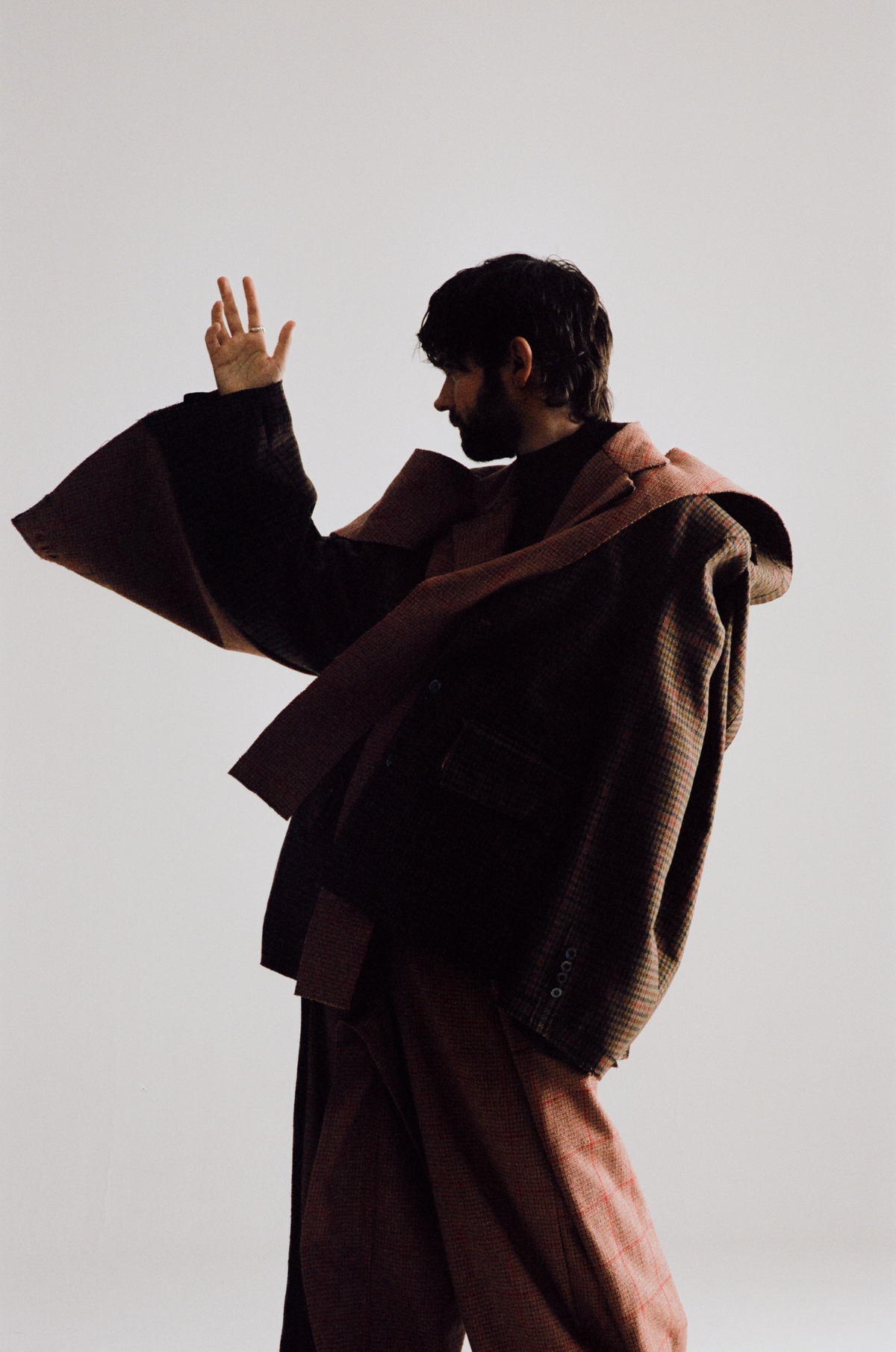
My taste had evolved significantly as well. I got really interested in high fashion, and the life I was living was so different. I felt this disconnect, which every artist should feel between their last project and who they are at a given time. You feel a need to update people and create new imagery. I wanted those interests to express the theme of portraying yourself in a way that is stronger than you truly are, and the shapes that you can produce with fashion were a great way to illustrate that. It's like armor. So there was a really striking juxtaposition between this distorted rock sound and that particular messiness—but instead of doing the obvious and accompanying it with a punk aesthetic, I wanted instead to do very polished, high fashion, and photography-based. I figured out a visual vocabulary that's striking and feels risky and dangerous. There's a greater project I want to unfold, but in this moment, this is the truest and most important thing that I could share.
It's funny to hear you talk about your relationship with Porter, whose most recent album presented a very new sound from him and was a huge risk. You're definitely doing something similar on this record too. Talk to me more about stretching your legs genre-wise.
When i work on a project, I try to curate my influences, so there's sides of my taste that I shut off. Anything rock or punk-adjacent that I grew up with—the Clash, even the heavier side of the Beatles—was so irrelevant to Good Faith that I turned it off. For this album, I wanted to do the opposite, and it felt like a playground that I was suddenly authorized to visit—a place that was forbidden prior. You always follow your intuition, and my intuition for this was that I should expand my freedom and pursue it.
There is definitely a general history of French electronic artists making rock moves as well. Daft Punk did it with Human After All, Gesaffelstein did it on his most recent record, and whenever I've interviewed Air they've been effusive for their love of the Strokes in general. Is that something specifically cultural, or is it just a series of coincidences I'm observing as a critic?
No, I think you're right. There's always a zeitgeist. To me, there's a recipe to good art, with three categories that you need to fulfill to make cool stuff. There's legacy —the things that have always been great and institutional that you should master. There's the stuff that's zeitgeist-y, where you're aware of and inspired by your context. And there are things that are as personal as can be, stuff that's not shared by your peers. Some of the references on the album are French new-wave bands that my peers in America have never heard of, so I was like, "OK, let me pull from that distinctly because it's not the zeitgeist distinctly—it's mine."
If you only have two of those three...if you're making music that's institutional and personal, then it can be irrelevant. If it's institutional and zeitgeisty, then it's impersonal. If it's zeitgeisty and personal, it's probably not very good if it doesn't have that dimension of musical timelessness. So I pulled from all three, and I suddenly felt like I was authorized to explore some of these sounds because there's a greater context.
With the Charli XCX record she's rolling out now, there's a lot of these moments where we've opened the door, and we all have our own take on it. I mentioned a couple of rock bands that I grew up listening to, but I wasn't a rock guy at all. I'm fairly ignorant, and that's good, because I'm making music that is my impersonation of something I don't fully understand. The way I execute it is different than somebody knowledgeable. When I made "Hi!," I was thinking of a Ramones-esque riff, but I don't really know what kind of drums or bass they'd be using—so I used like a very synth-y, Daft Punk-y bass, because that's just my natural taste, so the ignorance led to an original combination.
You mentioned COVID before. Where were you living during lockdown?
I moved to the US in 2018, so I was living in LA alone. It was a unique time, because I have no family in the US and I couldn't really visit France. There were a lot of restrictions, so I was stuck alone in my house throughout COVID, and I experienced it very intensely. It made the few relationships and the events of my life that transpired during that time feel massive and defining, because a lot of my typical anchors were gone.
One thing I've heard from a lot of musicians is that COVID was actually a really productive time when it came to creating.
It wasn't for me.
Talk to me a little bit about that.
I'd just came off the first leg of Good Faith Live, and I found my purpose. I had a great show, I was insanely proud of it, and I wanted to show it to everybody—and suddenly, I couldn't tour it anymore. It felt like the natural inspiration for the rest of my career had been taken away from me. For a while, we didn't know if we were ever going to be able to gather and have shows ever again. There was a brief moment where we felt like the whole industry might collapse in a way that was going to be hard to reconstruct. So I was quite pessimistic, and I wasn't sure what the purpose of my music was anymore.
For the first time in my life, I invested myself in some form of a personal life. I've been touring and having a career since I was 16. I never went to high school, definitely not college. A lot of formative experiences that people have, I never had.
In some aspects, I was very ahead for my age, and in others, I was underdeveloped. I never learned how to drive because I'd be brought on tour in buses and cars. I couldn't really write love songs, because I hadn't experienced any of what people write about. I was catching up to a sense of normalcy, which was the core of my COVID experience.
You mentioned earlier that you went through a breakup. Talk to me about that experience, and how it informed this record.
I accidentally dated a married woman, and then came in all this drama. By the end of it, I thought, "Well, that's probably good songwriting material." Everybody has an album about a breakup, but not everybody has an album about this kind of messiness. It all seems so distant now. I'm in such a different place in my life. But I love that I get to listen to this album and hear a little bit of that vigor and anger. I felt like the scale of those things especially during COVID, and the beauty of being an artist is that you get to transform it almost retroactively—to give it purpose. Now, I'm glad that I went through all that, because I got some songs out of it. Humans have a bias in favor of justice, where we don't like the experience of what seems like is unfair. Being an artist is a way to create a sense of justice where you're able to find meaning in things that are, ultimately, a little meaningless.
I'm curious to hear you talk more about the evolution of how you use your voice in your music. I'm always really interested when electronic artistS play around with ways in which to present their vocals.
Being a singer, that kind of performance never came naturally. I remember being jealous of pop singers and rappers that could go on stage and embody the music. They'd say those words about their lives, they'd be at the center of it, and the show would be theatrical because of that. That was a frustration I had with electronic music. If you have features everywhere, you're this ghost absent from the center of your music. In many ways, it still makes for extremely great shows, but the shows that I admire a lot are French pop and rap shows. Their artistry and theatrics only made sense because there was a central performer. There was the idea that I'm missing that access if I don't find the courage to perform.
"Shelter," specifically, was very validating. I had all these features, and the one song that broke through is the one that I happened to sing. To this day, I get to play the song and see people sing along, and I love that those are my words and voice. That became so fundamental.
The best vocalists are the ones where their desire is greater than their skill—where you can tell they desperately want to communicate and say something, and they reach for it, and it's slightly out of reach. There's some tragedy to that. A lot of my favorite vocalists aren't very technical. You don't want to sound like America's Got Talent, you know? That, to me, is the least cool music—and it's why a lot of vocal coaches have, in my opinion, very unappealing voices. I was trying to solve my limitations in ways that were a producer's solution. With Good Faith, I'd do formant shifting to make my voice deeper. I was creating a voice that was the product of my body, my brain, and my production capabilities.
With this album, I wanted something else there. I wanted to belt big choruses, scream through distorted microphones, and find another solution that matched the artistic intentions of this album. But unlike Good Faith, I felt more welcoming and more ready to supplement with a cast of characters. Slatyyyter coming into the album was great, she was the missing piece to that song and her voice texture is so wonderful. It felt like playing with a great, powerful instrument. Sam Gellaitry, Erick the Architect, those people came onto the album in a way that expressed the intention of the music and complimented what I could provide in ways that got me very excited.
My voice is a necessity, because I feel so much better on stage being able to embody the music. Sometimes, with Victory Live, there's moments where I vanish into a more of a dance performance. There's moments when I'm front-and-center performing, moments where I perform with an imaginary cast of characters, and there's even moments where I'm playing with a clone of myself. It's almost a demonstration that I don't need to be there for my identity to be there, but all of this is only possible if you're willing to take the risk of owning the songwriting and performance.
Let's talk more about the evolution of playing live, especially post-COVID.
I try to carve my own lane. I'm not trying to emulate anybody. There's nobody's show that I see where I'm like, "Oh, I wish that was my show." My format is quite distinct, and there's elements that I've seen as inspiration to other shows. I just look inwards to what's most magical and will make me the most happy to perform. All the visuals are produced in my house with my collaborators. We live together for weeks making this show, and I know every frame. I can stand behind every second of the show. My love of the process means I'm not really considering the the market as much. People will always follow something that's special and sincere. There's a cost when you shift your taste to the zeitgeist for the sake of optimization, and audiences can sense sincerity just as much.
I do DJ'ing and my live show. DJ'ing is very different, but I love it so much. I just played Coachella, and seeing a huge crowd felt very contemporary. Victory Live is this uncompromising, theatrical vision, and it's also a show that wins on ideas. It doesn't win because it has the most fireworks or lasers. It's actually a pretty homemade show, and we're a very small crew. It punches above its weight a little bit, which is good. I know shows that people consider to be of similar size, but their budget is actually five or six times ours. We've managed to create something that's scrappy but feels very prestigious and impressive.
You've had a journey in your career where you're now a point of inspiration for younger artists. I'm thinking very specifically about Ninajirachi, who's had this enormous ascent over the last year. She appeared with you on stage recently, and she's been very vocal about how you and Porter were influences on her. What is that like for you?
Thematically, the idea of transmission is very meaningful to me. That's actually what the song "Shelter" is about. Experiencing this now as an artist was always my dream, and there's something funny and humbling about it—but, also, I can relate to it. I know which artist I felt this relationship to, and they came into my life at a time when I was very intangible.
I think "iPod Touch" touches on that, and she told me that that song specifically refers to my early music, which blows my mind. But I can relate to those lyrics—this unique moment where, whatever music you'll discover then will follow you for the rest of your life. Getting to meet some of these people that I admire back is incredible, and I love the idea that, in however many years, there'll be kids coming up where Nina will be to them what I am to Nina. The idea of passing on ideas is very moving to me.
Inherently, when you try to process your influences, you'll do it wrong in a way that's more interesting. The other day, I listened back to my early music from 2010 to 2012. The music I loved at the time, I could see the ways in which I failed to make that, but instead stumbled upon something that's more unique and interesting. There were little production techniques that came from my experience in other genres, so as I was trying to explore this other sound, it was inevitably informed by the drums I had available to me and my reflexes as a producer. The combination of my taste and uniqueness produced a distinct sound, and that's true with Nina and Underscores and a lot of the music that I love right now. They're processing their influences through an arsenal of tools and a cultural context that transforms it. That's not necessarily intentional—I don't think I sat down and decided to make "Madeon drums"—but when I listen back, I'm like, "Oh yeah, Madeon drums are a very specific style now." I get a lot of emails and DMs from producers asking me, "What was the technique? How did you invent those drums?" I didn't intend to. I had these tools at my disposal, I attempted to do something, and I did it wrong in a way that proved to be right in the end.
One thing that's distinct with this generation that wasn't true before is that it's a lot less concerned and limited by premise of exclusion and coolness. That was very distinct in like French Touch 2.0, where so much of how you were establishing yourself was by what you rejected or had contempt for. That's not the case at all—there's basically no hate. I played this B2B with Underscores in New York, and we played everything from Justice deep cuts to Cascada and Mario Kart music. All of that felt cool, because it was played with confidence. A good song is a good song and that's it—and that's a freedom that's been earned over time and wasn't present prior. Beyond stylistic evolution, there's a form of context that's more free and inclusive, and hopefully it brings in people that wouldn't have felt as comfortable being a part of it in 2008.
The press materials mentioned working with Lady Gaga on Artpop as one of the first times you were in a real-deal studio. You got back into the mix with her again for Chromatica. Talk to me about that creative relationship with her.
I was a huge Gaga fan, and she was the one artist I wanted to work with. When that opportunity came came along, it was a dream. I got to enter her world, and I also opened for her on tour. She's distinctly great on a number of levels. She's very generous, and she was both protective of me and respectful of my artistic maturity. Retrospectively, she talks about some of these eras in her life as being quite difficult—but what I saw of her was very inspiring. She's a real artist. She has a lot of respect for producers and her collaborators, but she also has a lot of agency. She writes all the melodies, she writes all the lyrics. She has creative superpowers. Every day, she'd come in and it was another incredible story—from the fashion to the ideas. I took a lot away from it A lot of the imagery that I'm drawn to today, I can trace back to my proximity to Gaga.
Artpop, at the time, wasn't fully understood—but in recent years it's been really celebrated, which makes me happy. I felt very happy to get to be a small part of Chromatica many years later. I just did a little bit of production, but we still got to catch up and see each other. It was very emotional, and she's a very loyal artist. Even to this day, when I see her—and I'm not saying I'm working with her, she's just very loyal, so we chat—she continues to inspire me in the way she evolves and grows. When we worked together, I thought she was such a grown-up, but she was so much younger than I am now—and she actually had the weight of the world on her shoulders. It's interesting to have this perspective now, many years later. I just love her deeply.
You just talked about the notion of Gaga being very young when you worked with her, and you were obviously a lot younger when you got your start in this industry. It's really hard to get started at a young age in the music industry and navigate a lot of the perils and challenges that comes with the industry itself. Reflect for me a little about your journey over the last 10 years in terms of what the challenges were.
I was a specific young man, and don't feel like my career happened to me. I felt pretty in control, and it's because I was failing school and had nothing else going on in my life. I was headed down a difficult path if I wasn't "making it," so I had a sense of focus and determination, and I was learning a lot from artists that I admire that I felt like had made the right choices. I was very careful, and I wanted a long career for myself, so I said no to a lot of things that would've made me a lot more famous quicker and wouldn't serve the goal of the life I wanted to live.
Even when I shot "Pop Culture," I was debating between filming it with me in frame, because I looked even younger than I was. There's those viral TikToks where young girls and boys watch those early Justin Bieber videos and they're fascinated—and when they find out that that little boy doesn't exist anymore, they're really sad. "What happened to him?" I would've been haunted by the delta between my presentation then and now. Instead, "Pop Culture" goes viral to this day, and people look me up and assume an adult made it.
Those were very intentional decisions I made. For some of my early interviews, I didn't want to be photographed too much. I didn't appear on [album covers]. I made decisions for that particular sake, and I did a decent job of protecting myself. I'd test adults by pretending to be more naive than I was, to see if they'd take advantage of it. I'd bait them with pretend innocence and, when I saw people try to impress or manipulate me in some way, I'd cut them out. The people that I surrounded myself with were the ones that were treating me with respect and protection. I also benefited from living in Nantes, since I only moved to L.A. when I was 23. I was living with my parents up to then.
Some of the challenges that I faced—the big battles of my life—were unrelated to the music industry. In fact, I'd say that my life without the music industry would've been significantly worse. It gave me a sense of accomplishment, purpose, and identity, which you crave when you're younger. I got access to that in a way that made me more at peace, somehow. There were very difficult times, obviously, where I felt like I was wasting opportunities and not living up to my potential. But I never connected my self-worth to having a radio hit. It was always about a certain level of artistry that impressed me, on my own terms. I didn't need to please gatekeepers to please myself, so i didn't give a lot of power to the industry, and I didn't feel desperate to have access, fame, or money.
A lot of younger artists, their success can sometimes happen to them, and they might not be prepared—but I was very desperate for it. I wanted it very badly. I wasn't especially prone to addiction, and I didn't surround myself with bad influences, so I didn't have to deal with a lot of the potential traps. But I think I got lucky. I'm sure that there's parallel worlds in which I make a couple of different decisions, and then things go terribly wrong. For most kids, it can be irresponsible to throw them into it. But, I don't know—I felt like I was prepared, somehow.