Beth Orton on Getting Dropped, Self-Producing, and Touring Out of a Volvo
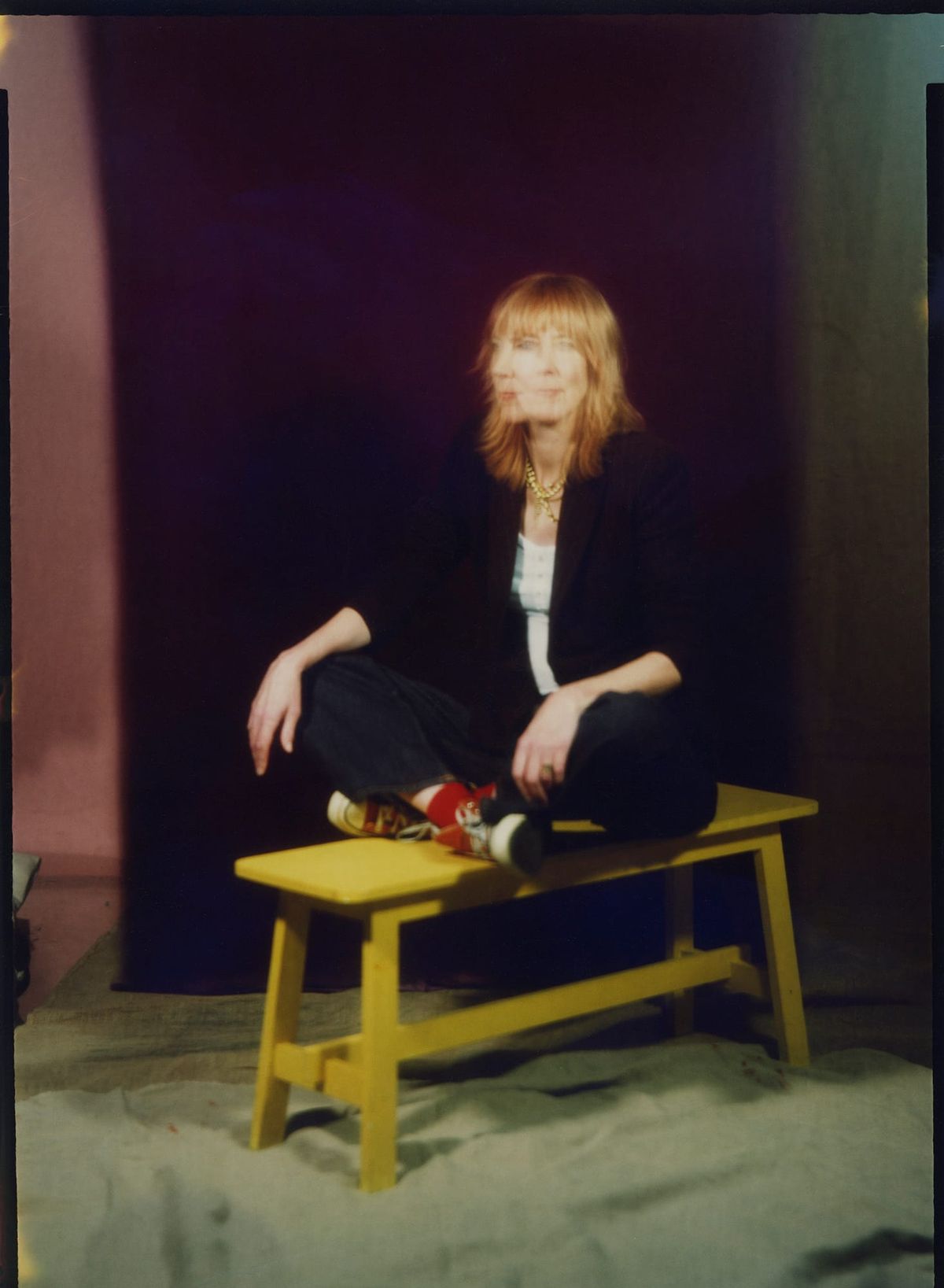
This is a free post from Larry Fitzmaurice's Last Donut of the Night newsletter. Paid subscribers get one or two email-only Baker's Dozens every week featuring music I've been listening to and some critical observations around it. Subscriptions currently run $3/month or $30/year, hit one of those little pink buttons on the right side of your screen to tap in, you won't regret it.
Here's what's going on today: Beth Orton is on quite a roll these days, and last Friday she continued her really strong recent run with her spectacular new album The Ground Above, which might honestly be my favorite thing she's done to date. I was extremely honored to have her on the newsletter for a chat about the production skills she's picked up over the years—and, in a rare occasion, her husband (musician Sam Amidon) also joined in for a very brief and funny exchange. This is a great one, check it out:
Walk me through this record's sound, especially in the context of your considerable career at this point.
I go into a record with the songs, but not necessarily with an overview of what the record will sound like. I choose the musicians knowing the length, breadth, height, and width of what they can bring—but even then, I don't know what they'll hear in a song and what they'll bring to it.
There was a sense that I'd pick up where Weather Alive left off. I recorded in London for four days with a cool bunch of musicians—Chris Vatalaro, Tom Herbert, Sam Beste, Adrian Utley, Dave Okumu. People would come and go, and something very beautiful happened. Then I went to New York to Shahzad Ismaily's Figure 8 studio and worked with my American touring band for three days—and something grew out of that session that informed the earlier session in terms of atmosphere. Then I got back to London and tried to do tempo-mapping and blending between the versions I did in the UK and the ones I did in New York. There were certain parts that you could fly over, but at a certain point, I just wanted to work with the core tracks.
I was talking to my daughter the other day, and she was like, "It's the most minimalist-maximalist record you've ever made." Each song had moments where I'd strip it down to the bare bones, and then there'd be this layering of sound. She's just about to go and do fine art in Glasgow, and she was like, "It reminds me of painting. There's these layers of colors that just keep building." And on every track, you can feel that sonic development. There were certain points where I was like, "Is this the point where I should stop? Or is this the point where I continue?" It's often quite clear, and sometimes I thought, "I'm just pushing this, I'm over-egging it, I shouldn't add another thing."
Then I was like, "I'm just going to pop back to New York and have Mauro Refosco put some percussion down, because I think that's what it needs"—and it did need it, and it did need that one last bass line from Shahzad. Finally, it was this very full and complex record. It's funny, because I'm going through the stems at the moment, and the amount of beautiful sounds layered into that record is really extraordinary.
That notion of knowing when to stop and feeling confident that something is finished—is that something you've dealt with throughout your career?
Honestly, this was a record that was hard to stop tinkering with. The interesting thing about not having a producer and being put in that position myself is that I do get to follow an idea through, so I find it positive. The drums on "The Ground Above," if there'd been another person in the room who had a sway, they would've been like, "It's fine as it is." But I was like, "No it's not, we've got to keep going." I knew what I wanted to hear, and there were approximations. Finally, it was Vishal Nayak, who was engineering the session and is a drummer for Nick Hakim, and he was like, "Can I have a go?" And he nailed it. It's a whole science that I was allowed to be part of in a way I might not have otherwise.
Let's talk more about the journey of self-producing these last few records.
First and foremost, I have to say that Craig Sylvie mixed both records. His influence in that final sound is undeniable. But Kidsticks was the first record I co-produced, and I learned to engineer and layer sounds from my flat while my kids were running around.
When I was starting to make Weather Alive, I didn't know what was going to happen. I just started engineering the demos and playing around with Ableton, various kind of different keyboards, and ways of making sounds. I was writing on keyboard, and then I put it on piano. We went into lockdown, and I went in to record with the band. We had no producer, just an in-house engineer. I was still expecting, once the lockdown finished, to find a producer—so I put it aside again for the summer holidays. I came back to the tracks and started to play with the arrangements, and suddenly I was hooked.
I started to work remotely with Shahzad in New York, and a producer came onboard and sent me a couple of ideas—and I just really didn't like them. I said to the label, "I'm not sure about this," and within about three weeks they dropped me, and then I really was on my own. I was like, "I've come this far. I want to finish this record," so it was out of necessity. I started to produce, if that's what we want to call it—I guess it is what it's called—and that's how that record came about.
With this record, it was a similar thing. Well, it was very different, actually. Tim from Partisan was like, "Go and do it again. See what happens." It was very different, because we were no longer in lockdown. It was much more expansive—it wasn't just me in my shed. I couldn't even work in my shed, because the building going on next door was so loud.
When your previous label dropped you, what was your reaction?
I felt really devastated, because it was a scary time in lockdown. Everything seemed so fragile and strange, and I was gutted—but, then I was determined. Then, they said they'd keep me on, but they'd do something [else]—and I was like, "No, just drop me. Let me go." So I got a loan from the bank to finish the record, and that's what I did.
Talk to me about what you look for in collaborators at this point.
I definitely want a good vibe and good energy in the room. The musicians that I've been working with, I have total trust in their taste, instincts, and sensitivity, so I definitely gravitated right back to them. With Shahzad, you never quite know what you're going to get, and the way I work now, I love the sense of surprise—and I know that he strikes gold. When he does, it's like, can music change people? Can it change their minds? I feel like music can. It has its power to transcend, and all that jazz. I look to work with people who aren't trying to have these grand schemes and just love to play good music. With Nick Hakim, I adore his music, his voice, and his sensibility. Vishal works with him, and if he ever wanted to sing on one of the songs, I'd love to have him.
I saw that Adrian Utley is credited as playing a paintbrush on "Before I Knew." Every time I talk to somebody who's worked with him, I'm always learning interesting things about the creative left-field thinking he employs in terms of instrumentation.
He's brilliant. I was surprised, because I thought, "He'll be really confident, because he's the dude." But in some ways, he was the most under the radar. It wasn't obvious always what he was doing. It wasn't obvious what I was hearing. It was a bit like Shahzad, where it wasn't sometimes until later, when I'm on my own—and that's the privilege of being at the helm of my ship, is that I get to sit in my studio and tune in to what each player is doing and be like, "Oh wow, that's incredible, let's get more of that, let's pull that out of the mix, let's loop that the whole way through the mix," and you get to bring those colors out.
It wasn't entirely clear what was going on there at some points, and then there'd be this random fuzz guitar on "Cigarette Curls" where I was like, "That's fucking awesome." Sometimes it seemed like he was tuning, sometimes it seemed like he was just figuring out a sound—and we recorded everything, and on later listening, I realized there was intention.
The bio materials mentioned grief being one of the emotions you were working through on this record.
Because the word "grief" is in a song, it becomes, "This record is about grief." It's been so hard for me to define the density of these songs and lyrics. Each line is a short story to me. and I could—and I maybe one day will—write about what those meanings are. But more than anything, It's a record that's woven through with paradox, and that really interests me. It isn't something I necessarily do consciously, but it's something I always seem to do as a writer. "I'm invincible as grief"—the power and the vulnerability, all within one line and to the next.
The whole record is a exploration of these human frailties and—what's the word I'm looking for? I'm really bad at it in real life, I'm much better at it in song. But we live in a world where everything's so cut-and-dried, black-and-white, this side or that. I actually think that within the paradox is where the wonder is. The mysterious existential nature of being alive is woven into our inconsistencies, from one moment to the next. We can be so many versions of of a human.
So I don't think it's a record about grief. I certainly think there are lots of references to grief, and I do think I'm very tuned into grief. It's a state of life, and a state of my existence. There's this Faustian bargain I feel a lot of the time with my existence. You can have this, but you can't have that. I think that's how it is for many people.
You mentioned lockdown earlier. How was COVID for you?
Well, there was obviously the challenges of it, but I was pretty lucky in that there was an element of it that I got a lot out of. I feel bad for saying that, because so many people didn't. But for me to have my family in one place was kind of amazing. Yes, it was scary, and in our profession, it's pretty scary anyway, so that was frightening. But there were these moments of joy—of being home with my kids and my husband, and having just enough that everyone could get by. I'd also built a shed in the garden literally two months before the lockdown where I could work.
The thing with the lockdown—the COVID, the this and the that—is that it's a bit like grief. We're all still finding our way out of it, the ramifications and knock-on effects. They still exist. My husband's dad's dead now, and if it wasn't COVID, he would've been taken to the hospital sooner. The way it's kind of unraveling like it's i don't know about you but it's like how you are or how you you know it seems like there was these knock-on effects.
Talk to me about some music—newer and older—that influences you these days.
I do come back to the classics. I'm influenced more by instrumental music now than I am by anything else—a lot of jazz. Today I was listening to Curtis Mayfield and I was just listening to the drums. I'll always be influenced by Joni Mitchell and Leonard Cohen, the greats. In terms of new artists, I went to see Big Thief the other night, and it just blew me away. There was something about the interaction between the band—it wasn't showy or a big deal, it was just the simplicity of their relationship with each other on stage. Musically, it was so satisfying to watch and to hear. You can feel the energy of their interaction, and that was really inspiring.
Are you a movies person?
We watch a lot of movies, though I haven't been recently. I've been home alone with the kids, and I've been really sick with this longwinded, boring cold that went on for fucking five weeks. I just couldn't deal. [Calls out to her son Arthur] Hey, Arthur, what's the last film we watched together? The one I loved and you didn't love so much. Being John Malkovich. Obviously, I've seen it before, but watching it again, it was brilliant—and I love Punch Drunk Love. What else have we seen recently? Oh, gosh. Went to see a terrible film the other day at the cinema, but I won't be seeing that again. I've become obsessed with that program called The Americans.
What was the terrible movie you saw in the cinema?
It was the one where they go to space.
Project Hail Mary. I'm a big movies person, but I haven't seen that because it didn't look very good.
I went because I thought kids would love it. They fucking hated it. I hated Marty Supreme as well. I thought Marty Supreme. Hang on, I'm gonna ask Sam. [Calls out to Sam] Hey Sam, sorry, what was the film we went to see that we loved? It was before you went away, and it wasn't Marty Supreme.
Sam: We watched it in the theater?
Or maybe we watched it here.
Sam: Hamnet?
No. I mean, Hamnet was good, but I wouldn't—
Sam: What are you trying to think of? We saw it in the theater?
Maybe we didn't see it in the theater.
Sam: I need a little more on it.
I need a little more on it as well. There's just been such a lot going on.
Sam: When did we watch it?
I think it might have been before we left.
Sam: Before we left for what?
The house.
Sam: A new film?
I think so. It was around the Marty Supreme time.
Sam: About the mom?
Oh, yeah—If I Had Legs, I'd Kick You.
I loved that movie.
That was so good. She was brilliant. It was so right-on. I loved that.
The director is married to the screenwriter of Marty Supreme!
Isn't that funny! What's the film that the If I Had Legs I'd Kick You person did before?
Yeast, which I also love. It's much more antagonistic.
I'm gonna watch that.
You've obviously been within the music industry for a while. Let's talk about what you've seen change over the years from your vantage point.
I came into my own in the '90s when there was a lot of money in the industry. I also had a breakthrough moment—so, you know, lucky me. It was a good time to come out and have that moment. Because I'll only view it through my lens to a certain degree, I can zoom out and say, well, the industry is, in lots of ways, in a difficult place. But then again, I'm in an interesting place personally, because I shouldn't still be pushing the envelope—but I am, and I've found a place for it with Partisan, so that's really a wonderful situation for me to be in, artistically speaking. It's really satisfying.
But I also know, for myself and my husband, that it's hard to make a living. Unless you're the 1%, you don't make a living out of this easily. I could be all Pollyanna and say, "Well, that has its own level of creativity"—and, of course it does. But the struggle is real, and it's difficult. A lot of people don't make it, especially two people who are in the same world. But at the same time, I don't think I'd be making the music I am if I didn't have that tension, which has created something that's really meaningful to me.
In the last year, I've been doing these little tours of regional churches in out-of-the-way places in Scotland and around the UK. We drive in our car, we don't take crew or sound—and I'm not saying this is how I want to live, because I couldn't do this the whole time. We've done it three times. But it was this really extraordinary experience of meeting your audience. We played really beautiful churches and a few clubs. It was really edifying and enriching, and I'd rather make music as a creative endeavor than not. So far so good, just about by the skin of our teeth
I've talked to a few people recently with similar experiences of doing small tours where they're traveling by themselves. Obviously, it has its economical benefits.
What I'm coming to learn doing it this way is that you can't strive to be getting ever biggerThe audience doesn't necessarily always want their people in a massive. stadium. They like to come and be up close, and that kind of communication between you and them happens. It's wild, it's really exciting, and it's interesting to sidestep the cliches of what it means to be successful or not. Having said that, we do need to get out there. I'm not going to do every tour in a fucking Volvo.