Jump Source on Electronica, Sharing Studio Space, and Recording in a Closet
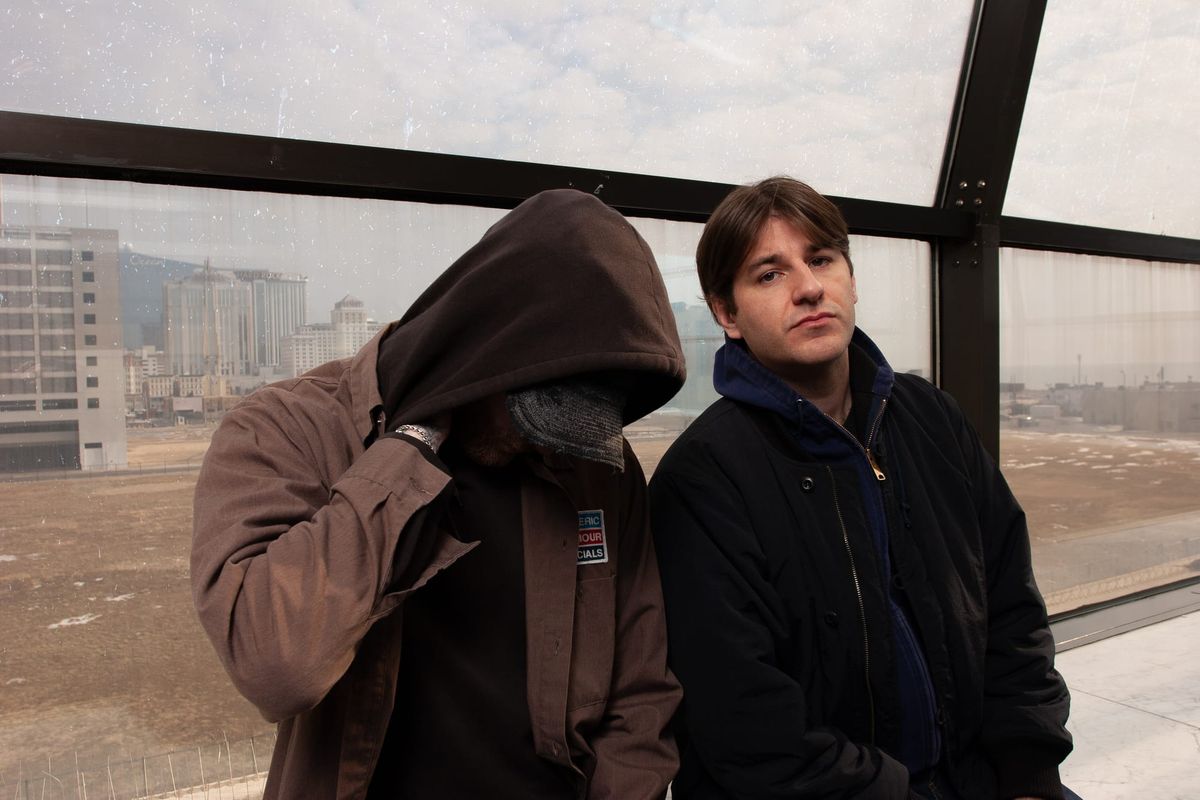
This is a free post from Larry Fitzmaurice's Last Donut of the Night newsletter. Paid subscribers get one or two email-only Baker's Dozens every week featuring music I've been listening to and some critical observations around it. Subscriptions currently run $3/month or $30/year, hit one of those little pink buttons on the right side of your screen to tap in, you won't regret it.
And the spring subscription sale is something you need to tap into if you're interested in supporting this largely very free publication. 26% off monthly and annual subscriptions, that's $2.22 a month for the first six months, or $22.20 for an entire year. All in all, it's cheap and it's nourishing. You can grab the monthly sale here, and the annual sale here.
Now for the main event: Today marks Patrick Holland's entry into the newsletter two-timers club, he last popped up on here back in 2024—and this time Patrick is back with his notorious co-conspirator in Jump Source. I'm talking about Francis Latrielle, who makes music as Priori and has been an in-demand figure all over the electronic world, both on his own and alongside his studio mate Patrick. The two have been putting out work as Jump Source for a minute or two as well, and their just-released excellent debut LP Fold is a collab-heavy culmination of the genre-bridging dance sound that the two have been working in for some time now. I had a great time chatting everything out with them and I hope you have a great time reading it—you know what? I know you will. Check it out:
Let's start by talking about the name of this project.
Patrick: There was no huge concept behind the name. We started jamming in 2015 and made an EP, and we were like, "Let's like think of a name for this pretty quick." We were just thinking of words that, phonetically, sounded really nice.
Francis: We also used a Moog Source that our friend lent us, which is one of Moog's weirder synths. There's one big knob and a panel with buttons and stuff. We used that to do some of the leads on the record, and [for the name] we were like, "Something with 'source' would be fun." We were riffing, and our friend Dev was throwing things around, and he was like, "Jump Source, that has a really fun ring to it."
I talked to Machinedrum forever ago about naming conventions when it comes to electronic producers, and he was saying that a lot of the time a tossed-off file name just sticks until the end. It sounds like that's what happened here too.
Francis: Yeah, we're Notes app-heavy. It's a lot of things that we'll think about on the road while watching a movie or reading a book or something. I'll just write down some word or expression that resonates with me, and when it's time to name something we're working on—even before it's finished, sometimes—we pull up our phones and see a bunch of words that resonated at some point. A lot of the lyrics for this album were a bit more intentional, though.
Let's get into the process of putting this record together.
Patrick: Basically, this whole record was Francis and I together in the room. Maybe some final mixing stuff was remote between the two of us. But generally, we're always saving stuff to do together in the room. Certain files were shot back and forth between other artists, but the tracks with [Helena Deland] we did with her in the room. Some writing was done where we'd send us singing in a shitty way back to [vocalists] to sing back to us.
Francis: I was traveling a bit more, especially towards the end, so Patrick did a lot of the final mixing and I was trying to listen on the road on different systems, or in my headphones.
Patrick: Out of anything we've done, this was maybe our most road-tested stuff as well. Getting to hear it in so many different environments is not a thing that we really had the privilege or ability to do as much before, which was pretty sweet.
Talk to me about the sound you're striking here. Patrick, you have Daniel in the studio today, and I do think of this as very similar to his recent Car Culture record in terms of the lanes it's straddling.
Patrick: It's a culmination of a lot of the records we've been working on with other folks. We've both learned so much in the collaborations Francis and I have done, as well as the records we worked collectively together. We'd always talked about wanting to do a straight-up dance music record with a lot of live instrumentation and glitchy electronics, and that was a starting point. But a lot of these tunes were early drafts that were made a long time ago and then were recontextualized together as a record. There were tons of influences that caused it to sound multi-influential.
Francis: It's ambitious in the sense that none of the tracks were like, "Let's do something exactly like that." The biggest influence for me was the late '90s-early 2000s electronic bands like Underworld. They'd do albums where there'd be a hip-hop track, some dance-y stuff, some poppy stuff, some weird experimental bits. Spiritually, that's what we were going for.
Patrick: It was about stylistically letting things develop as the writing happened. The opening track was started in a friend's studio with a really weird synth that was a hard thing to handle, and then we took it back here and thought it was gonna sound like one thing. Then, we flipped it completely with a live bassline and let it constantly develop, instead of trying to keep the initial idea.
Francis: We kept pushing things further until they were fully-fleshed ideas—a bit more than we do with normal dance music, where you stop at the point when you're like, "This is playable, let's not do too much to it." On this album, we were like, "I think this could be more." Not in terms of maximalism, but in trying to push the envelope a little bit with our own sound.
It's funny, I do think the electronica thing has been in the air for a minute now—or, at the very least, something of a merging of indie rock-ish aesthetics with electronic music. I felt like the Ben Bondy record last year was similar to this, but I can't seem to pin down the trend itself.
Francis: Some of it is that people feel like there's two options: Either you sound really retro and you try to emulate something that already existed, or you do something that's like, "No, this is the future." But those albums allow you to be somewhere in the middle, where you can reference things but make them your own. There's something about the the spirit of those records.
Patrick: Larry, do you mean in the spirit of underground records reaching further into album-y territory?
Yeah. CFCF's Memoryland is a huge one in this subcategory for me too. Francis: The idea of electronica in general music that borrows from dance music but is not necessarily made for the dance floor. There's been a bit of a gap there, where people have been speed garage or trance that's very club-orientated, straight-up pop music, or ambient. Obviously, we come from dance music, so we love those those sonics, but we also love pop and things like that. Without trying to be on the radio at all, we were trying to make a record that's dance music with a sense of musicality—pushing ourselves to be like, "Wait this chord progression could go there." On "Fold," there's a lot of weird harmonies with the vocals. We were trying things out, and it's not optimized for a dancefloor, because it's a bit more heady than that.
Patrick: Just to get a listening experience, over anything.
Francis: Yeah, exactly. We were like, "Oh, this will be fun to listen to again and again, hopefully," which is what I thought about some Underworld records.
Patrick: Even a lot of pop, in recent times, has become more experimental than what's labeled as "experimental music." Electronica got a bad rap in the later aughts and became kind of a derogatory term for a bit, because it got too experimental and heavy. It didn't always lend itself to listening, necessarily. Finding a middle ground is kind of an interesting point that we both strive for.
Francis: DSPs are making people very single-minded, but groups like Orbital and Underworld are very album-orientated. With this album, we tried to do something a bit more like that, at the risk of not being like, "What's the single?"
You guys have pretty much worked with everyone I've had the pleasure of speaking to in recent years, and you pulled a bunch of collaborators on this record too. Let's talk about herding all these cats, so to speak.
Patrick: It's a lot of work. [Laughs] For the vocal melodies and lyrics that we'd written—the ones with CFCF and Helena—we kept that to people that we have personal relationships with. I know Harmony Index pretty well—I've been helping her with her stuff at some points—so even though some of that was remote, that came with ease because it was a lot of friends that I always wanted to do something with but didn't have the right project. The bigger reach was to work with billy woods. That was a big goal. We had some of these bigger ones where we were like, "This would be pretty amazing if they were down," so it was cool that someone like him was down to write and record himself on top of a track of ours. I feel very lucky.
Francis: woods and POiSON GiRL FRiEND were the two people we had on our bucket list of people to work with. We're big fans. We just reached out, and luckily they liked the tunes. I'm very grateful that that happened.
Patrick: The CFCF one is a funny story. It started in one afternoon years ago. We'd been trying to make one type of track, it wasn't working out, and then I had to leave. I knew that Mike had pulled out the microphone to potentially do something, laid something down, and totally forgot about it. Years later, we listened to the session and were like, "This is kind of cool." We wrote out the whole track, because it was just drums and a loopy bass line in the vocal, but we kept Mike's vocal melody, wrote a whole song around it, and went back and forth with him and Helena to wrap it up.
It was a nice surprise to see Deaton Chris Anthony pop up on this record, too. I'd been wondering what he was up to for a minute now.
Patrick: That's the same thing as the Loukeman track. When it came to working with the other producers, it was pals that we'd jammed with on the road or something. I've been to Deaton's studio a couple of times, and we chat here and there about gear. It's really nice having someone like that who's a super nerd that you can bounce shit off of. We took a long-ass jam that him and I had done, and Francis jumped in and we fleshed it out.
Let's talk about the relationship aspect of the creative partnership between the two of you.
Francis: We've known each other for probably 10 years now and sharing a studio for six or seven years. So many things could have gone wrong in the process, and they didn't. We're still really good friends. We've always talked things out and have never got into serious arguments about anything. It came to a point where we knew each other's strengths really well, so if I was working with someone on a record, I'd be like, "It would be really good to lay some guitar on this, Patrick." We've invited each other to try to enrich projects that we're working on. I know my weaknesses, and sometimes those are Pat's strengths. We've helped each other out on so many levels over the years. We're pretty lucky to have this.
Patrick: It's been an interesting trade-off. When we first had a studio in the 2010s, I was touring a shitload. That's swapped out in this next decade, so there's empathy for that because of the shared experience. But even just starting out, there was a big-time shared interest in music and overall vibes. When it came to DJ'ing together in 2015, things just flowed really nicely from that.
Do you guys remember your first impressions when meeting each other?
Francis: We immediately were like, "Hey, let's get in the studio."
Patrick: "Let's jam." We barely talked about it.
Francis: I was living with my girlfriend at the time, and my studio was in a walk-in closet, because that was the only space I had. We made the first Jump Source record in there.
Patrick: Francis had gear, and I had nothing at the time.
Francis: I had gear, but it was all crammed. It was six feet-by-six feet or something. It was tiny, and the acoustics were terrible because the sound was bouncing off the walls.
Patrick: That was very funny.
Francis: I tried to put clothes behind us so that the sound wouldn't reflect as much. When the opportunity came to have a studio, it was pretty obvious to both of us that this was the best partnership. Financially—sharing the rent and gear—it meant we could have a studio quicker, because we didn't have to buy doubles of anything.
When it comes to creating in the studio, some producers also just create anywhere. I was reading an interview with Regal86 the other day where he was talking about how he'll write in the airport, which is wild to me.
Patrick: I'm trying to work on being better at creating music outside of the studio. My last year has been trying to set up patterns and habits of doing that. When I used to tour, I'd never make music. I'm trying to get better at that, but I'm still pretty chained to the studio.
Francis: I'm the same, in some ways. I've developed good friendships on the road with different people who I make music with when I travel. I'll just happen to be in a city where someone has a studio, and we start making music together. Some of those, we've repeatedly done—whether it's Al Wootton, Cousin, or [Ludwig A.F.], who I'm with right now. Now, maybe we'll record something in the studio and then on the road I'll be able to make some progress on on the arrangement. I've also gotten better at getting a mix that I like on Airpods and trying it at the club that night, which I didn't have the confidence to do five years ago.
You guys like movies?
Patrick: Yeah.
What have you seen lately?
Patrick: My favorite thing that I saw that's new is The Love That Remains.
Francis: Is the other one Godland?
Patrick: Yeah.
Francis: I'm trying to log into my Letterboxd right now. Just being on the road and having to think about a million things, my memory is so bad. Someone asked me what I watched on the weekend, and I can't remember.
Patrick: Daniel and I watched The Moment the other night, which we liked more than anticipated.
Francis: I watched the Goodbye Horses documentary.
I thought that documentary was pretty brutal.
Francis: Yeah, it's extremely sad and moving. My girlfriend and I were in tears by the end.