The Format on Reuniting, Surviving the Pandemic, and Hoping for the Best
This is a free post from Larry Fitzmaurice's Last Donut of the Night newsletter. Paid subscribers get one or two email-only Baker's Dozens every week featuring music I've been listening to and some critical observations around it. Subscriptions currently run $3/month or $30/year, hit one of those little pink buttons on the right side of your screen to tap in, you won't regret it.
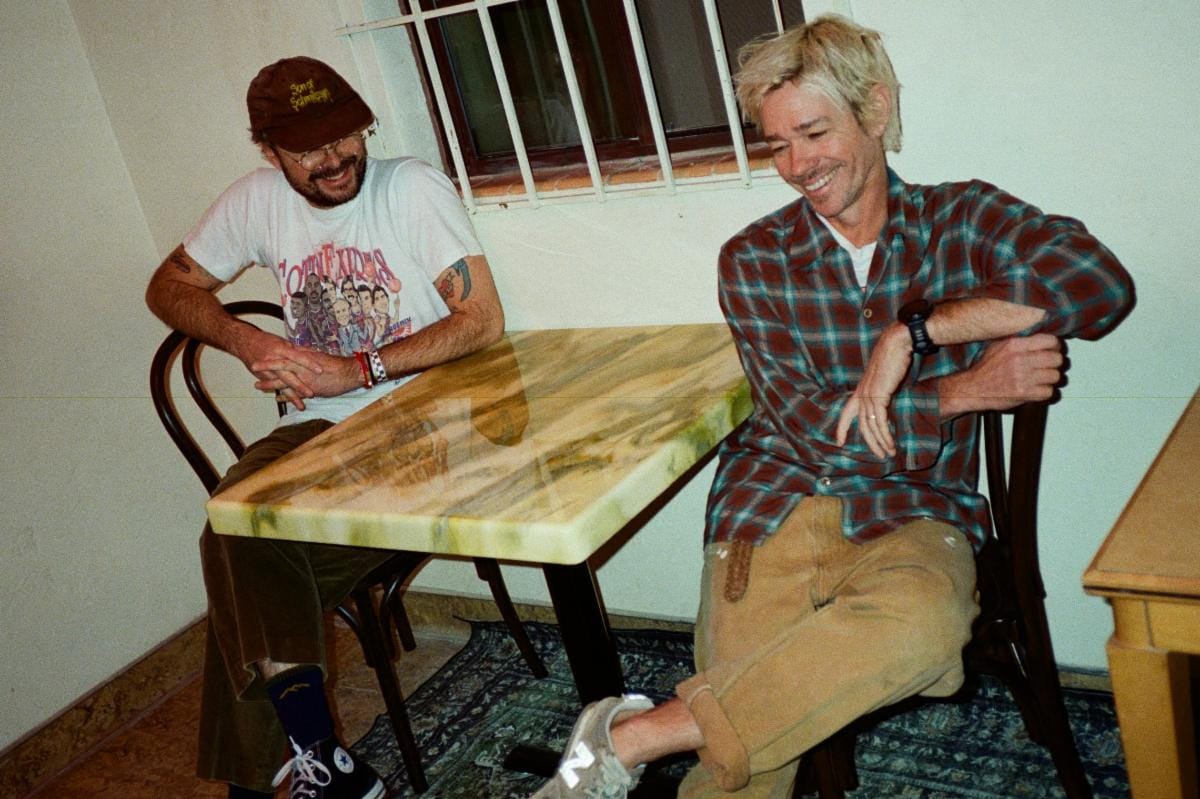
Let's get down to business: A few weeks ago, I saw Nate Ruess—singer, songwriter, former Fun. frontman, recent-ish Young Thug collaborator, ClayneCast-er, and alongside his bandmate Sam Means one-half of once-dormant-now-reunited rock outfit the Format—expressing his dissatisfaction on Twitter regarding a recent profile that focused disproportionally on various aspects of his career. I tweeted at him and said in so many words, hey, you could do an interview for my newsletter and whatever we talk about, it's gonna be printed as-is. Nate was down, and after getting Sam in the mix and coordinating our schedules, we hopped on a call to discuss the Format's great new album Boycott Heaven as well as a host of other topics. We chatted through things for an hour, and it was an engrossing convo that I'm happy to present to you today. Check it out:
I think this record was a bit of a surprise for people who were initially looking forward to the 2020 shows that were cancelled because of COVID. It's wild how, six years in, I'm still talking to people whose current musical plans are still a result of the pandemic. Talk to me about that experience for you guys.
Nate: COVID was an awful thing, but there were some happy accidents that happened out of that. I don't think this album would've been made if it wasn't for COVID, because I wouldn't have started necessarily writing music again. I was just happily retired. But then COVID happened and boredom set in a little bit, and I started teaching myself how to play guitar, and then I was writing songs. I don't think we were necessarily ready, or even that excited, to do those reunion shows.
Sam: It's definitely crazy how underprepared we were. The amount of times that we've rehearsed since, leading up to the the first shows...we got in, like, a day and a half before what was supposed to be those shows in 2020. The balls that we had, to think that we were ready for that.
Nate: I mean, we would've been fine, I guess. We did one rehearsal, and we were like, "Okay, that sounds good." The other thing is, we were doing underplays at venues like Bowery Ballroom. That's a different type of energy than when you're rolling out to a 13,000 seat arena.
Sam: That's true. It's a much bigger production this time around.
Nate: It had nothing to do with the Format or anything—maybe it did, I was still enjoying my time not doing music—But I'd just keep texting Sam and our manager being like, "This COVID thing's going to happen any day now. These shows are going to get canceled. We might as well cancel these shows already." If it were me, we would've canceled it all the way in December, because I was already starting to see the writing on the wall.
But we tried to ride it out as much as we could, and then we tried to reschedule it after that, because who knew? I remember my wife being like, "How long is it gonna be like this?" We'd just moved to a new place and didn't really know anybody with two very young kids and I was like, "It'll probably just be a few weeks." She was daunted by the thought that it was gonna be two weeks. Then, you're rolling into month seven.
Sam: It is crazy, in hindsight, to go back and see everything pushed out for a month. Everyone was so hopeful.
Nate: It was one of those blessings in disguise, as far as making this album was concerned—and, also, it got us out of those reunion shows that we weren't that excited about. Sam wasn't excited because he wanted to do new songs, And it feels better just coming out and being able to play new music—not necessarily going the relic route. I can see why he was thinking that, in retrospect, and I do believe this album isn't just pandering to a fan base we used to have. It just feels a lot better because of that.
How many times have you guys had COVID?
Sam: Once.
Nate: Twice. I got it way late in the game, and then I just got it over Christmas.
Sam, when was the one time you had it?
Sam: It was pretty early—Christmas '21 or' 22. It's definitely been a while, but it almost ruined Christmas and I almost got stuck in New York. It would've made for a great movie.
I've only officially had it once, but I do feel like it's very possible that I actually had COVID, like, four times and just didn't have the symptoms. Who the hell knows?
Nate: Well, that's the thing: You never know. Even when I had it over Christmas, I thought I had this lingering sinus thing that wouldn't go away. But I felt great. I was like, "I could run a marathon." My nose was just stuffy. Then, my wife texted a doctor friend of ours, and he was like, "Well, he should test for COVID." I was like, "That's the dumbest idea I've ever heard, but out of respect I'm going to do it." Then it was like, "Alright guys, Dad's got COVID for Christmas."
Sam: It must've definitely evolved into something a little less obvious since when I got it. Leading up to before when I got it, every time I got a cold or the wind blew and I had an allergy attack, I was like, "Do I have COVID?" But when I finally got it, I was like, "Oh shit." I knew I had it, I was dead certain. It was 11 o'clock at night, and I was like, "I've never felt this before." It was like a black cloud flew over me.
Nate: Yeah, that was the weirdest thing. I was like, "I've never had these aches before," and that was when I was like, "Okay, I better test, because it's probably COVID." Fortunately, the first time I got it, it wasn't bad. The second time I got it, it wasn't bad. I took Paxlovid because I was like, "Let's speed up this Christmas thing so I can be there for my kids." Paxlovid was worse than COVID! It tastes like shit, it makes you feel like shit—but, I was cleared in three days. I went from the full-on fucking positive bar to having nothing. I didn't finish out the pack, because I was like, "I'm not gonna finish out the whole entire thing." If I catch it again, whatever.
Sam, when it comes to running Hello Merch, you were incidentally well-equipped for the pandemic. Anecdotally, a lot of people bought merch during that time. Tell me about that.
Sam: It was the most bizarre few months. In March, every single tour we had lined up got canceled. King Gizzard and the Lizard Wizard were finally coming back to the U.S. with this massive tour plan, and we already had all the t-shirts ordered and everything. It was the biggest order we've ever had. I'd just moved into this new building and brought the screen printing in-house. and the Format was getting back together, so it was like, "Wow, everything's coming together. And then, everybody obviously canceled their tours.
People immediately just stopped buying things for at least the first week. I saw everything massively drop off just out of fear. I like to plan, and I was panicking, so I just started making spreadsheets. I was like, "In an apocalyptic situation, how do I keep this all going? What do I do? How does this work?" It got pretty dire for a few days, and all the bands we work with were having the exact same feelings. We had an artist that had a crazy back surgery scheduled, and the tour was supposed to pay for it.
But it turned into this beautiful thing, and I was happy—although, it was incredibly nerve-wracking and scary. Operating a business with people during that time was incredibly freaky, but I was realizing we were doing a lot of good and helping keep all these bands keep going. Into the summer, we were doing a ton of fundraising things. There was a balance of wanting to make sure you're able to be there for the people that you work with, while also making sure you're doing as good as you can for the employees that are here working.
E-commerce was a lifesaver for a lot of bands at that time, and then livestreaming and all that stuff started kicking in. There were all these new ideas—digital merch tables and all sorts of weird things—but we got through it. It was a crazy time, but it did feel good, at the end of the day, to help those bands stay afloat during that time. It was pretty tough. You couldn't play a show until livestreaming came along—but, even that stuff, everybody did one, and then you do another, and then it's like, how many times is it gonna work? Everyone had to keep increasing the production quality of these things. It started out with, "Oh, this is Mac DeMarco in his backyard," and a few months later it's full-scale productions in cathedrals and stuff. It wasn't a sustainable situation. It was gnarly. I hope I never have to go through anything like that again, because it was terrifying. It was good in a lot of ways too, obviously—but it was also very, very freaky.
Nate: I definitely would say that the odds are we're gonna have to go do something like that again.
Sam: We might! We might.
Nate: The fear is going to be so much less, and we're just going to do stupid shit—not that we didn't do stupid shit for COVID, but I think we'll be even dumber. I'm even looking back and I'm like, "That wasn't so bad. I don't know why I had to go on so many antidepressants and had crazy hypochondria." The next time it rolls up...like, I'll be fine, but those of us who actually cared will probably end up getting bit in the ass, just because.
Sam: It is so weird, how quickly your brain recovers from those things. You forget how strange it was until you get back in a situation like that again. You want to think that you were so tough through those things, but you're just trying to downplay it after the fact to cope with the trauma of it. With the music industry, some of the things [it did], I was like, "How did they get this stuff together so fast?" It was just ready to go, somehow. I could not understand how they were happening so fast.
It makes you wonder what people have prepared for all the time, honestly.
Nate: Yeah, you've got preppers just sitting around, buying businesses and sitting on them until something shitty happens.
Nate, you mentioned learning to play guitar following the tour cancellation. You also got into podcasting. I interviewed your recent tourmate Dan Boeckner recently, who did similar during lockdown. Talk to me about what you got out of those creative pursuits.
So much of it is having kids that are starting to grow up. I used to have to be so attentive to them. It was the greatest thing ever, and then eventually you're stuck at home. Getting online was a great thing for me, because I'd found this niche group of people that somehow had the same exact sense of humor and beliefs as far as how to be people. It was a really special thing for me. From that, I started a podcast with my friends not really expecting anything. It's a way to get together once or twice a week and just fuck around and talk shit—and that's one of my favorite things to do, and in the middle of COVID, you don't really have those opportunities.
I'm not online even remotely as much anymore. The times have changed so much that it's just better to not have to be there. As that was starting to wind down, I started to play guitar too. I was like, "Okay, you got to put the fucking phone down." That was the other thing—there's just so much depressive stuff, October 7 and the blowback that happened after that. So much writing was done because I was just looking at my phone, in tears constantly. I was like, "I gotta fucking learn to play a couple of cover songs to take my mind off of this. And from that, the floodgates opened for the first time in a long time.
You wrote "Leave It Alone (Till the Morning)" a week after October 7th.
Yeah, pretty much a week or two after it. I'd started the basis of the song because I just saw everybody around me...I mean, I live a much more privileged life than most. I've been afforded a lot because of the success I've had in the past. Living in an affluent place like Santa Barbara, you definitely see peoples' lack of empathy, and I saw it a lot of the people around me. A lot of people had been conditioned—and, God, the tides have turned so much, and that's great on one hand. On the other hand, it's like, "Oh wow, the tides have turned so much and we can't do anything about it." I wish the tides had turned into something proactive.
I never think ignorance is bliss, but we are exposed to so many things. We know so many things now because of the internet. We're shown so many horrific images that are not fake. They're not doctored—they're real, and we have to be faced with them. That caused a lot of people to change their minds, change their stance. and face reality. The next step is, how are we going to move even further? We saw the people in Minnesota, I think they've done a good job. But a lot of what's happening today in America...what Israel has done to Palestine has been a big blueprint for that, and how Americans have silenced the voice of student protesters. I'm just curious to see where we're going to end up in the next few years. It's just horrible to see the writing on the wall, and it sucks to say I was not wrong to think that it was just going to get worse.
Yeah, I recently read The Jakarta Method, and it's pretty bewildering how we spent the last century doing this to other nations as well. Now, we're doing it to ourselves.
Nate: Yeah I'm reading Overthrow, and it's crazy we're doing the exact same thing to ourselves. All this stuff's out in the open. I was talking to a friend this morning about how all you have to do is go look at history, and you can see exactly what's going on. Every great superpower has fallen. You see exactly how they got to their positions of power and how they eventually fell apart. So many people think that that can never happen here, because we're some mighty thing. But we're sort of like an infant in the grand scheme of history. These things can fall apart any day now, but the good news is that like beautiful things typically rise from the ashes of horrible situations, so there is a silver lining. We just have to figure out how we are going to get through it, if things do get worse—and, as we know, they probably will. It's really just a matter of when.
You guys worked with Brendan O'Brien and Matt Chamberlain on this record—two really serious rock guys. Talk to me about what that was like.
Nate: Brendan was someone that I always wanted to work with. If there was going to be another Fun. album, I wanted him to do it, because my favorite albums are always a band coming off of their success and making something like No Code, Tiny Music..., Pinkerton, or Tusk. I was so just burnt out on the "pop music success" situation that I was in self-sabotage mode. But Brendan was like, "Nate, I love you because you know how to write hits"—and I was like, "But Brendan, I like that you can do a whole album of, like, 'Wild Honey Pie.'" And he was like, "No, I let [bands] do that so that they listen to me on the songs that I think are really good." It was a dream come true to have Brendan O'Brien produce an album that I did. When I started making these demos, at the same time I sent the songs to Sam, I sent them to Brendan and was like, "What do you think?" And fortunately, both of them were like, "Let's do this." Sam and I finished writing the rest of the record, and we all got it together in about four months.
Matt signed on pretty early, because Brendan was like, "I'm playing bass," and we were like, "Can you please get Matt Chamberlain to do the drums?" Because, you know, he's Matt Chamberlain. Flash forward, and the four of us are in Chaplin Studios doing live takes, and it was just spectacular. It's like those MLB fantasy camps where you pay a bunch of money and get to play softball with a bunch of legends.
Sam: Yeah, it was both terrifying and incredible at the same time. It was very cool.
Nate: My love for Brendan is limitless.
Sam: Yeah, he's so efficient. It was a different way of making things, but he's made a few albums in his day, and he knows exactly how to get it done. It was kind of stressful, because the heat's on. I almost felt imposter syndrome—like, "What am I doing in here?" We've got Matt Chamberlain and Brendan O'brien, and even Nate had done so much stuff in the time in between—and I was just slinging shirts. But it was so incredible. It'd be amazing to work with those guys again.
You guys explore a few different textures on this record, too. Talk to me about branching out sonically on this one.
Nate: For this album, it was just playing guitar, learning power chords, and wanting to have big distortion. We were always huge children of the '90s—huge Weezer heads—and distorted, alternative music is my absolute favorite. When it's insincere, it's awful, so I felt like we could make a sincere alternative album. I wanted to record some big, loud guitars, because I always considered us to be a rock band. I didn't think we were a pop group, using drum samples or doing shit like that—but I always felt there was always an extra level that we could've added and still had in us as far as turning up the guitars. I wanted more of a live sound, and I've worked with some unbelievable producers in my day, all of them amazing for different reasons. But with Brendan, you get more of a real sound, and it feels more sincere.
Sam: They also put in so much work sonically—the tones, endless research on amps and guitars, trying out so many different things, and really getting me excited about those types of things. Typically, if I was a gear guy, I was into vintage keyboards, stuff like that. Guitar tones were an afterthought. We wanted to be quieter on stage back in the day, so we had electric guitars playing out of combo amps and turn them up to three or four. But doing the research on how these things are gonna sound on record and branching out into the live environment, there's been so much refining and tweaking. Call it a fixation or whatever, but it's making us sound great.
I feel like you guys have seen almost every angle of the music industry over the last 25 years. I'm really curious to hear from both of you regarding broad takeaways when it comes to your own experiences.
Nate: I mean, the music industry fucking sucks. It's awful and it's only getting worse, and you hear it in the quality of the music. But I alsot hate being the angry old guy. I've been the anti-music industry guy, even when I was in the thick of it. So it's hard for me, because I really don't want to sound as bitter as I probably am.
Sam: And everybody knows it sucks.
Nate: There's not as good enough of a community, and that extends to artists being the ones to lift each other up. There's too much star power that runs the whole entire thing, and that sucks. Even with the success I had, 70% of that is just luck—and then I see people get it, and they want to fucking hold onto it forever, and that's just so greedy too. I don't need to hear your seventh album or whatever—and you have to somehow be at the top of the charts or whatever. Let it go! Make room for others! But you also don't know when your paycheck is gonna necessarily show up, because the industry themselves treats the artists so poorly, and they've been doing that forever.
Sam: Everything's been consolidated, which is the most depressing part about it. I mean, this was going on when we were kids too, but not nearly to the degree that it is now—and at least, back then, we were at the tail end of still being able to get in a minivan and forge your way to New Orleans or whatever. We played shows wherever you could play them, which I can't even imagine right now. I have a 16-year-old daughter who's playing music, and you can't even find an all-ages venue in Phoenix anymore—a community center-type place to play a show. You see how hard it is, even when you are fortunate enough to navigate your own existence within this hellscape that is the music industry. Even for us, there's so many weird roadblocks that you have to try to get around. It's crazy, and it's very sad—but hopefully, like everything else that sucks, it will eventually find its way into some sort of new territory where music and art forms can exist in a gratifying way that's gonna foster growth for independent musicians.
Nate: Yeah, and also, just stop ripping off the fucking fans—and that goes as much to the artist as it does the industry. We try to sell our tickets as low as we can to still pay people that we have with us and just pray that maybe we can have a little extra afterwards to pay for future tours and shit like that. Thankfully, we've got Sam, so we can sell our merchandise as low as we possibly can.
I'm looking at these people like Harry Styles or whatever, just doing 30 shows—I don't even fucking know, because I don't pay attention—and then having the gall to charge people so much fucking money for it. People work so hard, and I don't understand how fans aren't insulted by that. If the artist doesn't give a fuck about you, don't give a fuck about them!
It's tough, and this harkens back to our conversation about how America is eventually going to burn down, and that's when new and good stuff will start up. As far as bands, Sam has his ear to the streets way more than I do. But I'm encouraged now more than ever—and I sound like a fucking old guy—but I just like seeing guitars. If that's not your thing, cool. I'm fine with that. But I remember the community that we had as pop-punk kids growing up in Phoenix, going to see shows, and what that meant to my life. I wouldn't be here without any of that, and I couldn't be happier with where I ended up in my own personal life—and those formative years of going to see bands played such a huge part.
Sam: There's no better time to have something like that exist than when you're living in dystopian times, when it's like some futuristic book where everything's been consolidated to a single corporation is running everything. We're not that far from that. Josh Freese, he posted an AI picture of himself yesterday on Instagram—and then he posted a screenshot of his daughter replying, "Don't use AI." My daughter's the same way. This generation of 16, 17, 18-year-old kids are very much rebelling against technology, and I fucking love that.
Nate: That's why I hate the fact that I sound so boomer, because I'm very proud of what I'm seeing from from the younger generation.
Sam: They're finding ways to use technology that's there that you can't really avoid. They're using YouTube to become shredders, because they have endless hours of things to watch on how to do these types of things. YouTube, on one hand is "What have we made here?" On the other hand, it's actually this incredible resource for young people to learn how to do really cool shit or, like, learn how to make salsa. It's still informative.
Nate: I just saw something the other day about how 80% of successful, major musicians went to private school. I didn't have parents who could bankroll my career until it took off. I went to a public school. and, and, um, and yeah, and that, that, So that whole thing is depressing, because you want to hear about real struggles, and wha we have at the top of the charts—there's not a lot of real struggle. Most of these people have all been to private school and have had their parents fucking bankroll them until they can make it. But I do see these kids coming up now, and I think they have a better understanding and a little more class consciousness, too.
You guys have known each other forever. Talk about how you perceive each other having changed since you were kids—and what's stayed the same, too.
[Crosstalk]
Nate: Go ahead [Sam]. What's changed is I'm letting him talk!
Sam: [Laughs] Thank you. No, we just met at such a formative time. I was 16 when I met him. That time in particular, just really discovering music—getting a car, being able to break out of the suburbs and go to see shows, and get to hear things that are much different than things that you've heard in the past, to see things that are unexplainable to what you've learned in elementary school and in your neighborhood, seeing like the real world happen, discovering movies and reading. That was the first time I read On the Road and heard about that lifestyle where you can just travel around and exist as a person without any structure—just starting to like understand these new ideas. There's just some incredible, unexplainable bond that happens in that moment that's cemented for all time, even if it's been 30 years.
We're obviously very close friends because of that, but there's certainly been times in the last 30 years that we've probably gone a year or two without speaking to each other. That just happens, and that's a beautiful thing about those types of friendships: You can just pick up right where you leave off, especially when we have that formative brain connect as far as ethics and how we live our lives, as well as having learned the same things in music. It gives you this unspoken bond that's there in a shorthand. Whatever it is, I know it's not really explainable—it's just something that I acknowledge in my life. There are a few people that I have that with, and you're just happy that you have made it through life and found somebody like that, because actually pretty rare. I consider myself incredibly lucky to have someone like Nate in my life.
Nate: And you need that time for yourself, which is why it was probably good for the Format to end when it did. We worked together as such young kids. I had to go learn and discover more musically to take me down the road that would lead me right here. By the time I called Sam, it was at a point where I could truly say I was just so comfortable in my own skin, and you come back and find someone who shares the same ethics and influences. It's like family, and it's been special not just with Sam and I, but also with our other bandmates a point in time where we can be comfortable with who we are and what we've done in our lives and fucking do this for, truly, the love of the game—which, I thought I was just so over the game. But fortunately, I've got these people that I just love being around.
I never thought that being a musician defined me—it was just something I did to um make money. But I'm okay with this iteration defining me, because I do feel like we're trying to be much more socially involved and proactive. This couldn't happen unless it was just the two of us.