Shame on Hitting the Road, Eminem, and Surviving the Post-Punk Revival
This is a free post from Larry Fitzmaurice's Last Donut of the Night newsletter. Paid subscribers get one or two email-only Baker's Dozens every week featuring music I've been listening to and some critical observations around it.
Aaaaaand we're just about at the halfway point through the holiday subscription sale, which will play out right up through New Years Day. It's 50% off monthly and annual subscriptions, as good of a deal as any. You can grab the monthly sale here, and the annual sale here. It's a great way to support a 100% independent publication.
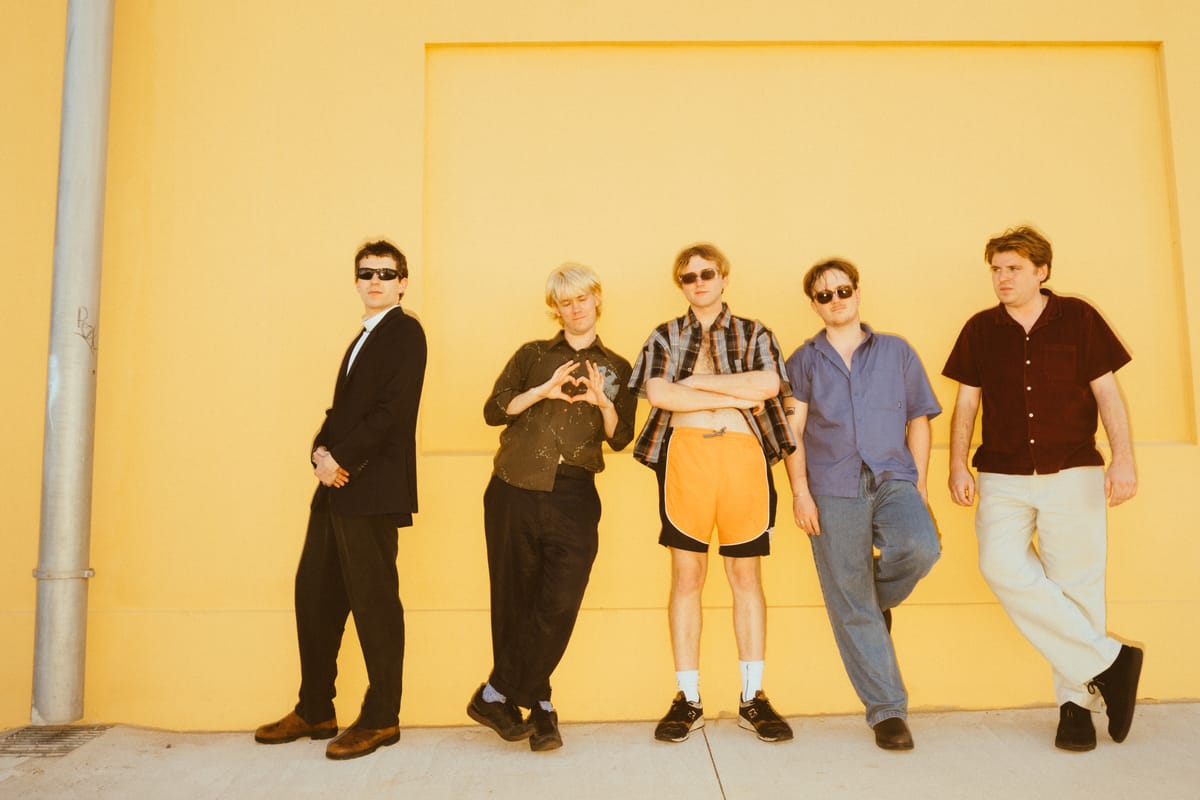
OK, let's keep it moving on this very busy December: Over the last seven years, South Londoners Shame have established them as a sturdy and reliable rock act in an era where sturdy and reliable rock acts (and this isn't a discourse-triggering statement, I swear) have been in relatively short supply. I've increasingly enjoyed checking in with the records they've put out across this decade, and that certainly includes their latest, Cutthroat, which saw release just a few months ago—so I was pleased as punch to hop on a call with bandleader Charlie Steen last month to chat through the band's natural progression as well as a host of other topics. Check it out:
You guys have established a pretty solid reputation as far as your live show. Tell me about what goes into that.
We've always been a band who just plays and plays and plays. When we started out, that was what we were doing all the time—turning up to any pub that we could play in. For a really good show, you rely on the crowd as well. Sometimes when you play in places where you just get an amazing crowd, it just makes it easier.
In terms of the physicality, it's just so fun to be playing these new songs live. They're such fun songs. We were thinking about how they'd be performed live when we were recording them. In the past, there's been moshing and stuff like that—people moving—but now it feels like these people are singing along to a lot of them. which is really good.
Are there any particularly rough gigs that have stood out to you?
God, we've had some real stinkers—some real shit ones. We did a show in L.A. ages ago, and it was great. Then we drove for 10 hours to this place in Arizona—maybe it was, like, a Mormon place—and it was just five people there. It was awful, we were very hungover, and I'd left my phone in L.A. It was a pretty rough one.
It's kind of refreshing to hear you mention playing shows like that. As an American, I feel like the general trend of things over the last couple years has been seeing less bands venture outside of major cities when it comes to tour routes. But what happens to the kid in the middle of the country who'd drive two hours to see his favorite band, and then they don't play there because touring is so fucked right now?
We definitely try to not do that. We've made a point of it on this tour. At the moment, we're about to do our first headline show in Finland, then we're going to do our first-ever time in Estonia and Latvia. We're going back to Istanbul to do our first proper headline show there. Two years ago, we played in Ljubljana and Zagreb, and all these other places where we had so much fun that when we came to talk with our booking agents about doing this tour, we were like, "We want to go back to those places." If you make the most of your affordability of being able to tour, you get to experience different cultures and meet different people.
You guys worked with John Congleton in the studio for the latest record. Talk to me about how that experience differed from the last few records.
It was fucking great—a really good experience. The difference was that he starts at 10 a.m. and finishes at 7 p.m. every day, but he was very involved. He was the captain of the ship. We'd come in and we'd pick a demo we wanted to work on that day, we'd play the demo and talk about it, and we'd go into the live room together and play through it. When we were all feeling happy with it, he'd run a few takes, and we'd be like, "Do you think we should do some more?" And he'd be like, "We got it." He was a really nice presence.
How do you feel like you've evolved musically and lyrically? You're four albums deep now, and that's a point at which you may be able to tell how you've changed over time.
I think this record just sounds confident. There was a period of time—which is natural—where some amazing contemporaries were coming out when it came to guitar bands, and you're inspired by the bands. You almost want to get their sound and do their thing. But I don't want to do records that sound like another band. I just want to do a Shame record and make it short, punchy, and as melodic as possible.
How do you think you've matured as a lyricist?
Every album has a different fixation, but with this one I tried something I've never done before and wrote the majority of the lyrics in the studio while recording and doing a lot of the melody work. It was hard, but it a great challenge, and I did that because I think it's quite important for a record to be presentable and clear. The songs were written over nine months, so when we got in, the way I was feeling nine months ago was different. I focused on clear themes and character observations.
A lot of bands have felt the impulse to express themselves about "the current moment," to employ a cliché. Sometimes it comes quite naturally, for others it's a conscious decision to be topical. Where do you land?
At the end of the day, you've just got to mean what you say. The environment around you will affect what you're thinking about. I'd never say it's bad to be discussing what's going on, because you could be trying to understand something emotionally or work out what's going on in this therapeutic way. If you're a band like us and you gotta go onstage, you might as well mean it.
Do you remember the first song you ever wrote?
Me and Sean probably would've been nine years old. Do you know the Traveling Wilburys?
Yeah.
I really liked the song "Tweeter and the Monkey Man" when I was that age, so it would've ripped that off. When I was a kid, I got into everything Bob Dylan, especially Blonde on Blonde and "Subterranean Homesick Blues."
What was your overall taste progression when it came to music?
When I was really young, I liked Busted, and then my mum got me into Dylan. She wanted me to see him before he died, and he's still going now. I liked Travelling Wilburys and Roy Orbison, and I loved Eminem and Wu-Tang. A song that really blew my mind was Roxy Music's "In Every Dream Home a Heartache." When I was a kid, instead of getting an LP of a certain genre you're listening to, we were just exposed to so many various types of music growing up through the iPod. That's something that now we think is very normal, but it definitely affected the generation when it came to, "Okay, I'm listening to Eminem, the next song is Jimi Hendrix, and then the one after that is fucking Adele or some shit."
It's interesting you mentioned Eminem. Obviously, Americans love Eminem. He's a very specific part of American culture. But I've noticed over the years that he's really huge in the UK as well. I covered the Eminem and Jay-Z stadium tour for NME forever ago, and they asked me specifically to focus on Eminem in my review instead of Jay-Z. They were like, "He's bigger here," which, at the time, I was like, "That's crazy." I'm curious to hear you talk about why Eminem is so appealing to British audiences.
Well, he had massive songs and he's controversial. He appealed to children as well—you hear it in his songs, he talks about kids buying his records. I had Curtain Call, the greatest hits record, when I was a kid. He was always on MTV, too. As a child, you get the humor of what he's talking about. It's so funny, and his lyrics were amazing.
You mentioned other guitar bands before, which I'm curious to hear you talk about. From 2018 to—let's say last year, maybe—there were several successive waves of British guitar bands working in a similar sound. A lot of the time, these bands were just coming and going. Maybe you hear one or two records from them, and they'd be over. But you guys have stuck around and stayed consistent. I'm very curious to hear you talk about surviving the UK post-punk wave.
When we put out Songs of Praise, it was a crazy time. Then, all these other bands started coming up. Songs of Praise had been out for a week, we were on a big one, and we all went down to the Windmill with our management to see black midi. Then, our management also started managing black midi. The crazy thing is how long we've known all these people for. A lot of them are good mates. It also shows the amount of time everyone's been putting in. It's funny, because in that scene, a lot of the bands weren't even from London. Maybe only two were.
Talk to me about what the financial situation is like for you as a musician. How have you guys navigated that over the last five or six years?
I mean, COVID was very tough, and there have been other moments that have been very tough. If we're on the road, then we're fortunate enough to be in a position where we're able to come back with a bit of cash. But we've got to play to get paid. When you're not touring, the money's still being used for practice rooms and stuff like that. It's a tight rope. But because of how young we were when we came in—how long we've been doing this for now—I'd like to think we're relatively clued up about how to do things.We know that if you want the swanky things, you're paying for it, and you pay big. Even my living situations have always been quite strange. I lived in an abandoned nursing home before I lived in an actual flat, and then I lived without a mattress for two years. That just feels like London. There's no way we're able to live like other people who have well-paying jobs. We're not going to live in the trendy areas. That's just the reality of it. It's tough,
but buy a ticket, take the ride.