Sha Ray and DJ Haram on Teaming Up, Backrooms, Live Shows, and Distinctive Voices
This is a free post from Larry Fitzmaurice's Last Donut of the Night newsletter. Paid subscribers get one or two email-only Baker's Dozens every week featuring music I've been listening to and some critical observations around it. Subscriptions currently run $3/month or $30/year, hit one of those little pink buttons on the right side of your screen to tap in, you won't regret it.
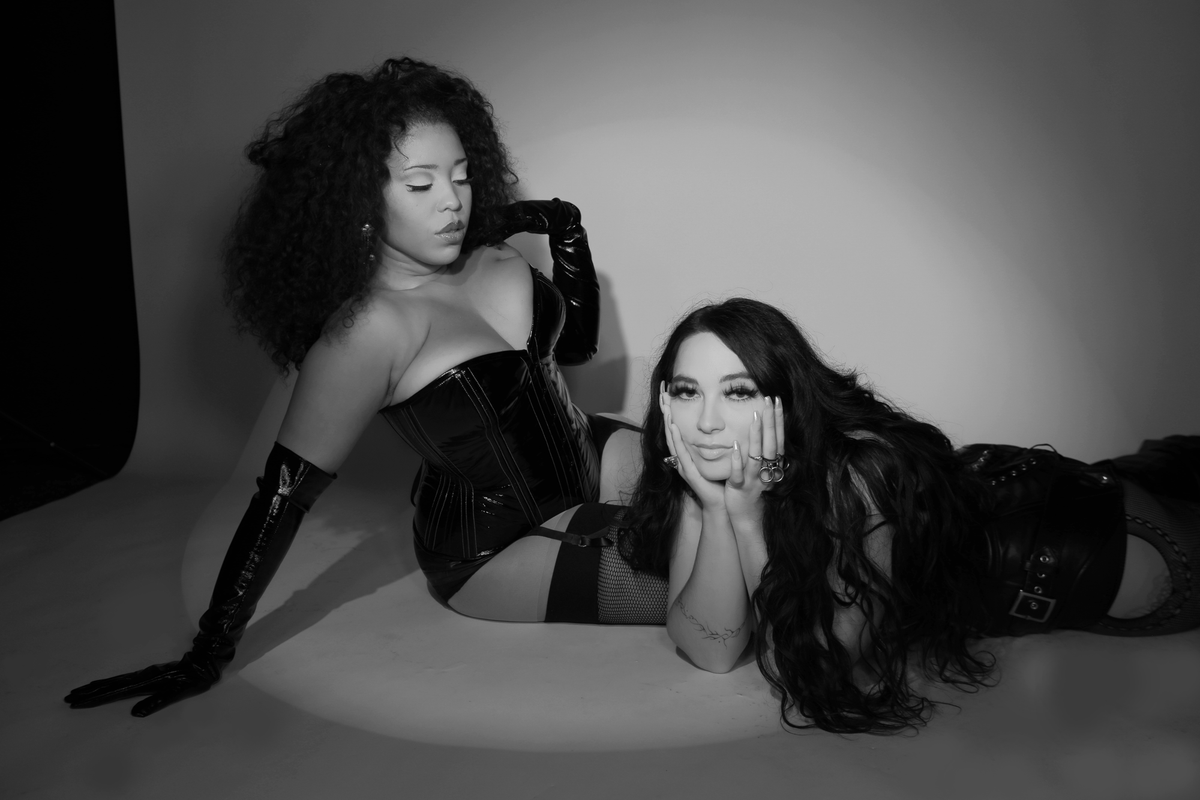
Today's newsletter: I've been an admirer of DJ Haram's left-of-center production style for more than a minute now, and she's found the perfect foil in Bay Area rapper Sha Ray for their collaborative debut Critical Thot, which just dropped last Friday via billy woods' Backwoodz Studioz label. I hopped at the chance to talk to the both of them about what it took to put this record together as well as a host of other subjects, and the conversation was extremely enlightening and fascinating—I think you're gonna love reading it. Check it out:
Walk me through the genesis of this team-up.
DJ Haram: I can tell that story because, as per our last interview, Sha Ray doesn't remember when we actually met. But I just went to one of her shows. When I have time, I'm a big live music enjoyer. I prefer meeting people in real life, so it's legitimately fun for me when I can go to a show and I'm not performing—and she did her thing. She's very focused on executing the fuck out of a performance. So I just said hi, and then we talked on the internet.
Sha Ray: That show at Elsewhere was probably the biggest show that I had ever played at that point, so it doesn't surprise me that I was in a daze and didn't quite remember that me and Haram had actually were introduced that night. I was already a fan of hers, because I love 700 Bliss. That's so funny that you said hi to me, because if I wasn't entranced by how crazy it was that I was playing that venue—if I was more lucid—I would've been extremely gagged by meeting you in person. So yeah, we connected online, and then it just evolved into us working on this record.
DJ Haram: I found the email the other day, it was January 2024. We didn't jump right to it, but we started getting to know each other.
Talk to me about how the record came about from there.
Sha Ray: I had a bunch of songs that I'd been working on. Something that's really important for me as an artist is that I was doing live performance way before I was actually recording records. Being a rapper is getting on stage and rapping, in my opinion—so I was getting on stage and rapping. People who are really interested in going to underground rap shows and seeing music live—those are my fans, rather than people who stream and buy records. So I had a bunch of demos that had changed and transformed so many times over the span of like two years. There were certain points where I was just experimenting, using live performance to write songs for the stage.
I had so much material that I'd built up over two years that I came to this record like, ""What makes sense to use, and what new material needs to be written for this?" Of course, Haram's production is so inspiring, so there was lots of new material written for this as well. But I came to the table with quite a bit of it, almost fully-realized. I just needed the production to ground itself in what the album eventually became.
Do you remember the first rap show you ever went to?
Sha Ray: The first rapper I ever saw live was Vince Staples. Kilo Kish opened for him, and I'm obsessed with her because she's very theatrical. Her music is very experimental, she's taken her sound so many different places.
Something I really love about Vince Staples is how he doesn't talk to the crowd at all. I thought, "Oh damn, that's so crazy." I didn't even think you could just get on stage, rap, and not say anything else. Something about that was so dope to me. I was like, "Period. That's exactly what we came here for, so why do anything else?"
Sha, you said on Twitter recently that you're a classically-trained violinist. Talk to me a little bit about your musical history.
Sha Ray: I started playing violin when I was 9 or 10, so I've been playing for about 20 years now. I took private lessons into college. It's my primary instrument, but I also play guitar, bass, and keys—but, those, I'm self-taught. My training with violin was very traditional and formal—private lessons, recitals, learning a lot of the musical canon—and I just became very bored with classical music.
I definitely think that I'm returning to violin after the completion of this record, but in more of a free-jazz context. For the last five years, I've hooked it up to a bunch of effects racks. But violin, for me, is purely expression. I don't always advertise that I'm a violinist, because I view myself as being more of a rapper, and being a writer is the immediate way that I want to send my message. But I'm fully capable of being a session musician, and it's not that I wouldn't necessarily seize those opportunities when they present themselves. I just view myself as a rapper, so the visibility that I have is going to be about that.
It's funny, I did conservatory when I was a kid for a little bit, obviously it's a really specific sort of discipline you have to have. My main takeaway from it was that I was not cut out for it.
Sha Ray: Yeah, that's baked into the culture of it. You're in or you're out—and if you're not a very technical player, you're basically out automatically, from classical music specifically. The feeling that I got from the 15 years that I was doing that is that any influence you may have from Western music— jazz, blues, hip-hop—any way that bleeds into how you approach as a player is not going to be accepted whatsoever. A lot of my teachers and my professors would be like, "Kayla, you're such an expressive player and you're so passionate, but you need to work on your skills." There's no feeling in that, so I kind of don't care.
Let's talk about how how the creative pairing here complements each other when it comes to production and vocals.
DJ Haram: The hard job is on Sha. Something that was interesting, healthy, and helpful—though challenging—was that I was working on beats for this project while working on my album. For all of the build-up for my last album, I locked in and had nothing else on my plate, so I tried a bunch of different stuff and took note of what appealed to Sha Ray. But since I make the beat first and she has to get on it, the task of finding space is like on her more than me.
Sha Ray: I'd agree with that. Taste-wise, there isn't a genre of music that I don't have interest in. Because I have a non-conventional background as a rapper and have made so many different types of music, I'm not intimidated by Haram's style of production. If I hear something and I like it, then I know I can do something with it. I won't say that there weren't songs on the record that didn't feel challenging. We actually were just talking about this the other day, where sometimes there are certain songs that just fall into your lap. You wake up, and the song is there.
"Elixir" and "Boudoir" were songs in which I definitely knew there needed to be something on the record that simulates these very specific feelings. The ideas came first, but the songs weren't necessarily there yet, so I had to sit with that and think very critically about the way that I want to approach. Every song necessitates its own process, and some processes are more complicated than others. A song like "Strictly," I just turned on the mic. It's very free and open, a no-edit situation— whereas a song like "Boudoir," there were a few iterations of that before we landed on the version you hear on the record.
The one-sheet mentioned the two of you having overlapping experiences when it comes to being women in the music industry. Talk to me about where the common ground is found.
Sha Ray: The girls that get it, get it. I do want to answer your question, but a lot of the time, what's understood doesn't need to be explained. We are two women living in the United States under a patriarchal society. There's inherent danger to having this identity, and we're operating in these social contexts where there's not always a safety net. You have to build that yourself through community and your own resources. I've been lucky enough to have access to community where there's a mutual aid that's baked into the way that we all come together. We're going to look out for one another because that's literally just our way forward. We go to these shows and understand what's going on. The music industry does not exist in a vacuum outside of the political landscape of the United States of America, so it's like, "Girl, we probably need a link-up so that we can make some shit happen."
DJ Haram: It definitely gives us strength for sure. When I started doing 700 Bliss with Moor Mother, it was because we're friends. We weren't serious artists in the way that I am now. I didn't even know any labels—I was just in Philly, making music for fun. So this experience is a little different.
Since I've become more of a professional, serious, real artist, a lot of women and non-binary people hit me up and they're like, "I can't deal with the male producers, the male bookers, the male promoters, the DJs. That's why I want to work with you." Obviously, I get that, because I also have to deal with annoying men, masculinity, and patriarchy. But just because of that, it's not always necessarily a link-up. Sometimes, male curators—people who are putting together a compilation album or a show—will be like, "Y'all should work together, because you probably have shared experiences." It doesn't have to just be about gender—it can also be sexuality, or ethnicity. There's strength there, but Sha Ray and I also have similar and compatible ways of thinking and approaching music. If a woman is a rapper and is trying to hit me up, I will try to support—but, also, I'm only going to work with people who are really nice. Moor Mother is one of the greatest living rappers. billy woods is one of the greatest living rappers. So is Sha Ray. I'm not going to just work with anybody to be like "Let me empower all the ladies."
It goes without saying that there's a lot we share that makes us stronger. But, in the same way, things are much easier when someone who can navigate patriarchy with privilege does it for you. I'm not saying that we're seeking male support to do things for us. It's strong to be two women—but, also, when you're two women, anybody who doesn't take women seriously has no one in the picture to look at and be like, "Oh, you're the man, not both bitches."
The one-sheet also mentioned this project "interrogating misogyny and sexuality. Talk to me about how the work on this record reflects that.
Sha Ray: It was very important for me to make this project centered around being really antagonistic towards a lot of the overarching themes and events that I've observed. As a woman who makes rap music—which is definitely a very male-dominated space, in my experience as a working musician—this album deals with feminine sexuality as a way to exalt power over your audience throughout your work.
In the universe that I've built as Sha Ray, oftentimes I'm put in this position where I feel like I can't afford to not use my sexuality to push my message forward, which is ultimately a message about black feminine liberation, and true liberation for all marginalized and oppressed peoples globally. I, of course, am speaking specifically through the lens of the Black feminine, because that is my personal experience. But what I'm talking about on the record can be applied to so many different experiences. The record is about grappling with the reality of feeling like, "This is power that I have, and this is the best way for me to use it, even though sometimes it may actually put me in situations that are uncomfortable or even harmful."
The circumstances of my material reality are constantly affirming that, if I wear this outfit, present myself in this way, or talk about these things, people will listen. I'm always taking the message back to the source, though. I might be presenting it in a way that's erotic or sexy, but it's a very inherently political message.
DJ Haram: Capitalism and our economic foundation of our world is based on the exploitation of people's bodies in general. Sorry to step super far back and get ideological with it, but I don't think that being an MMA fighter is that different than being a stripper. It's the essence of our world and how hierarchical systems control people with bodies. This is what it is. Sex work, sexual violence, sex trafficking, those things exist in this world—and everyone is subject to a type of system where the majority of us are oppressed by it. Reducing people to just sexuality hurts all of us, right?
The way you can navigate that and be empowered can either be through building solidarity, or joining in with the oppressor and knowing that the privileges you get are based off other people's continued subjugation. There's no option in our society where there's no sex work, no sex trafficking, no degradation, no trans misogynoir. We can't just all will it to be and then it will be. The only right thing is the option of solidarity, so I'm extremely interested and drawn to Sha Ray's perspective. She has the skill of a good writer that can talk about complicated things without sounding like me right now on this microphone. She can make it interesting and relatable, which is true for women in rap in general.But in [regards to] the mainstream, something that Sha Ray pointed out in the last interview we did is that she doesn't actually talk about having sex, performing sexual acts, or having them performed on her.
Another thing I've noticed is that, a lot of times when you have these girl rappers talking about, "He's tricking on me, he does whatever I want, I'm the powerful feminine, I took over on the dynamic," these quote-unquote empowering. narratives—which Sha Ray does do—I can't really think of any mainstream female rappers who do that who don't also talk about other women. There's always going to be some bars where it's like, "She's doing more than me for less money," "She's fucking these dudes for features"—hating on people who are essentially in the same position. These details are actually what make Critical Thot critical. That's gonna be part of my work no matter what—that's just part of my life.
I'm doing a residency this summer, and the next project I want to work on is talking about the sex work economy, sex trafficking, Epstein, and Zionism's role in that—things like the OnlyFans [founder] being a Zionist. Again, I'm mentioning Euphoria in an interview, but that's the Israeli show that has this crazy fake-woke pro-ho thing. I don't know what's going on there, but it's something I'm interested in.
Both of your voices are on this record, and both of you have distinctive voices in general. Let's talk about what the two of you see in each others' voices.
Sha Ray: First of all, I love Haram's voice so much, especially on this record. The first time I ever said out loud what my favorite track was, it was "Elixir," and Haram's performance on that song has so much to do with that. Her voice is so hypnotizing, and it really draws you in. There's that big hit immediately after she starts delivering this poetry, and the timing of it is so cinematic and jarring—and it's exactly what that moment needs, because that song is the turning point for the full descent into the very last act of the record. "Elixir" and "Boudoir" are pulling the veil back on what the actual message of this record is. We're talking about it a lot thematically throughout the record, especially in the first half, but we get a lot darker and more experimental on the last few tracks—and Haram's verse is transporting us into that. I love that we get that one moment from her after mostly hearing her expression through the production.
For me and my voice, I love theatrical rapping—using different voices, manipulating my tone and cadence to tap into different types of emotion and expression that's going to be palpable to the listener. Al of that is intentional. Recording is a very intensive process. I'll spend hours of time working on one section, and not because I'm a perfectionist—there's a specific emotion that I'm trying to simulate, and I want to make sure it's clear.
DJ Haram: All of the things that Sha Ray is really good at, I'm not. She's particularly emotive, where I'm notorious for being really dry. Last night, I was talking to my friend on the phone, and her girlfriend was like, "The Knicks won!" and I was like, "Go Knicks." She was like, "Fuck you!" I was like, "I was being sincere, hello?"
I like talking and trying to get a message across, and I like combating people getting things wrong by telling them what it is—so I think more people should use their voices in music. That doesn't even mean that they have to. One of our production collaborators, JWords, we should've got her singing, because she just dropped an album where she's doing a lot more vocals, and they sound really dope and add a lot to her music. It's nice to hear introspection from people, but even if you don't include your voice on beats, more people need to be like, "Yeah, my music is saying something."
I had two lines to "Elixir" written for a while, and once it came, it came all at once. I was like, "This is a cool song on a cool record, this is my only appearance. Let me do good. The option of me messing up totally still is possible." You can definitely hear the way that I'm inspired by Sha Ray. I also have an alter ego called Punchline Maiden, because I'm funny. I feel like there's a little bit of Punchline Maiden in there. One of my proudest moments as a vocalist is that my lyrics made Willie Green laugh, because I was like, "I was born with good pussy, ready to die that way." He was like, "Ready to die that way, crazy." And I was like, "See, but that's literally Sha Ray's influence." We're talking about pussy regardless. The assignment is, period: Talk shit.
What movies have you guys watched lately?
Sha Ray: I just saw Backrooms. I don't want to do too many spoilers, because I don't think Haram has seen it yet—but I do highly recommend it, because O honestly really think you would like it. The movie was very anti-nostalgia. A lot of that analog, liminal, internet horror is supposed to be really dreadful and psychological, but I actually left that movie feeling very optimistic and inspired, because it was so cool to see a movie that was very much taking a hard stance against being lost in the past. The Internet and the music industry is very nostalgia-pilled. Everyone wants to do remixes and references—where's the new shit? We need to think about the future—and, this is getting into an Afrofuturist bag, where it's like, yes, we exist in the future, we need to imagine ourselves existing in the future. The main character of that story refuses to imagine a future for himself and it literally leads him into becoming nothing. I loved that movie so much. I definitely want to go see it again, because it has so many layers.
DJ Haram: I haven't seen it yet, I'm gonna watch it though. I'm really bad at watching movies, so my New Year's resolution in 2026 was to watch one movie a week—but I definitely gave up in the first week of February. But I still have a running list of what I've seen this year. I like horror mostly. I like historical stuff. I like sci-fi. The best movie—or, the most important movie—I watched this year was The Voice of Hind Rajab. When I heard that there was being a film made and Hind Rajab's mother was involved in it, I knew I needed to see it.
It's one of these movies where your reaction to it tells you a bit about things that you have in your mind unconsciously. For me, this unconscious thought going into it was apprehension versus, "Well, I know what happens. The IDF murdered an entire family, including a child, and all of the people who tried to rescue her, firing hundreds of rounds of ammunition at her." But something that's important to me with art, which I definitely try to embody in music, is that it's not all for entertainment. It's to share ideas and document history accurately, especially as the oppressed.
As a Syrian, there's this concept of having Syria fatigue that happened after over 10 years of the civil war there. I think people are now having Gaza and Palestine fatigue as well, where it's like. "I'm not even going to see that movie. I know what happens. It sucks. I can't live my life thinking about that." But the film shows real life, and people who work as first responders or journalists know that there's nuance to this shit. The idea of being like, "I don't want to watch it, I don't want to deal with it," is really you choosing to be like, "I'm going to make no effort. I can't help"—and this movie illustrates all the steps along the way where people tried to help and could've helped, where some small thing could've changed reality and saved lives. It's definitely not an empowering movie, but it's a movie that documents something really real, and I think more people should watch it.