Ratboys on Therapy, the Endless Scroll, and the Power of Cowboy Chords
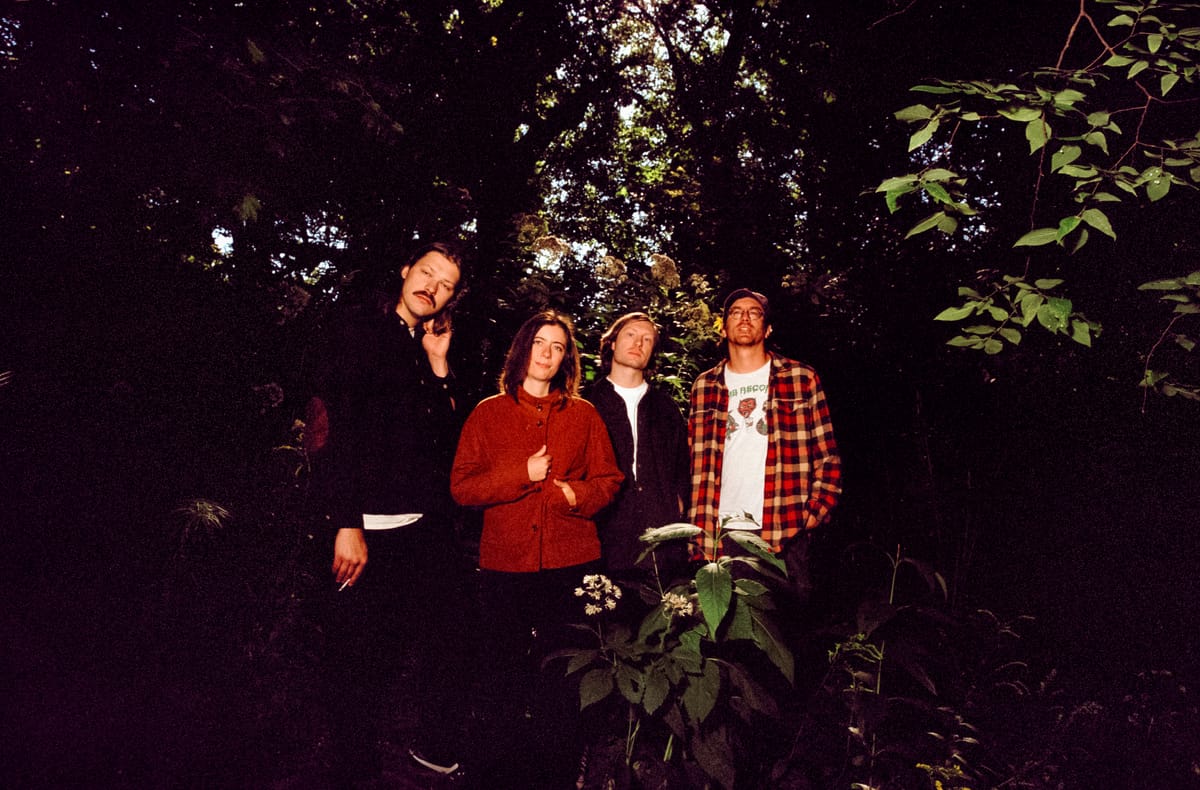
This is a free post from Larry Fitzmaurice's Last Donut of the Night newsletter. Paid subscribers get one or two email-only Baker's Dozens every week featuring music I've been listening to and some critical observations around it. Subscriptions currently run $3/month or $30/year, hit one of those little pink buttons on the right side of your screen to tap in, you won't regret it.
Up today: One of the first-ever newsletters I sent out highlighted Chicago indie rock heroes Ratboys' "My Hands Grow"...if I were a normal publication this is where I'd link to the newsletter in question but, listen, I've sent out almost 700 of these things, how am I supposed to keep track of it all? Anyway, it's been a pleasure to watch Ratboys' presence grow with every successive album, and their latest album Singin' to an Empty Chair—out this Friday on new label home New West—is absolutely poised to bring more converts to the cause. I was very happy to hop on a call with front-woman and band co-founder Julia Steiner earlier this month to chat through the band's impressive career thus far as well as a host of pressing everyday-life concerns, check it out:
Talk to me about this new record coming together.
I have a personal goal to never write the same song twice. My favorite kinds of records are the ones that have a lot of variety across them. We're pushing further and further each time. It's fun to have a pretty straightforward, midtempo fucking Weezer rock song as track 2, and then have this frenetic, all over the place song on track 3. It's fun to keep pushing ourselves and see what happens. We don't place any constraints on the kinds of songs we want to write. It's a recipe for fun and adventure, and we're stoked when folks are along there with us.
The press materials said that this is the first record since you started therapy. Talk to me about that.
It's given me a sense of clarity about my own experiences, my memories, and my relationships with the people I love. At this point, it's so mainstream in the sense that a lot of people see a therapist—and I think that's a positive development for humanity. I was never skeptical about it. But I never felt a great need to introspect on a regular basis until some things started to unravel in my family life, and I needed some support from an outside perspective—in addition to the constant support that I get from Dave, Marcus, and Sean. It made me feel healthier—and, I don't know, I don't exercise much. I eat like a heathen. I'm not the healthiest person in general, but this is a part of my health journey, and it makes me feel really good.
Yeah, it's one of those things where, if you put the time and work in, it can be really rewarding.
My therapist checks in pretty often from time to time, making sure we're on track to meet certain goals. But at the end of the day—and maybe this is selfish—I don't really look at it as a means to an end. For me, it's just been really nice to have a set-aside chunk of time every few weeks to just say what I'm feeling out loud. Sometimes I discover stuff about my own feelings and outlook on things that I wouldn't maybe have otherwise thought about—I just never made the effort to say it out loud.
One thing I've been talking to a lot of people about over the couple weeks is that, if you're online and using any form of social media, it's like a switch is flipped on January 1st where you just get sold all of this content that's like, "Be better, be better." It's maddening, honestly. Do you feel like you've been weathering the pull of the "new year toxicity," so to speak?
Oh, man, I don't know. I have some things on my to-do list that I still haven't done. I'm trying to learn how to speak Polish, but I got off Duolingo because it's been infiltrated by AI, and I feel like I'm losing my mind. I feel like AI is just seeping into every facet of my phone. So I got off of there, but I want to get on a different language learning service—I just haven't done it yet.
One thing I kind of started doing on January 1st and haven't really looked back—this feels insane, because I feel like I'm trying to wean myself off of a drug or something—but I set this 20-minute timer on my phone every day whenever I'm on Instagram. I'm trying to be very conscious of how much time I spend on that app, because it's so attention-hogging. I go on there without even realizing it. I'm mainly just trying to keep track of my impulses to get on there.
I think back to our whole time as a band, and back when we started, these apps weren't as much of a thing. God, I wish we could put the genie back in the bottle. There's this feeling of, "I have to be on here, keeping up with things." It can be this constant churn. It doesn't feel good, and it's tough too, because our manager has offered to do the posting for us. Some bands really love to connect with people, and I enjoy the social aspect of it—it's just the incessant advertising and weird algorithmic churn that's changed so much from the wholesome "See what your friends are having for dinner." I miss the simple friendship aspect of it.
Do you have TikTok?
No, I've never had it.
That's one that I hear a lot from people in terms of experiencing a form of social media addiction. "This is engineered so that you just can't stop scrolling." But the few times I've used TikTok, it's almost like smoking a cigarette—and I say that as someone who's never been a regular cigarette smoker. At first I'm like, "Fuck yeah, this feels awesome," and then after five minutes I'm like, "Alright, I'm done, I don't want this anymore. I feel like shit."
That's honestly how it feels scrolling Instagram sometimes. They've tried to become TikTok with the Reels, and it's just all suggested video content. TikTok for me would be like, if I'm standing at the edge of the cliff, that's the feather that pushes me off. There would be no going back. I'm avoiding that with all my might. But [drummer Marcus Nuccio] has it, so he keeps us surprised.
You guys worked Chris Walla again on this one. It's been really cool to see Chris working with a wide variety of artists over the years. Tell me about what he brings to the table.
I'm not surprised that he's been working with such an eclectic mix of young bands, because that's one thing that we really admire and enjoy about Chris. His music taste is all over the map. I'll never forget the first time we met. Somehow, inevitably in our conversation, I brought up both ABBA and Yes, which are two of my favorite bands who sound nothing like each other, and we went off on deep tangents on both of them. He has such a fun, spirited knowledge of music, and that's one thing that people don't really talk about as much or think about from a fan perspective about the process of making records.
So much of our approach in the studio is listening to music. Obviously, we're working and don't want to be slacking off, because studio time costs money and everyone's there to do a job. But at the end of the day, giving yourself time to be inspired and enjoy bands together is a very important part of the process. Maybe it doesn't show up in the final product, but it's a big part of it, and Chris is such a curious listener and has that magical combo of technical and spiritual know-how and people skills. He's a true wizard in that way: He can do all the things you ask and he'll lead you along the path. I can't say enough good things, he's a dear friend and one of our heroes.
He's also one of those names where, if you were a young person in the 2000s getting into music—
Yeah, I was definitely one of those millennials watching The OC. I've told him that it was my first intro to Death Cab—really, my first intro to indie rock. I hope they realize how many bands exist because of that appearance.
It's been interesting, over the last couple years, to witness the randomness of how bands catch on via TikTok or viral moments. In the 2000s, you had a few very specific entities making something of a monocultural push when it came to indie rock. It would be interesting—nice, even—if that ever happened again.
Yeah, I wish. I miss the cozy feeling of "It's 8 p.m. on any given weeknight and there's only three choices." It was everyone was watching at the same time, so it reached more people. Hopefully, we get back there at some point—that'd be cool.
You guys are on New West now after being on Topshelf for a few records. Talk to me about what the label change means for you guys at this point in your career.
It's exciting—a new chapter for us. To give some context, with The Window, we weren't in an album deal. We didn't have any label obligations or commitments. We shopped that one around and sent it to 50 different labels, and no one said "Yes." It was a very tumultuous, tenuous time for the music industry and the economy in general. It was 2022, so we were still in COVID times. Topshelf swooped in at the last minute with that record, because we were seriously considering self-releasing it. They agreed to put it out and gave us a friendly licensing deal, and we were grateful, because we'd worked with them for such a long time. [Topshelf co-worker Kevin Duquette] is one of our dearest friends, and he has one of the greatest aesthetic senses in indie rock. So we were excited to work with them again and keep that relationship going.
This time, we were kind of in the same situation all over again. We weren't in a deal, we shopped it around again, and we met New West in this funny happenstance way. We were playing at Third Man in Nashville, where New West is partially based out of. We were playing a bunch of new songs, and I introduced one of them by saying, "Hey, Third Man, we don't have a label, so if you're into this, let us know." Third Man didn't really say anything, but at the merch after the show, Meg from New West was at the show as a fan, and she was like, "Hey, I work for a different label in town, we really like you guys."
It all just snowballed from there, and it was really exciting. It happened very organically, which is something you always hope for. They've been really great, I love their catalog, and their whole team is super on board and knows what they're doing.
You mentioned the early 2020s of it all. Your guys' profile actually rose a little in the midst of the pandemic. In terms of like indie rock bands that have had a growing audience across the last couple years, you guys seem to be definitely one of them. Given that you've been making music for quite a while now, I'm curious to hear you talk about how this decade has felt as opposed to the 2010s.
It's so wild to think that we're officially in the second half of this decade now. I was thinking the other day that 2018 was such a big year for us. That's the most touring that we've ever done in one calendar year—I think we played something like 130 shows. The fact that that was eight years ago is pretty insane. It reminds me that we've been doing this for a long time. But it's tough, because at the very beginning of the decade, we were so poised and ready to do our first-ever ticketed headline tour. We had all these big plans, and in 2019 we took a break in order to plan and rest up for all the touring that we'd booked. Looking back, that was not meant to be.
But I think a lot of things worked out in our favor in 2020, during the whole COVID isolation period. At the time, Dave, Sean, and I were all living together. We were able to do stuff in person still—to do internet streams, be silly, and get our energy out in a productive way. Marcus wasn't far, so we brought him into our little bubble and focused on doing whatever we could to find our audience where they were, which was in their homes. All of the Twitch stuff was a fun chapter for us, despite the backdrop of chaos in our country and the world.
Part of me kind of misses those times, because I don't think we'll ever have that much free time again to learn covers and interview other artists. We basically produced a web show, and the idea of doing that now, on top of our normal band schedule, is impossible. So it was an awesome excuse to learn new skills, and I'm glad that we were able to make something out of it. But, like, no judgment and all the respect to people who just needed to completely reset and do nothing during that time, because it was such a complete mindfuck of, "What will we even have to come back to so?"
I'm grateful, though, that shows still exist. Even though everything's expensive and our country has kind of jumped the shark, we still get the opportunity to play music in venues that are still around—so it could be worse. But this decade has not been an easy one.
Jenny Conlee plays on "At Peace in the Hundred Acre Woods." When I first started listening to your guys' music, I was like, "This is not unlike the Decemberists, to me." And I've always loved the Decemberists.
Hell yeah.
Talk to me a little bit about getting her into the mix.
The Decemberists were honestly one of my more shameful blind spots growing up as an indie rock fan. I knew of them, and I knew Chris had worked with them. I dove into their discography for the first time pretty late to the game. When we were making The Window with Chris, he talked about some funny memories of recording Picaresque, so I listened to the records that they had made together, one of which they made in a church. That remote recording experience informed what we did this time up at the cabin, where there's no recording gear.
We toured with the Decemberists in 2024, and it was such a godsend of a tour. They kept us working all year and are just the sweetest people. We really bonded with them, and they welcomed us in a way that we never assume is going to happen. Jenny, in particular, is such a chiller—the sweetest, most down-to-earth person. We were trying to figure out what to do on this last song, and that was the first idea that we had—and her organ totally makes it. She recorded it remotely within a couple days, so we threw that in the mix immediately. That was the thing we needed.
We're also in a space right now where a lot of indie rock over the last several years has leaned on more alt-country-ish textures. This sound that you guys have been doing for a minute or two now suddenly seems like it's right on time. I'm really curious to hear you talk about the sonic evolution of the band.
We're all freaks. We like a lot of different types of music and sonic textures. We're really not ones to say "No" on first instinct. Marcus always says, "We can always mute it later—let's just try whatever we want and whatever we feel. If we decide later that it's weird or doesn't fit well, maybe we should keep it in. But if it's just not vibing, then we can always mute it." Anything that feels authentic—anything that fits that description—we're game.
The post-country thing, I think, is people just realizing how good it feels to play those songs. It's not that we figured out some secret first—I think a lot of people have been playing in that style. But, for instance, the pedal steel is an amazing instrument, and it's not that easy to play. But you don't have to give yourself permission to want it on one of your songs. It's a wonderful sound, and it can really complement and elevate straightforward cowboy-chord songwriting.
When I first said [post-country], I kind of said it in jest, and the reporter really jumped down my throat and made me feel insane—just questioning me like, "What does that mean? Give me examples." Where I was coming from was, when Dave and I first met, he—in complete sincerity—was telling me about these post-hardcore and post-rock bands. I was kind of sheltered growing up, so I'd never heard those terms. So I thought that was hilarious, and I was like, "Well, you can put 'post' on anything—and post-country, by that logic, it surely applies." So I do feel a little vindicated now that the sound is so in vogue—and I'm glad, because I love simple cowboy-chord songwriting. If you can do something really memorable with that, you've really achieved something.
You've known Dave for quite a while as a bandmate. Talk to me about nurturing that creative relationship between the two of you over the years.
It's something that we're constantly working on and, honestly, talking about. An underappreciated aspect of band life is that your bandmates really are your co-workers in some sense. So Dave and I are fully aware of the fact that we work together. I've realized, about myself, that sometimes my timing isn't great. Maybe it's not a good idea at 11 p.m. to bring up something about this merch design that we need to edit. [It's about] having some boundaries between when it's time to talk about the logistics of the band—which takes up a lot of time in addition to the creative conversations—and being able to let it go and talk about being together on a personal level. That's the trickiest challenge, and it's something that I'm working on as the de facto like point person.
I'm constantly trying to be better at picking my moments and not blurring those lines too much. Also, we're both purposeful about carving out hobbies on our own and doing stuff separately, in addition to the context of being together all the time for the band. Dave's really into biking, and I like to bike, but not as much as he does. I love to read, and he's not as much of a reader. So we have our own things, and that's really healthy. But at the end of the day, he's my most trusted collaborator and my best friend. He's still very much my sounding board for new ideas. I don't have confidence in a new idea until he's given me some sort of positive feedback. Maybe that's pathetic, but I crave his opinions about any sort of fledgling idea, just because we have copacetic music taste and his is so much more far-reaching than mine. I think Dave's a genius, so I feel grateful to have him by my side, and grateful that he's still down to keep rocking and give me that feedback that I need.