Nirosta Steel on Driving an Uber, Social Media, and Queering the Outlook
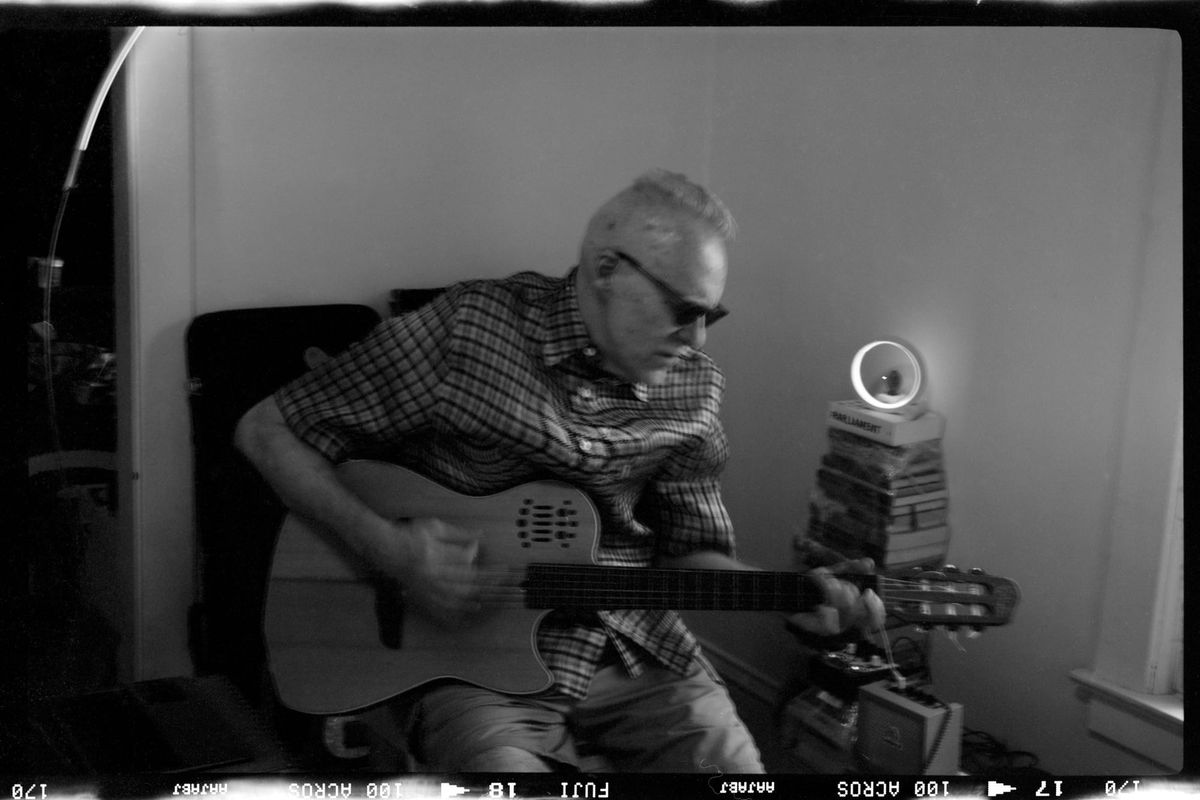
This is a free post from Larry Fitzmaurice's Last Donut of the Night newsletter. Paid subscribers get one or two email-only Baker's Dozens every week featuring music I've been listening to and some critical observations around it, along with a Screen Memory column every one or two weeks where I write about stuff I watched lately.
And hey—[Podcast ad read voice] did you hear!?? The "birthday layoff" sale I'm running is well and underway, and people are grabbing up these deals like friggin' hotcakes. We're talking 39% off the first six months of a monthly subscription, or the same discount off of a year of the annual subscription. You can grab the monthly sale ($1.83/month) here, and the annual sale ($18.30) here. You won't regret it, and you'll be keeping this 100% independent publication alive and well, too.
OK, let's get into it: Steven Hall's 40-years-in-the-sorta-making record as Nirosta Steel, the very excellent My Skyscraper, is inarguably one of the year's most sensational and conversation-starting releases. It's always a real treat to see left-of-center music connect with audiences on any sort of wider scale, and between the endless chatter around My Skyscraper's shapeshifting pop music and the immediately sold-out NYC dates Hall has booked this fall, it seems totally reasonable to deem Nirosta Steel as one of the year's most beloved records for certain.
Hall has been on a seemingly nonstop press tour behind this record; in between my booking a call with him and actually getting him on the horn last week I witnessed several interviews pop up elsewhere, and the same sensation has taken place over the last week as well. Despite this seeming full-court-press approach to press itself, our nearly hour-long convo was chock full of revelations and surprising left-turns; I got the impression that he's a great person to just sit down and let the convo unfurl in front of you, and as the following interview shows, he doesn't need much poking-and-prodding to unearth even the most casual of new facts. (In a rare occurrence, I didn't even get to most of my prepared questions—which I was far from frustrated about, I love letting subjects take the wheel for a long drive.) I think you're really going to enjoy this one, check it out:
You just moved, but you're still living in Champaign, right?
I'm still in Champaign. My husband is working for the university here. He went to law school here, and that's how I ended up here—Otherwise, I'd still be in New York. I mean, I basically gave up my life in New York. I've been here going on four years now, and his contract was just renewed for another year. So we decided to get a place and settle down. We're hoping, eventually, to move to Chicago and keep this place as a weekend country place, since it's literally on the edge of a cornfield. In terms of Arthur Russell, that's one of the themes in his songs—the corn belt, the farm—so it's very much in tune with that.
Do you miss anything about New York?
Well, what I don't miss is that people here are much more civil and polite. I had every walk of life, everywhere I go. Even when I was driving Uber, before the heavens opened up—people are very civil as opposed to New York. The only car accidents I've ever had in my life were in New York. I was back in New York, two summers ago in the Bronx, and driving is a nightmare. Maybe the excitement of being in New York gradually mutated into stress.
New York, when I was younger, really was the center of the universe in terms of style, music, and art. Now, it's much more diffuse. There are centers of activity. I just heard yesterday that there's a very interesting music scene in Argentina happening now, which is a reaction to the political situation there. I had a musician invite me down to Argentina to work there, and it's a very interesting idea. I'd love to go to South America.
The surreal quality of this thing that's happened to me also has its roots in an almost terrible reality, which is really happening. There's certain points to which I realized it's real. The first week, the record label sold more in a couple of days than they had in the last four years. My Bandcamp sold more in the first few days than in the last couple of years. My husband said, "You've had 16,000 free downloads of Cool Fire," and I was like, "What?" Yesterday, they told me I have 100,000 followers on Spotify.
It's almost ridiculous—I mean, it's almost overwhelming. But as long as I keep my sense of humor—and I'm Scottish, so I'm very practical about these things. It's not going to change the world. My life is changing, but the way I see it is this is my job. This is what I've been doing for years. This is what I do every day. Now I'm getting noticed and rewarded for it—which is wonderful, because who wouldn't want that? Every young musician's dream is to have what happened to me happen, because no one gets to be an overnight sensation anymore. Big pop hits, in that way, don't really happen anymore. They're part of a machine that's delivering it, the whole package of auxiliary things.
But you couldn't buy the promotion I got for a million dollars, because it's all organic. The people helping me—Clark, who's now my manager, Eric from the label—they were doing this for nothing, even though their day jobs happened to be A&R and PR. So, as a consequence of signing with Clark's management company, now he gets paid to do what he was doing for free before, which is really sweet. I like the idea that other people will get rewarded, or noticed, or even make some money, because of me—because that was also one of Arthur Russell's ideas, and that's the way Allen Ginsberg worked as well, to take care of his friends. So that's very appealing to me.
Also, we're talking about doing a charity thing—I just found out from my booking people yesterday—where you can do a "plus one" or "plus two" thing on a ticket, where some of it goes to charity. One of the booking agents was involved with this place in New York, on Astor Place. Do you know New York? Where are you?
I live in New York, yeah.
Where are you?
I live in Bushwick.
I was in the Lower East Side for years and years. I saw a transition, and you know what that's like—the neighborhood was taken over—and then I moved to Fort Greene, and then it was taken over and turned into Clinton Hill. When I moved out there, it was gangs. You couldn't leave a car out on the street. Now, it's the rich kids, with their designer dogs and their nannies—but, that's okay too. That's fine. So I was in Clinton Hill for many years, and that was nice, because I could see the city. I could see the Chrysler building, made of Nirosta steel, from my bedroom window. That was good, because I was keeping it at arm's length—the craziness of New York.
You mentioned driving an Uber for a bit.
Yeah. My twin sister—who's now my late twin sister—she did that for several years, and she found that she really enjoyed it. I come from a driving family in Scotland.
We were always into cars. My father had a car, my mother had a car—which was kind of unusual in those days, to have a two-car family. I was obsessed with cars and driving cars, so I tried [driving an Uber] because my twin sister liked it. I happened to like it because it gave me a social life. When I moved out here, I didn't have any friends, so I was meeting people and, also, in a way helping people—taking kids to school, taking people home from work, picking people up from the hospital, stuff like that. It was like a social service. Because of my insomnia, I would get up at 4 or 5 in the morning and get these early rides that were great, like an early ride to Chicago airport. I'm two hours south of Chicago here. It was sometimes something glamorous, like taking someone to a private airport. You'd get to hear people's stories.
It's interesting to hear you talk about the positives, because you typically only hear about the obvious negatives when it comes to doing rideshare or delivery app work. How long did you do it for?
I did it for about a year, and I did quite well. Sometimes, like in the early morning, you would have bonuses, because there weren't many riders. I took advantage of niche things, and I was willing to take rides to the Chicago airport, which a lot of the local riders wouldn't. Also, generally, this area here is a university town. It's generally quite safe. There's some parts of town that are dodgy, but I've lived all over the world. I can take care of myself. Also, if you've lived in New York, you can take care of yourself. I mean, any New Yorker can handle anything pretty much in the world. Also, living in Bangkok, which sometimes was pretty scary at times, because I was there in the middle of a civil war at one point. That was when it got really, really intense.
But living here, life is generally civil and—not laid back in a California way, which I really like too—but more just taking your time, but not being lazy. Getting things done, but not rushing, not scratching too much about it. Maybe that goes into the music I'm doing. I don't know. We'll see. Because the other thing is, now that I'm getting all these opportunities to work with new people, try new things—as well as offers to go back to my old thing of doing Arthur Russell music, because some opportunities are coming up with that too. That's something I don't mind doing as well.
When I set this interview up a few weeks ago, you'd already done a bit of press, and I feel like you've been doing a lot of press in general. I'm curious to hear you talk about what that experience is like. Just going off of this interview so far, you're obviously very easy to talk to. It doesn't always come naturally for people, and the act of doing press can maybe be kind of underrated in terms of how difficult it can be for one's mindset. Talk to me about navigating this flurry of activity over the last month and a half, and maybe even what the challenges have been.
For me, it's still as a positive thing. I mean, there's been points where it's almost been overwhelming in terms of how much I can do in a day. But the only person who actually has experienced any kind of challenge is my husband, because we have a sort of normal married life—I mean, we don't have a picket fence, but we do have our own cornfield in the Midwest, so that's about as close as the American dream from the '50s that you can get. We had this thing worked out, a life worked out together—and also, I'm able to work on music. I have that freedom. But he was scared that my life was going to change so drastically that our relationship would be under a lot of stress.
But I think he's realized that I see it as a very separate thing for me, because it's almost like playing a part. I saw this recent interview with Mick Jagger—because I'm really interested in older musicians and how they deal with this issue—where he said, "Well, you're just playing a part. Someone has to do it." So I enjoy it. Someone's got to do it, so I play the part. But it is a part. I see it both as a job and a performance—so, when I do an interview, I see that as much as a performance as if I was playing music. One thing that people seem to really like about Cool Fire, which was almost by accident, is that the talking parts were left in. I actually forgot to tell my friend to take out the talking parts, but he put it all in, and that's what people love.
I'm going to do a solo show first in New York before all the young pop stars turn up—which is a whole 'nother story. It's mystifying to me, but it's real. It's silly, but it's serious at the same time. When I think about it, it's kind of crazy, but it's actually real, which I get reminded of once a day. I got 850,000 views on my Instagram in the last month. Things like that are just mind-blowing—but, I have to accept it and also accept responsibility, because this is the result of what I did for the last 40 years. And what was I not working for, if not for this? It wasn't expected to happen, and it happened so quickly, and to see it so mind-bendingly large in terms of the way it was spreading, like some kind of chaos theory thing that took off almost with a life of its own...it's almost like it's happening to somebody else on another planet.
The way I keep my sanity and sense of humor is to observe it as a very interesting thing that's happening, but not to be too attached to it. Otherwise, it would be overwhelming. Also, I'm sorry, I forgot to say I'm a writer. That's why I studied at Columbia. I went there to study literature and poetry, and then I edited the Columbia Review and the St. Mark's Poetry Newsletter. We started an arts magazine after school where I was the photo and music editor. So I've been on the other side. I know what it's like to interview someone. But my interviewing started being criticized by my husband, because he said I talk too much and I don't let the interviewers actually ask questions.
Remind me—how long have you been married?
He's 35, I'm 69—so that's the part that's really interesting. We met 10 years ago when he was in art school and worked on his MFA thesis together. I did some music for this project he did. It was a queer history project about the piers on the West Side that used to be like a gay sex area. He did research on that and interviewed some of the people who were actually around at that time, who were also around my age. His student visa was up and he had to go back to China—so I married him, so he wouldn't have to go back to China. Not because I believe in marriage—we have an open marriage, I believe in free love. I'm an old hippie, a child of the '70s. But that was in order to keep him here and help him get a green card to stay here. We got married seven years ago and came out to Champaign four years ago. We met in New York, and then it all happened from there.
Being in a relationship of any sort is very specific, because you're taking somebody else into account. I think it's underrated how challenging it can be.
Well, yes. I've often talked about the angel Tom Lee, who was Arthur Russell's partner, because he's the one who created an environment—a home, a space—where Arthur could just do what he wanted to do. I've been very fortunate myself to have partners, to be in long-term and stable relationships with partners who not only understood and appreciated what I was doing, but helped me do it. It's very difficult to be involved with someone who's a musician or writer, because whether you're a songwriter or writing prose or poetry, you're writing by yourself. By nature, you're selfish, because that's what you have to be. There's also an element—particularly if you're a musician—of childishness, which you have to access in order to access certain very basic emotions, and also to be both masculine and feminine in terms of your approach to your writing and performing.
Arthur and I had this idea that we wanted to appeal to everyone. I mean, we like guys—well, Arthur was bi, I was bi, and then we both graduated towards guys when we got older. But we still understood and felt the attraction to girls, so our idea was to make our songs available to everyone. The idea of being a gay musician, or a gay icon, is not foreign to me, but it's a little uncomfortable—partly because I never even saw myself in those terms. Not only because I'm bisexual, but because I think everyone's on the spectrum at some point, and it changes at different times.
Given that cited discomfort, I'm curious to hear you talk more about watching your art be interpreted by a mass audience, and what that provokes within you.
Personally, there's no issue around this. In terms of presenting myself, I think one of the reason all this craziness happened was because there's something about me that people see that's maybe authentic or realized—not in the Buddhist sense of realizing grace, but being realized as an individual. Again, that goes back to being spoiled. In terms of relationships, there's a real commitment that the partner of a musician makes, which is almost like an enabler in a sense. You're enabling that person to do what they're going to do.
One thing that [Ulyssa's Eric Deines] really caught on to with Cold Fire was the quality of my voice. He put a couple of those tracks into a mix for Ulyssa. I keep talking about Arthur, forgive me, but there's a reaction that people have to Arthur's voice when they hear it, which is maybe similar to mine. There's something very— it's not sensuous, people talk about it in sexy terms because maybe some of the grooves are sexy, but my voice is more intimate and friendly. Also, it hasn't really changed very much. I don't know if that's because I sing every day. Maybe that keeps it young. There's also the aspect that's talked about in other disciplines—that if you're singing, you're releasing the chakra of the throat.
I've been seeing you do a lot of Instagram live sessions, and you've been fairly active on social media in general. That level of online engagement requires a different set of demands than being a recording artist or even a live performer. Talk to me a little bit about what that's been like for you.
Two days ago, there was a sudden surge in the followers I had. Before, it was just a few here and there, but it was adding up. Suddenly, it got to the point where I couldn't keep up with it anymore. Instagram is this phenomenon where, in the past, I couldn't have sent a direct message to David Bowie or John Lennon. The idea of this direct conduit to a person that you perceive as living in some kind of rarefied world is based on my music, because my music is a kind of rarefied world—a utopian environment in terms of both the sound and what I'm striving for in the lyrics.
A lot of people contact me, and what happens if you're not really having much of a social life, and then suddenly people are contacting you directly from everywhere in the world and telling you that you have changed their lives. What's your reaction to that? That's a really interesting conundrum for me, because my first reaction is, "That's just silly." But the person who's sending that message is totally sincere. So it's not only my job, but my responsibility to respect their feelings. I take that very seriously, and I also celebrate that. A meme has come out of it, because when people say a nice thing or post something, I say "Coolsville," which is a 1950s word. I like these old, groovy hipster words, which now people are copying.
Another thing about the responsibility involved is something that I say may be taken the wrong way or be irresponsible. Some of the direct messages are asking about my working techniques or daily habits. I've also been asked if I was married, but that was a lady in China. But if someone says, "How do you write music? What's your routine?" Do I tell them what I actually do? Because maybe that's not responsible, if someone is young and maybe trying to copy what I'm doing in order to find whatever I've found. So, in terms of my responsibility, that's something I'm aware of—that it could go much further and crazier. Yesterday, I did three interviews and had two business meetings. So today I'm kind of wiped out, because it's just a lot of talking. Also, I have to be wary, as a self-editor, of saying the same thing over and over again.
I saw an IG post you did that was a printout of you asking Google Gemini if it liked your album. Talk to me about the thought process behind that.
That was my husband. He's doing legal research for the university, and he's a real whiz. I don't use it very much. I actually used it to write one song, which I haven't recorded. I told it to write an abstract love song, and it gave me lyrics. I haven't used them yet—it's on my to-do list. My husband is really good at legal and internet research. He's from a younger generation where that kind of skill is really highly developed, so he does incredible research using AI.
He's been finding stuff that's posted about me in China, which is really interesting. That one review I posted that this guy somewhere in the middle of China, wrote. Eric said it was the best review that could ever be written, because it was like a long poem describing some kind of heavenly state that he thought I was in—which, I was when I was doing that music. For certain songs, I think I achieved that state—they would most often be in another country, though, not so much in New York.
Let's talk about tech and music, and what you've seen evolve over the years.
I've been on the leading edge of a lot of the technology that involved in both recording and video, because I tended to gravitate towards people who had those kind of skills, which I always admired. I always wanted to find what the latest recording equipment would be, and that's something that Arthur and I both did. "MOHAN" was recorded on the first ADAT recorder in Taiwan. The guy had it shipped from the U.S., and he had the only one in the whole country. That was state of the art at that time—a 12-track kind of tape that almost looked like a videotape, but wider. It got a really good sound on the vocal.
The advent of digital technology created a dialogue—particularly among engineers, because some engineers didn't like the digital sound, and they wanted to keep the analog sound. That's still a big dialogue among musicians, engineers, and producers. I'm thinking about going to an analog studio that's nearby here called Arthur Analog. Those recordings with Arthur playing the drums, they were recorded live to two-track, which has the warmest sound. Cassettes also sound great because there's something about tape. I actually prefer the sound of tape-to-vinyl, but there are a lot of purists who think that vinyl is by far the best.
But for a long time, I didn't even have a record player. I only got a record player two years ago. Even when I was putting out records on my own label, I didn't really play them. It's kind of a confession. But what was happening with Arthur, and also with me, was that if you wanted to record a song with a band that was ambitious, you needed a lot of money to go into the studio—even if you already had the band and they were ready to go. Arthur got his own two-track machine so he could do the editing at home and literally cut the tape, which is what we did for some of the early stuff. He sat on his floor in his apartment and cut the tapes with a razor.
The next stage of was when everything switched to digital. First of all, you didn't need the studio, so they didn't need that expense. Then, you didn't need other players in the band if you were good enough at multi-instruments, or good enough playing around with MIDI, because there are certain early functions of MIDI where you could quantize and change the feeling of the beat so that it wasn't completely like a machine beat. If a drummer could play with a kick drum and it was a disco track that was 10 minutes long, the drummer could stay on the beat if he was following a click. The drummer I worked with, Paddy Boom from Scissor Sisters, he won't work with a click—so that was the first thing that was established in working with him.
The digital technology freed you from the studio, and it got smaller and smaller. I had a digital setup. As long as you had a pretty good microphone and interface, between that microphone, your guitar, and your laptop, you had as good a recording as the best recording studio in the world, because there's nothing better than digital. 64-bit in digital is where my producer friend likes to operate, and he can hear the difference. I can't, but my ears are not that accurate, as someone else who's really trained their way of listening to things. Also, I've trained my ears in a very specific way to hear different parts in a track, so that's really helped me when it comes to producing. I can mentally isolate the tracks and focus on one track in particular, and I can know what that player or programmer was doing.
Some people who have a photographic memory. I have a musical photographic memory, whereas I can hear sections of Beethoven, Chopin, or Mozart, note-for-note, exactly the same as they're recorded. That's the only way that I think I'm different from anyone else, because I've never met anyone who had the same kind of memory. Maybe Brian Wilson had that.
So because I had a digital setup, the only heavy thing I had to carry was my guitar, but I could borrow guitars or basses wherever I was traveling to and meeting other musicians. I could do music literally anywhere in the world and almost at any time. I wasn't living like a tourist—I had to rent a place so I had a base to go to, so I basically could set up a studio anywhere in the world. That's something you couldn't do like 10, 15 years earlier. That was not possible. I had to find studios when I lived in Hong Kong before I had the necessary equipment that I could travel with.
You said before that you wrote a song with Gemini. What did that entail?
I was just playing around as a way of getting out of my writer's block. The other ironic part of this whole thing is that I haven't really written any new songs for a while. I do work on covers., I did a recent cover of Johnny Cash's "I Still Miss Someone." It's hard to get heavy, but my twin sister died a few months ago. I sang Arthur's "Love Comes Back" at her funeral—which, that song is just a prayer, so it was the perfect thing to sing. I also sang "Your Motion Says." There was the "Twin Mix," which was me and my twin sister. We sang that together. "Love Comes Back" is a song that we always played at the beginning of any Arthur's Landing gig as a way to make everybody quiet down and focus—and then we launched into the disco apocalypse.
Someone asked me, "What do you want to do in the future?" And I said, "I want to conquer the world with the Buddhist army." I want to assemble these disco orchestras in different major capitals in the world and produce these dance events that would get people to forget about what's happening around them. There's some nostalgia for that time, when things seemed to be so wonderful—like some kind of party zone, which is another of my lyrics. So if people have a nostalgia for that time—which in a way, has never existed and never been lived through—then that's okay. I'd like to give them that, because I think that my music does contain that feeling. If that's what people respond to, more than anything else, it's the overall feeling that they get, which is that I sing quietly and I carry a big drumstick.
I'm a frustrated standup comedian as well. Another thing that Arthur and I did were hidden jokes and naughty references. There's a band—this boy and girl—that are performing my song this week. That's another thing that's happening, now other people are performing my music, which is really exciting for me. So, they wanted the lyrics for that song, so I sent them over. There's a lyric in the song that says, "This guy is no longer there." It's "this guy," but it's also "the sky," which is [taken] from "Purple Haze" by Jimi Hendrix. I always thought, "Wow, Jimi, is that you telling a secret? Is that you coming out and then using this double entendre to do it?" Why else would he write that lyric and actually record it, unless he knew that someone hearing that would think he was talking about kissing a guy?
Maybe I'm over-queerly interpreting. I'm already queerly looking at these things— but "queerly" in the sense of looking at things sideways, rather than being gay. I've mentioned it before, but the lyric by Al Green in his wonderful gospel album is, "It's you that I want, but it's him that I need." Now, if I were to turn that into a dance song, what would the young gay audience that I have think? They would think it's the most erotic thing they'd ever heard, a man singing to another man. It's interesting to think about changing the context of some of these pop songs. I thought of doing covers that would change the pronouns so that they would be changed into singing to another man, to gay them out. That would be an interesting project to do.
You've mentioned having a lot of new opportunities several times now. Talk to me about what's on the horizon for you at this very moment.
Well, my new mantra is, "Yesterday was cool, so what's next?" Every day brings a surprise, and usually a pleasant surprise—some kind of offer to someone who wants to collaborate. Right now, I'm working on two songs. One is by this guy, Trevor Powers. He sent me a song with two parts in it, to sing with the lyrics and the melody—and I love that. I love being told what to do in that way, because that solves the whole creative process dilemma. This band called YACHT sent me their cover version of my song "Lesbian Song," so I'm going to add a harmony vocal. Also, their mix is a little subdued, so I'm going to add a little bit of crazy guitar.
I like being given these fun homework assignments. I see it as a way of getting out of my writer's block, because I was kind of retired when all of this happened, and I was okay with it. I was living a happily married life in the Midwest. We may eventually put up a picket fence, but not yet. We're going to put up a fence for our cat. But I was fine with the way things were—with what I was doing and where I was. So it's not a surprise to me, because I expected this would happen to me when I was in my 20s. When I was working with Arthur, people around me had the same kind of thing happening to them. They would just get signed, because at that point New York was the trendsetting place. If you did something interesting you'd get noticed.
Part of my complicated relationship with Arthur was that he was terrified I was going to get noticed, because I was a better package in terms of what a record company would be looking for—conventionally good looks, I was articulate, I could write a hook. But in terms of working with other people, I really see myself in the lineage of singer songwriters like Jackson Browne, James Taylor, and Carole King, because I never saw myself so much as a singer. So, the idea of producing, say, if it happens, a famous pop singer whose name might begin with M, for example—I mean, since this demo I wrote for Madonna has now appeared in three or four articles, I think it's a fair assumption that she might hear about it and might consider it, and also consider it silliness. Another thing that Madonna has a handle on is being playful, and her new songs still have this playfulness about them of just being naughty. Working with someone else to me is very exciting, and I've had to promise my husband that I'd take advantage of my situation in terms of being seen as some kind of iPhone.
I once went to a dinner uptown when I was going to Columbia. I'd already gone to Nairobi and studied with Allen, and outside being a boyfriend with Allen was doing music with him. My teacher at Columbia was the poet Kenneth Koch, who was a very prim guy, but had a crazy streak as well. At dinner together, Allen turned to Kenneth, and said, "Don't you sleep with your students? That's the best part of being a teacher." [Laughs] Kenneth turned bright red and didn't say a word. I told Allen later that Kenneth had divorced his wife to marry this beautiful blonde graduate student.
So, anyway, what do you do if you're a pop star at 69? First of all, you have to realize that it's a very unusual situation. Also, I did write a lot of songs about sex, so I have to take responsibility for that—but, don't see me as a sex symbol, because I don't see myself in that way. I was joking with Eric at Ulyssa, "When is the first meme going to come?" It might be "Coolsville," because he's working on t-shirts and postcards that say "Welcome to Coolsville." That's becoming a meme. But the other thing was, someone wrote—I think it was on Reddit—that they thought "my skyscraper" was a reference to my penis.
Right, I saw that.
Like, what the fuck? That's the farthest thing. And then they were joking about it, so that became a thing. You can't control these things.
The other strange thing about this whole phenomenon is, where's the criticism? I can take it, I'm a big boy. One guy wrote on Instagram, "This is just a mishmash," which I thought was really true. It is a mishmash of demos. Someone wrote, "This is impossible to listen to." I can see that.
My dream is to work with a big pop star—to produce them, or co-produce them— and have them do one of my songs and walk into either my Nike outlet store or my Local Harvest market and hear my song. The other thing is about making people dance, because I love playing live music and the feeling of making people dance, especially kids. When we did Arthur's Lightning...concerts in parks, making kids dance, making families dance That's the dream state for me. It's like heaven on earth, because once a band really gets going, if you have a band that can really groove and the band starts to feel it amongst themselves, it's this alchemy, or some kind of laser beam which goes into the audience, and then the audience can feel it.
In my studio, you get to transmit that feeling—and you're right with me when it's happening.