My New Band Believe on the London Scene, Breaking Rules, and the black midi Breakup Aftermath
This is a free post from Larry Fitzmaurice's Last Donut of the Night newsletter. Paid subscribers get one or two email-only Baker's Dozens every week featuring music I've been listening to and some critical observations around it. Subscriptions currently run $3/month or $30/year, hit one of those little pink buttons on the right side of your screen to tap in, you won't regret it.
And the spring subscription sale is just getting started! 26% off monthly and annual subscriptions, that's $2.22 a month for the first six months, or $22.20 for an entire year. All in all, it's cheap and it's nourishing. You can grab the monthly sale here, and the annual sale here.
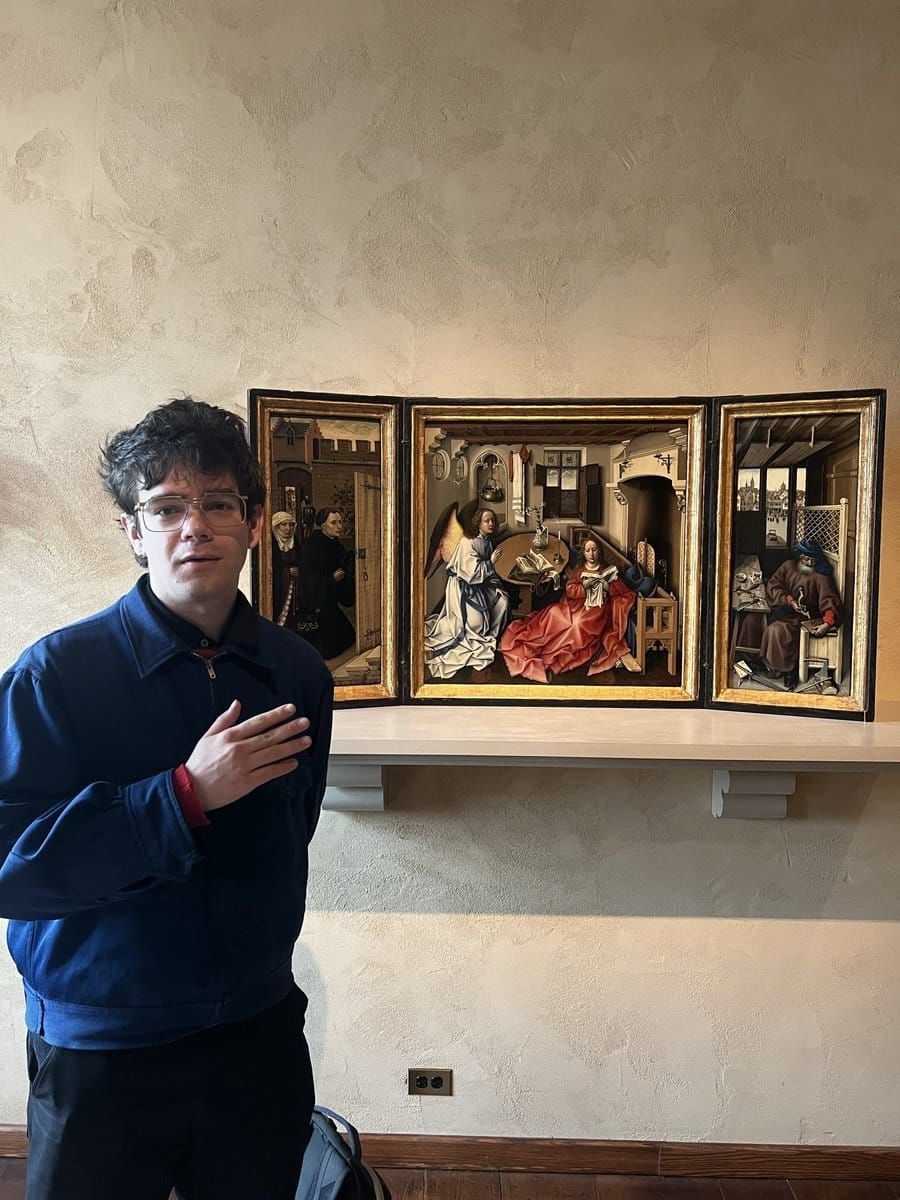
OK, so: I jumped at the chance to spend some time with ex-black midi member Cameron Picton ahead of his fantastic just-released debut record as My New Band Believe, and in true "ex-black midi" fashion we took the opportunity to do some NYC tourism bits by heading to the Cloisters up in Inwood and taking in some art. After making a beeline for Robert Campin's triptych Mérode Alterpiece (photo above), we settled down in the café area and cracked open a few Coke Zeroes while getting into his career thus far and a host of other subjects around My New Band Believe. I had a great time chatting and hanging with Cameron and I hope you have a great time reading it as well. Check it out:
Before the record was even announced, I saw the footage of the Windmill shows. How was it playing this material so early?
Good. We did three at the Windmill and four at the Horse Hospital, which is not a new venue, but previously it was more of an art gallery and they didn't really have a proper PA . Now they've made much more consideration for it as a music venue, and Alex from caroline is one of the programmers there. There's various venues in Bermondsey that are in these industrial estate areas: Venue MOT, ORMSIDE Projects, Avalon Cafe. We've done some other random little things, including playing a Christmas party at the Rivoli Ballroom. They mostly do mostly Northern Soul nights—no bands ever play there, because it's expensive as fuck to hire. We were the beneficiaries of getting booked by this literary night. We never would've been able to play there otherwise. The shows have been fun. I had various ideas for things I wanted to try out, and when you're not touring, it means that you can devote a bit more time pulling off an idea like having a different band for every song.
I was talking to Asha from Sorry a few months ago, and she was saying that she feels the number of venues in London, in terms of places like the Windmill, are kind of dwindling. What's your POV on that?
There definitely are lots of little spaces, but on an all-ages front, there's definitely fewer things. A lot of venues used to be in railway arches, and one big company bought up every single railway arch in the whole of London and hyped the rent. Some venues have survived and managed to turn into co-ops, but a good few venues lost to that. But I do think the same level of determination is there to do it. People obviously find a way to play.
But you spend five years at one venue that you have a close connection to, and then it stops, and there's definitely a commitment to try and find a new place, and you might not know the people that are running it anymore or anything like that. Also, these things come in cycles. It's obviously a bit pessimistic, but as long as the desire to play live music is there, people will find a way.
What was your showgoing habits when you were younger?
I obviously went to concerts when I was a younger teenager, but in terms of going to more local shows, when I was 16 or 17, I had a few other friends that were in bands. I struggled with going to venues that were 18-plus, but often the way to get around that was by going in with your mates that were playing, that were also underage. If you were underage, you could play, but you couldn't get in with a ticket. So that ended up being what I'd do. I didn't get a fake ID or anything—I'd just go to mates' gigs.
Were there any shows you went to when you were younger that particularly stood out in terms of flashpoint moments for you?
I remember seeing this band HMLTD that felt exciting at the time, because it was very different than a lot of music. They were really different from a lot of the bands that were playing at London at the time.
What did they sound like? I never heard them.
I don't know. They had a song with a Death Grips sample.
Oh, OK.
A lot of bands around the time sounded like Fat White Family, Country Teasers, or the Fall. That was the thing that, by and large, you would see. This was a lot more electronic, a lot more pop, and a lot crazier.
I hear a lot of what you and your peers have been doing as almost a rejection of that past era you just referenced. After COVID especially, the music coming out of your neck of the woods just felt a lot more indefinable in a very appealing way to somebody like me.
When we started out, we were just doing what we were interested in. It wasn't necessarily a rejection of anything. But similar to venues coming and going, there should be a cycle probably around now of young bands that are saying, "black midi? We should do our own thing." And I think that's good. Obviously, I'm happy with the work that I've done, but I think it's healthy that people put forward new approaches or reject the bands that were around for someone that was 11 when the first black midi album came out. They're going to be, like, 18 now or something. So they're going to be starting bands, and maybe they should be like, "Fuck that kind of thing. We should do our own thing."
It's necessary for the ecosystem, right?
Yeah, I think it's important. I don't want to just be like, "Yeah, post-punk!" Fucking shit. Don't need that.
You mentioned Death Grips earlier, I'm always curious to talk to younger people about the impact of Death Grips. For the generation right below me, they seem to have this presence that's not unlike how Radiohead was for my generation, where they reshuffled how people thought about music a little bit.
Yeah, I guess Kid A probably introduced a lot of people to Aphex Twin and electro-acoustic music, as well as music that's more experimental than Radiohead. It was and probably similar for Death Grips. That was an entry point for me. When I first heard it, I was like, "This is the craziest music I've ever heard in my life." Then you try to seek out more, and you see why the mix of everything in their music is exciting. They're a gateway in that way.
Let's talk about the band name My New Band Believe. It came to you in a bit of a dream, right?
Well, I was sick, so it wasn't a normal dream to have. I had food poisoning and I was in a state of delirium—kind of like an episode. I wrote it down, and when it came time to release "Lecture 25," I was struggling for names for bands, and I looked through my phone and said, "Oh, that kind of works." I'm not really sure 100% what I want this to be and how the project operates, so the name gives me this sense of openness and malleability. It doesn't suggest too much, but it also kind of does at the same time.
I read about how you're going a bit for the King Crimson approach when it comes to bandmates as well.
Yeah, because I wasn't really interested in doing a solo album when black midi was breaking up. Obviously, this is a solo album in a way, but I always thought I'd eventually come back to doing a band in the same way that black midi operated, where it was equal partnership. If I went under my name, then it's harder to be like, "I actually want this to be a band now." Whereas, if you have a band, you can do some kind of brand, for want of a better word. It's a lot more flexible within that, and you can say, "This is what I want this to be right now," and you can change it over time to whatever you think is best for the project.
After the split, you spent a decent amount of time just figuring out where you wanted to go next. At one point, you were seeing yourself as a bit of a sideman for other bands.
Yeah, although I would've been down to do that, I never actually made any steps to join another band. But what I was interested in doing, and what ended up being the start of doing this album, was that I wanted to do a collaborative album with caroline. Over the time that black midi was breaking up, I was speaking to them about doing a song or an album where I bring in half-finished songs and sing them, and everything else would be done with the nine of us. The idea, initially, was to do it in one hour and then go to a completely different group and do an album.
Talk to me more about what makes caroline such an intriguing band to collaborate with.
One of the reasons that it appealed to me is because there was no real frontman. There's a very collective nature to the group, and they're super self-sufficient in a way that a lot of band aren't. Having been around them, listening to the way that they discuss merch and how serious they are about it, they want to be totally precise. In black midi, we were very laissez-faire. We'd do something stupid—like, if we're doing an interview with Anthony Fantano, let's put a picture of Harry Hill on the thing. They'd never do something goofy like that.
The appeal of working with them was, when I'd been on tour with [black midi], I'd come back and hang out with musicians and do random little things. They did a six-hour improvisation at the Southbank Centre, and me and Geordie joined them for one of the hours. You meet a lot of musicians where you think, "It'll be cool to play with them," and the next thing you know you're going back on tour. So it felt like an excuse to hang out with people that I liked that I hadn't really had a chance to properly make friends with.
You said something interesting in the early part of that answer there about how there's no central figure in caroline. What I get from this record, as well as from just talking to you, is a desire to de-emphasize the ego of the music itself.
Well, that's the thing of trying to keep things open. It would be cool, at some point, to do a record with this project where I'm not singing or writing the songs, and I'm just playing guitar. I like the feeling of having some overview of the project, but not necessarily letting certain things go. The idea is a little bit, sometimes for the live shows, where a total non-musician can come in and make a useful or interesting contribution to the group, and your part is reacting to it, or trying to make this thing that someone else is doing sound as good as possible rather than being like, "This is what I want to sound, you have to play it like this, and I've got to like dictate the technique."
You're 26 now. 25 is one of those ages where it feels like you've hit something of an epiphany, maybe. Was it like that for you?
Well, the band broke up when I just turned 24, and that felt like a marked point of the end of my adolescence, because the band started and grew out of my later teenage years. We never went to university, so we never really had that thing of, "Okay, go out into the world." Most people I know my age kind of did. After that, it was very exciting.
That sensation kind of being thrust into real life, so to speak, with regards to to the span of black midi—do you feel like there was anything you feel like you missed in terms a more normal post-adolescent experience?
Not really, because there's so much that we got to do that you wouldn't get to do otherwise.
This record has a very specific sound to it, partially because of some parameters you set early on—especially the desire to be as acoustic as possible. I think your average layperson would hear the word "acoustic" and immediately think "quiet," but that's obviously not what this record is.
The fake rules that I set were just ways of trying new things. The idea that no one that played on a black midi record playing on this was interesting, because it meant that if I wanted a saxophone solo, I could call up [Kaidi Akinnibi] because I knew he would do a great job, and he played with black midi for ages. But it's slightly more exciting, and a bit more of a stab in the dark, to be like, "Well, do you know any other players?" I know lots of other players that I haven't had a chance to work with, and it's a good opportunity to do that.
With being acoustic an electric guitar has so much sustain and can fill a space up really easily. If you want to foreground the acoustic guitar, once you put electric guitar in, a lot of the time the acoustic guitar can just feel like a layer, even if that's supposed to be the thing on top, because the electric just eats up all the tones, and then you just get the percussiveness.
There's a lot of people on this record, and for anyone who's been paying attention to anything going on in the UK over the last five or six years, there's been a lot of big groups coming from your neck of the woods that reminds me of the 2000s.
What I said earlier about young bands—there should be more bands in London that are playing with two, three, or four people. It's since become the default thing that you have a lot of people in your band, and it's sometimes hard to see a reason why. This thing has had five people on stage, but even the show that we did the other day was mostly two, three, four people. So many of these bands have 10-hour soundchecks in order to play music, and I hate soundchecking so much. The idea of being able to go, "That sounds good," go and do anything else, and then play music on the stage later when you're actually performing, is more interesting to me. But that's just a practical thing.
In the "Numerology" statement, you said that the newer stuff you've been working on is more straightforward and pared-down. It sounds like you're contracting a little bit after this record.
Yeah, and slightly because I want to make the music more accessible, so that someone could come in that's not a super-technically proficient musician—or maybe not a musician at all—can come in and I can be like, "It's this note, this note, and then do whatever you want." That seems more exciting to me. Also, even if you're getting really good musicians in, with some of the songs there's a lot to remember structurally—little beats added here and there, you have to remember how certain sections slow down. It's the kind of thing where, yeah, maybe you could do a day of rehearsal, but there's not really a day of rehearsal in most cases. It's often just a couple of hours. I also don't like rehearsing for more than two hours at a time. So you do as much as you can in two hours, which usually means one complicated song and then you play through all of the more simple songs, and then you do it in the show.
What are you looking for in terms of collaborators? Are there turn-offs?
This benefits from people being really open and confident enough to just play what they think sounds good on it, and not being necessarily too referential to the album or other performances. It's way more exciting when you're playing and someone starts doing something totally different to how you've heard it before, and then you can lean into it.
How long does it take after working with someone new to figure out whether or not it's clicking?
It's a collective thing of, if you're listening well enough, then it should just work. It's not really about making an executive decision of, "This person's good, this person's not good."
Let's go back to what you admire about King Crimson. They did have a specific ethos when it came to making music.
Yeah, obviously Fripp is the boss, but there's a great deal of trusting other musicians because they're good. What I would like with the band, eventually, is to make it economically equitable amongst the musicians that are playing as much as possible.
This is the tail end of your press run, right?
This is the last interview.
How do you feel about doing press at this point?
It's okay. I hadn't done any interviews for probably three and a half years. When I did the first one for this, it was definitely a bit like rusty early on. But there's a lot to think about with the record and everything around it. Also, the fucking "Numerology" thing means you can talk a lot around the music as well, which helps.
The "Numerology" statement was an amazing way to bring people into this entire thing that you've done. It's really rare I have to read press materials multiple times.
Well, I was asked to do a spoken introduction for an internal label thing, and I started writing out something, and it was shit. It was bad, and it was really long. I was like, "Okay, well, let's just try and get every beat,"and the numbers thing was a good way of linking it. You can also get into quite a rhythm with it. I wrote that as a speech, and I thought it was an interesting way of not being too sentimental about it. The record is also linking the wider London music scene, in a way, and numbers is an easy way to make up bullshit numbers about anything and connect it somehow into another thing.
"Numerology," in general, I wanted to call that song "One Night," but I also wanted to have the last track on the album be "One Night," and the label didn't let me, because it would be impossible to account royalties for two different songs with the same name. But "Numerology" was a perfect other name.
Going back to rule-setting, as you mentioned some of the rules you set for the album you also very intentionally broke.
Yeah, and I think the rules that were broken were broken for good reasons. [Pianist Finn Carter], he played on one black midi song, and you can barely hear what he's doing. He's a good friend, and I was wanting to play with him more, so that was done for good reason. Using a MIDI guitar, there was obviously a point of doing that in the song, so it's justifiable. The rest of the album is very acoustic, obviously—but that moment felt like wanted it to be pointedly not acoustic.
The statement also said you went to the cinema a lot while making this record.
Yeah, mostly because I spent a lot of time waiting for studios to be available. Also, caroline were finishing caroline 2, and there were periods where they'd need to be mixing it for two weeks. I was also interested in taking a very leisurely pace. The album took two years technically, but the first six months of sessions were just one session a month and then doing anything else in that time.
Do you feel like that approach helps with your creative spirit?
Not really. It was just what I wanted to make happen after quite an intense period of touring with black midi. It was like, "Okay, well, I can have this as being ostensibly the thing that I'm working on, but I don't have to work on it that hard. The point at which I start doing it properly is up to me, and then I can explore and see what happens."
You a big movies guy in general?
Well, there's a few good cinemas in London, they're pretty good at programming, especially at the BFI and Prince Charles. I have a terrible lack of focus on anything, so it helps going to the cinema to watch films that I'd definitely pause a billion times at home.
What are some movies you've watched recently that you enjoyed? Recently, I haven't been to the cinema as much as I would like to have been. I saw 3 Women, which was really good. I go through cycles of going to the cinema multiple times a day, but at the moment I'm at a low cycle because I don't really have many chances at the moment.
I'd definitely like to hear you talk a little bit about the aftershocks of the black midi breakup. When time passes, the way these things seem to the people in them, sometimes that can change.
Well, it's a very complicated thing, so it might help if you had a specific thing that you wanted to talk about, because there's so much that went into it.
Well, how do you feel about it at this point?
At the time that we decided to stop, I was very relieved. My initial frustration was that I wished this had ended earlier, pretty much. I'm not frustrated about it, because lots of cool things happened in the time between the band breaking up and finishing touring. I got to go to China, Mongolia, Brazil, all this crazy stuff that we hadn't actually previously done. But it probably should have ended about six months earlier. But that's fine.
When I talked to Geordie about it, he mentioned that he's felt external pressure to bring the band back together in some way. I'm curious if you've kind of encountered any of that pressure as well.
There was one moment when someone came up to me and was like, "Oh, Cameron, I've been thinking about you a lot, and I just want to say that black midi's going to get back together and it's going to be okay." And I was like, "That's the last thing I want. That sounds horrible. Don't do that."
I was quite keen, after leaving the band, to not do something that was necessarily marketable. I was doing these solo shows with a different name every time, because I was trying something out and only doing it for the moment. I wanted to have something that I've worked on and used the time without touring extensively, and then come back to doing album campaigns and touring with something that I was much happier to push.
Do you feel like you guys are still on good terms in general?
Um, well, "still" is probably not the right word. But, I mean, we live in different parts of London, we don't really see each other. So not too much contact at this point—but we weren't really trying to hang out even when the band was still together. You gotta take a break from each other. Even if you're really good friends with someone, you've literally spent a whole month with them. There's all these people at home that you're friends with that you wanna see, and when you're going to Spain, France, or Mongolia next week, you're going to see these guys again. We spent six years in each other's company. It's only natural that you end up wanting to hang out with different people.