Mandy, Indiana on Haunted Houses, Getting Older, and the Physicality of Touring
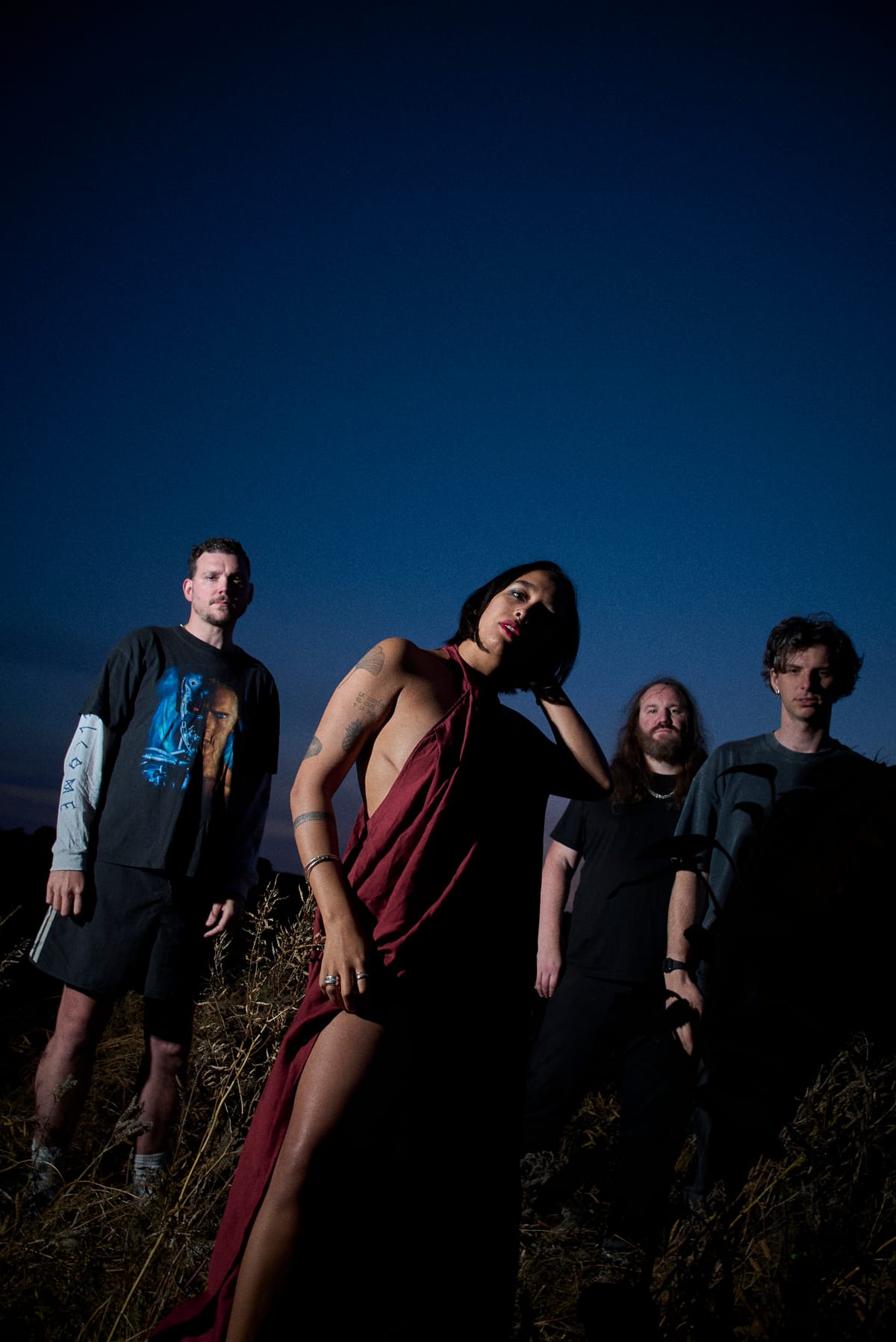
This is a free post from Larry Fitzmaurice's Last Donut of the Night newsletter. Paid subscribers get one or two email-only Baker's Dozens every week featuring music I've been listening to and some critical observations around it. Subscriptions currently run $3/month or $30/year, hit one of those little pink buttons on the right side of your screen to tap in, you won't regret it.
Today's installment: Mandy, Indiana's second record Urgh is a fucking blast, if you loved their striking debut I've Seen a Way from 2023 get ready to have your head blown smoove off by what they're doing on this new one. The record is chunky, colorful, surprising, and pretty much exactly where you'd want these guys to go. I hopped on a call with sticksman Alex Macdougall and synth guy Simon Catling to talk about the leveling-up that took place here, as well as a host of other topics. We had a good time, check it out:
Walk me through what you guys do on the side when it comes to making a living.
Alex: The main thing that gets me money is that I'm a fund-raiser for charities. I'm also a furniture maker—I make bespoke wooden furniture. The fundraising stuff keeps me afloat to do the creative stuff. I'd like to do more of it, but it's difficult, being an artist.
Simon: Most of my stuff is music-related. I program at a venue in Salford, the White Hotel. I also promote around Manchester, and I do a bit of teaching at a university.
What's the tension like in terms of balancing the band and the normal job stuff?
Alex: It's hard, we're not gonna lie—especially at the moment, in the run-up to an album coming out. There's an eye-watering amount of decisions to make, and we want to be involved with those decisions about how stuff is put out there. But, on a day-to-day basis, when you're working your job and getting pulled out of that every 10 minutes to check something else, it makes you pretty scattered.
Simon: It's always a bit of a flip-flop. We're lucky to be working with a great label like Sacred Bones. I've been a fan of them for a long time as a label. I know others have as well. Some of the stuff we've got to do over the last couple of years have been stuff we couldn't have dreamed of—going across to America, doing Primavera, all these sorts of things. So on the one hand, you're like, "Oh, it's amazing that we're getting to do this."
On the other hand, you're like, "Oh God, this is really adding a load of stress onto the work and home life." Then you go into the cycle and start feeling bad about that because you're like, "I'm complaining, but I'm doing this thing that's creating all these really cool experiences." It sometimes feels a bit self-indulgent, the whinge of it.
Talk to me about the new record coming together.
Alex: A big part of how it ended up was us playing gigs together as a band. I mean, we've always played a lot of gigs, but the viscerality of the new record is through playing some of these tracks in our live shows up to two years ago.
Simon: We didn't go, "Okay, album two, let's get a whiteboard out and write down exactly what it's gonna be." But in the initial conversations, we sort of said glibly, "Oh, an album of bangers." In our heads, there was the idea to go a little bit more direct. The first album was maybe a classic first album, in the sense that we had a few really good songs and we were adding to it to make an album. With this record, the actual initial selection of demos and ideas we had was quite concrete fairly early on. I can't think of too many things that we dropped. There was definitely a bit of back-and-forth, and some things have changed, but the core of the record got sketched out quite quickly. That desire to be a little bit more direct—to push the heavier side of our sound a bit further—comes with playing live a lot more and feeling the power and energy of these songs live.
Talk to me a little bit about the house that you guys made the record in. The bio gestured towards it having a very specific atmosphere, so to speak.
Alex: We did a fairly long session at The Calm Farm, which is a residential studio on a farm in the middle of nowhere. Scott had watched this pretty creepy film, and the first thing he told us when we got there was about this haunting presence in a building not so dissimilar from the one that we found ourselves in. I don't know whether it fed into a self-fulfilling prophecy, but [vocalist Valentine Caufield] especially was aware of something in the house, and it made the whole thing quite spooky.
I don't know about you, Simon, but it was really good getting together in a remote place, cut off from the world. The phone signal wasn't too great, and we just had to be together making music. It's not something that we've done a whole lot before, writing all together in a room—because the first record was much more coming from Scott and Val's ideas and building around those.
Simon: Yeah, it's really rare that we get the chance to actually be together. A lot of the way we write is usually stuff coming from one person or another. [Guitarist/producer Scott Fair] is usually the chief driver in terms of the music, and obviously Val's got her lyrics and vocal delivery. It's usually things being sent back and forth, so actually having the time for a couple of days to focus and not worry about jobs and trying to squeeze things in here and there...we actually like got a lot more done.
Alex: Yeah, it makes me think of bands that do it as their sole thing. Watching that Beatles documentary—I mean, that's an extreme example, but when they're just living and playing their instruments constantly around, it'll probably get on your nerves after a while. But, mulling and stewing in what it is that you're interested in—it was really good for doing that.
Get Back was definitely a document about interpersonal relationships in a band and how to navigate them. In some ways, being in a band is like being in a marriage. How does that work for you guys?
Alex: You're definitely right. It's like a marriage, but between four or five people and our manager as well. It's really challenging sometimes. Last year was really challenging, because we didn't actually see each other in person all that much. We only played five shows last year, which is nothing. Because Val lives overseas, that's our main time when we see her, so we're really keen to do more gigs and spend more time in person. But it's a very special relationship, being in a band with other people. You know each other more intimately—maybe because you're doing something creative with them. It's closer than other friendships that you have, because you're going through this process. It's a very special thing, but sometimes it's pretty difficult to navigate.
Alex, you underwent surgery while you guys were making this record. Talk to me a little bit about kind of the specifics of that experience. Alex: First of all, I got a hernia from woodworking. I was lifting a heavy piece of machinery, and it just popped out—so I had surgery for that. Then, they found a lump on my thyroid gland, so there were some biopsies of that, and it was inconclusive as to whether it was cancer, so they had to surgically remove half of my thyroid. Luckily, it was benign—but that surgery was in January 2025, and I underestimated how long that would affect me and my energy, because the drumming on this album is really intense. So I was in the studio, overlooking the fact that it might be still affecting me, and I was like, "What is wrong with me? I'm really having to push and struggle through the experience." Looking back, I probably should've put it on hold, but I didn't really consider that it was still having its effect. But I'm glad that's all in the past now, and I'm feeling loads better.
To that point, when I hear music like this, it sounds so physical to the point where I wonder what it takes to maintain that physicality. Being a musician kind of sounds like you're working out constantly.
Alex: Being on tour is such a crazy mix of extreme exercise and extreme hedonism. Not that we're a "crazy band" in that way, but you're drinking and going out after the show, and the shows are 45 minutes of pure energy. It's really extreme. I'm actually trying to prepare physically for these shows that are coming up, because I think it'll make everything a lot easier.
Simon: It's so funny, because it's like, "Right, so you need to be intensely active every day, and all the things that you need to help your body recover during that, you don't get." You don't get any sleep, you're usually eating rubbish food, you're gonna have to sit in a cramped van for a few hours in between each bit, you get to sleep on the floor—and then you basically have to do a 45-minute workout each day.
In the past, we've thrown ourselves a little into the later night part—the "having a few drinks" side of touring. But I do think, because we've gotten a bit more experienced with it, we're hitting the slightly non-rock-and-roll age of trying to take a bit more care of ourselves. The fun thing about playing our music live is—Alex is an amazing drummer, Scott's a brilliant producer, and Val's a really captivating front person, but we're not technical virtuosos. I don't think our focus and desire is to play our records live perfectly. It's music that's loose and wavy enough that we could really throw all of ourselves into a live performance without worrying too much if there's a slight bum note here and there. Getting across the urgency and passion outstrips that, which is great because you go all in bodily and physically.
Alex: I am curious to see what an hour-long set of our stuff would be like. We might have to slip some more interludes, or a 10-minute drone drop.
In general, we're all around the same age, which is a time where you start feeling like the act of going out itself can be a bit exhausting.
Simon: In 2022, we did MOMO in Rotterdam and Roadburn in Tilburg. We were on stage at midnight in Rotterdam, and I really wanted to stay up to see MC Yallah, but she was on at 4:30 in the morning. I was like, "I don't care, I'm gonna stay up and go watch Yallah." I rolled into bed at 7 a.m., and we had to get up at 11 a.m. The next day, I was just like, "Oh my God, I'm not built for this anymore." The whole day at Roadburn, I felt absolutely atrocious and was basically in a fetal position for the entire journey down. It was a real body check. That's not who I can be on tour these days.
Let's talk more about making the move to Sacred Bones, which obviously has this reputation at this point for left-of-center sounds that, where, even if you're not necessarily keeping up with every single thing that comes out, you can go to them and find something that's really interesting. You guys make a good fit on there!
Simon: They've been a label I've been a fan of for a long time, so when they expressed interest, it was really exciting for me, As a promoter and programmer, I've put on a lot of their artists over the years. Back when I was writing about music, I was a big fan of the Soft Moon records and the earlier records by the Men. Jenny Hval was on there for a bit. They're one of those really great labels where there's quite a different array of stuff they put out, but there's some intangible line that rolls through it all. It was a great chance to be a part of a label with an array of artists and albums that I've admired and enjoyed.
Alex: Looking at their roster throughout the years, when we were considering signing with them, made me realize how many of their artists throughout the years I've listened to and loved. I've never paid as much attention to what label a band is on, but when I went through their catalogue, I was like, "Whoa." There's an intangible mood that underlines their roster. Obviously, they have ties to David Lynch, and anywhere near where David Lynch was operating is a really good home for us.
You guys have billy woods pop up on this record, and he makes a lot of sense on your music. Tell me about how that came about.
Alex: We've been fans of his music—Scott, especially, has been a huge fan of his for a long time. We were playing a few of the same festivals, and we were thinking that it would be cool to do a collaboration on this record. It just so happened that Val started chatting to him at C2C in Italy, and he seemed keen. When we sent over some of our music, he was like, "Yeah, let's do this." So it happened quite organically, and what he did with the track is such fire. It was one of things where he sent over and it was like, "No notes."