Lex Walton on Hipster Runoff, the Strokes, Castration Movie, and the Scourge of Millennial Nihilism
This is a free post from Larry Fitzmaurice's Last Donut of the Night newsletter. Paid subscribers get one or two email-only Baker's Dozens every week featuring music I've been listening to and some critical observations around it, along with a Screen Memories column every one or two weeks where I write about stuff I watched lately.
And there's literally two days left for the "birthday layoff" sale I'm running (because it was recently my birthday, and I was recently laid off). This month-long sale is something I won't be doing again for a while, both in length and in discount, so you gotta take advantage of it while it lasts! We're talking 39% off the first six months of a monthly subscription, or the same discount off of a year of the annual subscription. You can grab the monthly sale ($1.83/month) here, and the annual sale ($18.30) here. You won't regret it, and you'll be keeping this 100% independent publication alive and well, too.
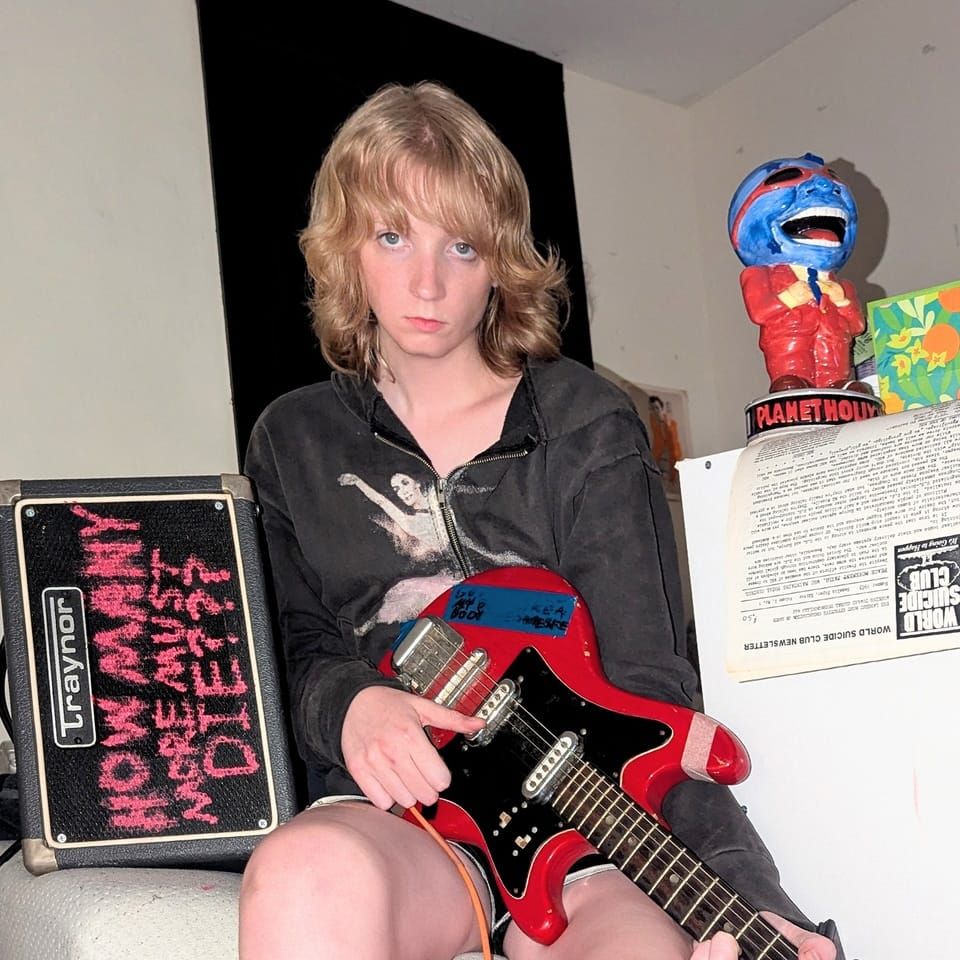
OK, let's get into this: Huge fan of Lex Walton, who is a very solid example of the type of artist I'm always drawn to—someone who thinks different and is aiming to express herself in a way that feels bracing, vital, and unique. Near the top of the year, none other than friend of the newsletter Dan Boeckner shot me a few texts about how he'd been working with Lex on what became her Sub Pop debut, the literally-just-released ULTIMATE LOVE FOREVER, and I was almost immediately intrigued by what I was hearing from their team-up. I got Lex on the phone a few months ago to talk about all things her artistic perspective and process, as well as her star-making turn in Louise Weard's Castration Movie; at the end of our 90-minute convo, I told her she's someone I could honestly talk to for hours, and by extension this is absolutely one of my favorite interviews I've run this year. I've been sitting on this one for a while now and I'm happy to share it with all of you, check it out:
Let's go through your origin story as an artist.
I grew up in the East Bay in California, in a drab, artless, and flat strip-mall suburb. I didn't start making music until I was 17. I'd gotten really into Suicide and Alan Vega, and I was like, "I don't really know what I'm going to do in my life, so I guess I'll just try to do that." I made a bunch of really bad Suicide ripoffs, and that was my entryway into all of this. Then I moved to Boston for school, started writing more, and I've been toiling in the mud ever since.
Tell me about what drew you to Suicide. The appeal is obvious, but when I was growing up, their music was one of those things where you were handed it and told, "Hey, get to know what this is." Their influence faded a bit across a decent amount of the 2010s, but the energy they channeled has been coming back in plenty of music I've heard in the back half of this decade.
The first time I listened to Suicide, I read this thing online that was almost like a scary story. "If you haven't before, you need to go to your room, put headphones on in the dark, and listen to 'Frankie Teardrop'." And it scared the shit out of me, as it does for everybody the first time they hear it. It really fucking shocked me. But then I listened to the rest of that record, and I realized what they were doing.
The music I was really into in high school was stuff like the Velvet Underground, Les Rallizes Dénudés, and Ariel Pink. This was very in line with all that stuff. I recognized this throughline, where you're taking these very elemental forms of commercial pop music and abstracting them in different ways to invoke different things. Not all of the Suicide record is scary, but it represents this oppressive atmosphere, and the different emotions that happen within that—all through what are effectively early rock'n'roll forms, but with different textures.
Talk to me about getting through adolescence and how music helped bridge that gap, so to speak.
My sister's seven years older than me, and was into a lot of music that I found scary or didn't like because she liked it. It was an oppositional thing, and I didn't consciously set out to listen to music until I was 13 or 14. But growing up, my parents had Sirius XM and would listen to the 1st Wave station with Richard Blade, so I heard all this new wave, post-punk, and New Romantic stuff through osmosis. But I wasn't actively listening to anything other than the Beatles' 1 and Queen's Greatest Hits. Because of that, when I first started consciously listening to music, I skipped a lot of the phases that a lot of people have. I never had the Weezer phase, the Ramones phase, the My Chemical Romance phase—the music that early middle-schoolers and high-schoolers listen to. I skipped all that and went straight Death Grips, the Velvet Underground, and Les Rallizes Dénudés. I was really into Yeezus—which, everybody is, right? That was a huge record for me.
The thing with the Velvets and Suicide is they both represented this thing that wasn't available to me, being in this suburban malaise. I was barely alive, barely conscious, not a real person—and this represented some greater world where it felt more real. There's all these people that are talked about in these songs that were unlike anybody I'd ever met before. It was the total antithesis to everything was around me, and that was an escape. Also, being a transgender woman, one of the first times I heard about trans people where it wasn't a joke in a movie was probably either "Lola" or "Candy Says." These were incredibly vital windows to a world that was outside of me.
Did you ever have a Jandek phase?
No, because I have this thing with both him and Tom Waits where I find it to be too much pretense. I can feel you putting on a character, and that gets just kind of grating for me. But I do like Ready for the House a lot. That was also part of the reason why I never got into Swans—because, theoretically, I should have. It was reinforced completely by seeing Swans play a year or two ago, where I'm just looking at this guy and I'm thinking, "Wow, if you actually believed anything that you've ever sang, you would've killed yourself by now." The illusion's completely lost. Like, "Damn, dude, like you are old as shit and you have two kids. You do not believe a single fucking thing that you're saying." It turns the whole musical project into a haunted house.
You mentioned Death Grips and Swans, and those are two bands where I talk to people my age and explain to them that younger people have really embraced them. For lack of a better way of putting it, Death Grips have become what Radiohead was for people my age.
Yeah, for so many people my age, they are the most important band of the 2010s. They are the band, and I'd take so many of those records as being the best rock records of the 2010s. They're so vital, and they shaped so many of my sensibilities.
I'm interested to hear you talk more about the notion of trans representation in music. There is definitely that experience of hearing something like "Candy Says" and realizing, "There's definitely a bigger world of thinking out there." Talk to me about witnessing the evolution of those conversations, as well as the meta aspect of those conversations, and if they've affected your direction as an artist.
I've gone back and forth on this, but for the last couple of years, the main through line I've kept is that I find so much music—and especially art in general—about being trans, made by trans people, to be so incredibly boring. It's just saying the same thing over and over again. But there's something I realized about songwriting that changed everything for me. So many of the singers that resonated the most with me—I didn't necessarily have anything in common with them, but the very specific way that they expressed their situations, combined with the form of pop music, became universalized, and I was able to project myself into it.
Very little of my music is about being transgender, but being transgender is a necessary precondition for the music to exist. It's an underlying thing as much as my upbringing, class, race—a fact of my being. There's a really great scene in Cate Wurtz's Crow Cillers where they're talking about trans people having to cohabitate with each other. One of them says, "What if everybody that wore glasses had to be grouped together?" But of course, we do have more things in common than that, right? Overarching systems that are against us? I've been trying to move towards speaking more directly to a trans audience, while also universalizing that anybody can find redemption from my music. If I'm just relaying good and bad things about being trans, that doesn't really do anything for anybody.
Something I've witnessed—a difficulty that a lot of trans artists face when having made anything that carries even the most remote air of transgressiveness—is this reaction where people are like, "Well, is this the right way to be representing things? Is this what we really want being put out there?"
It's something I contend with very often, and I've been trying to strike a balance. People will talk about this record as being about being trans—and it's like, "No." It is in the way that it's about me being white and middle-class—that's a necessary precondition of all this. It's about other things, but the way that I'm expressing it seems to resonate very much with an audience that's also trans But now I do feel like there's much more of a political responsibility to be more flagrant and overt with these things, too.
You mentioned Ariel Pink, who I'm always interested in talking to people about. Obviously, he's one of the ultimate "separating the art from the artist" cases for varying reasons, but the influence of what Ariel has done is pretty heavy across music. You really can't deny a lot of the early records, even though the conversation turned so much towards the 2010s releases when he got a big push.
And that stuff is just not as good. There's probably a six-year span of him making records—not when they necessarily came out, but when he was making them from '99 to, let's say 2005—where, in my eyes, he's effectively the closest thing that we've had to, like, fucking Mozart. He was just so constantly churning out work of so much quality, inventiveness, and power—and then he just burned out and lost it. I think that happens to people. It's a shame that it was all so public.
I also said this to Geordie Greep when I interviewed him a couple years ago, but the story of Ariel is kind of the same story as Mark Kozelek. You have two artists who, everything else aside, were very content having a niché but adoring audience, and as soon as they both got more attention, it was like, "Okay, how do I get people to stop looking at me as quickly as possible?"
All Ariel ever wanted was to be R. Stevie Moore, and then it ended up that Madonna knew who he is. That's got to break your fucking brain completely.
Talk to me about getting into the swing of putting out records yourself and establishing yourself as an artist.
Obviously, this can never be fully true, but I don't think there necessarily is much separation between how I perceive myself and the self that's publicly presented in the records. I put out records by myself because that was the thing that I could do. Recording, mixing, mastering everything on my own—it's all borne out of necessity. If I want people to hear this, I'm going to have to put it out myself. So it becomes another part of myself that I'm outstretching, and as the years go by, the records get more overtly personal and diaristic. When something happens in my life, I write music about it, record it, and release it. It's like breathing. It's my automatic mechanism.
Do you feel like there's a line in terms of what you're willing to put out there about yourself, or are you more of a "leave it all on the mat" writer?
It's historically been a more of a "leave it all on the mat" thing. There's something I did a lot a couple years ago when I was going through a specifically bad period where, when I was singing about someone and I needed to say their name, I couldn't make up a fake name, because I wouldn't believe what I was saying. So I'd sing the actual name and bleep it. When I'm recording and writing, I have to be true to what the original feeling is, and I have to follow that as far as I can. There was a period of two or three years where so much of my work became about myself and the people around me, and I started implicating a lot of people I know in the songs. People don't really like when their privacy is breached in that way, and it's very obvious to everybody, what and who is being talked about.
More recently, I've realized that there's this political duty that we have as artists right now, taking that same specificity and turning it outwards. When I made Shame Music 2, I took it from implicating other people to implicating myself. I was using songs as weapons before. I'd write a song to make somebody specific feel bad, which is cruel and evil, but also extremely exhilarating and addictive. I had to train myself to stop doing that. So I turned it on myself, and then that became extremely addictive. Now, I need to take these tools that I've built for myself and turn them on more righteous causes. It's the main undercurrent of the work that I've been doing more recently. There needs to be this spitting, righteous vengeance—because what good is it going to do if I'm just shitting on somebody as poor and gay as I am? that doesn't help anybody.
That's a very mature perspective to take on, and it takes a lot of artists—a lot of human beings, honestly—forever to get there, if they ever get there at all.
I'm not saying I've fully gotten there. The urge is still there, believe me. But it feels much more productive to take the energy, hatred, and specificity that would be reserved for a song about an ex and instead route that towards a writer for The Atlantic, or Gavin McInnes. "Hipster Runoff" is largely about dear old Gavin.
Yeah, let's talk about putting the EP together. You worked with Dan Boeckner on it, which he'd previously mentioned to me before we even started talking to each other.
Before "M80" was released, I was sending the press kit to a lot of people, and it ended up in Dan's lap through Will Menaker. He got in touch with me and was blown away by it, and he was like, "Okay, we need to get you a record made. It's insane that you've just been doing this all by yourself for this long, given how much output you have."
As I started putting together the EP and conceptualizing what the themes were going to be, I was re-listening to a lot of Wolf Parade now that Dan was in the picture, and I also reread the N+1 classic, What Was the Hipster? as well as a lot of the Hipster Runoff archives. In New York right now, they've become a little quieter, but they're still there—this downtown scene of right-wing thought leaders who, when you poke them a little bit, you realize they're all failed hipsters. Curtis Yarvin is a failed hipster. The most perfect encapsulation of this is Gavin McInnes, right? You move from Montreal to New York, you start Vice, and then you quit it and you start the fucking Proud Boys. The right-wing, in our country, is being operated by effete failed hipsters. That got me thinking more about the decline of millennial optimism. You have the failure of the battle for Seattle, Occupy, and Obama—all these things adding up to this extreme nihilism in millennials. All these millennials on the left become totally disillusioned and irony-poisoned, and then a lot of them turn right.
I was thinking about all this stuff, and I was like, "Well, this seems like a very good thing to make a record about right now, because I'm angry at these people. How do I express this musically?" I ended up writing a lot of these songs as sort of formal, not quite parodies, but channelings of aughts blog rock—stuff like Arcade Fire, stomp-clap-hey optimism—and how that's all decayed into a parody of itself. All These people are apolitical-slash-right-wing sociopaths. What happened? I tried to use this musical language to more directly talk about these things—the most clear example, of course, being "Hipster Runoff," which I tried to make sound like a Wolf Parade song, and I think I succeeded with that. There's also this really interesting meta-text, because Dan is producing this, and he got Sarah Neufeld from Arcade Fire to do period-accurate violins on it. You have like all these people that are very closely aligned with this thing that I'm talking about, helping execute this music.
As a card-carrying millennial, I found myself extremely vexed by a lot of my coke-snorting cohort in media being like, "Carles is looking into the soul of the hipster and gleaning some sort of truth." What I saw was the same garden-variety misogyny and bigotry that hipsters have hid behind since time immemorial. I find that period of time to be quite embarrassing.
Looking back, [Hipster Runoff] is such a great time capsule. It's very interesting, because he's not better than anybody that he's talking about—but everybody else became convinced that he was, and that's such an interesting tension. I love Hipster Runoff mostly just because I think he's a hilarious writer, but it was also the start of this very strong movement from millennial optimist sincerity into irony poisoning. He's patient zero. The hipster's earnestness becomes "it's not cool to care." The most defining thing about Hipster Runoff is that he has no values, and that's part of what makes it so fun to read. He has no ideas, no values, no beliefs—or, at least, the character does, I don't know anything about Carles himself. That became the main line of belief in like a personal strength through disavowment of belief, and a lot of that does come out of the in the late 2000s and early 2010s of all these left political movements.
Trump winning the first time was really illuminating in terms of seeing how people my age kind of reacted to that. Obviously, it was devastating and really frustrating. It was also what America was leading up to for 250 years.
Oh, yeah. Absolutely.
Seeing a lot of people my age—especially in media—be like, "This is the first time I've had to think about somebody other than myself." I was like, "Jesus Christ, this is really fucking dark."
The Obama campaigns were so oriented around making people feel like they were making a difference—even if they weren't doing anything, which they weren't. But you go from that to the Clinton campaign, which is all about chastising and being holier-than-thou, embracing ineffectiveness. It totally boxes anybody out, and our opposition party becomes "Pokémon go to the polls." If I'm in my thirties when this is happening, that is a totally disillusioning thing. But in the younger people now, there's more of a resurgence in belief in political action, and not in the voting way.
The millennial issue, as a generational project, has been a bit of a failure. A lot of people my age are scrambling to figure out, "Where did we go wrong?" And the prescription is, "Stop looking in the mirror."
The part in "Hipster Runoff" where I say, "I'll believe in anything," the original line I had in there was, "I've had to clean up the mess you left behind"—because the millennial apathy on the left is what enabled go-out-and-vote neoliberalism to take hold in the Democratic Party, and it created this thought system that takes a lot of effort to undo for people.
One thing that jumped out to me immediately in your Sound Rockers Prayer Addendum was the line about widespread meaninglessness in indie rock. Walk me through the origins of the text—and expand on that meaninglessness comment a little bit for me, because I'd love to hear you talk about that too.
The prayer originally came out of a lot of thoughts that I've been developing for years. It started with what I was talking about earlier, about the taking and recontextualizing of pop forms in order to achieve goals different than what pop music was made for. Pop music is quicker than any other art form in talking to you and invoking emotion, and that's because it's mechanically perfected from blues and jazz to be a perfect commodity. The beautiful thing about pop music is that, even though it was devised as this commodity, because it's without image or physical substance, these are tools that anybody can use for any means.
John Maus would talk a lot about how every period of time has a music that speaks to its people and ruling class. You see that with all the different periods of classical music, and now, with our modern capital, the language that we speak is pop music—and I use pop music very generally, of course. It's a fool's errand to try to make something meaningful by speaking outside of the vernacular of our time. There's a lot of harsh noise, power electronics, and modern classical I love—but they don't speak the language of our times in that same way. They aren't as immediate.
I lived in Boston, and there was this very big movement—there still is—where a lot of bands would market themselves as shoegaze bands. Shoegaze is a time period, and shoegaze, in real technicality, describes a bunch of bands that all completely sound different from each other. The "genre" of shoegaze has flattened everything into like certain harmonic and textural ideas. At all these people were making this music and willingly limiting themselves to this abstract, completely artificial set of rules—and being proud of it. And they're not even writing good songs!
I was on a bunch of Vyvanse and working as a nighttime security guard at the Museum of Fine Arts in Boston, and one day I was like, "Okay, I'm going to write this thing." I was really into Nietzsche's The Gay Science, Harmony Korine's The Mistakist Declaration, and Maya Deren's Amateur Versus Professional, all of which took these ideas and reduced them into very universal aphorisms. I wanted to make this thing that anybody could read and understand, which would tell you that you do not have to be limited by what's around you and the circumstances of the thing you're making. All these artificial categories that are imposed—et other people do that later.
Something I've tried to do from the start is, why would I set out making this kind of song when I know that the song exists? I can hear it in my head, and I should just follow it wherever it wants to go. That was the guiding principle. The original Sound Rockers Prayer was written specifically with vagueness and up to interpretation for whatever people's own mediums are. For the addendum, I'd been thinking a lot about going back and rewriting a lot of it, but I realized instead what I should just do is be like, "You know, we are in this moment right now. I'm going to actually tell you what to do and remind you that we have a duty." Part of the original Sound Rockers Prayer is against retrophilia. Why would you set out to make '60s rock and roll, for example? You can use all the tools and lessons from '60s rock and roll to convey your moment now, but if you set out to make '60s rock and roll, you're going to make just cheap pastiche. It's the same thing now for the intent of your songwriting. What purpose is your song serving? There are so many songs. What is your song doing? What is it saying? That's where a lot of this meaninglessness that I'm talking about is coming from.
I'm trying to think of how I can talk about this like a psychoanalyst's report, where it's sort of vague, so you don't know who I'm talking about. Let's say, for example, there's this guy, he's a big guy, a handsome guy, he plays the guitar, he does country-inspired tunes. Large platform, extreme success, and he's achieved that by having a sweet voice, being handsome, and singing songs that are just complete nothing gibberish. The kind of guy that people will say that is like the second coming of Neil Young or Jason Molina—and both of those people had this deep, undying emotional connection to the hearts of human beings. That's what burned at their core, a what so much of their work is about—the lives, loves, and failures of human beings—and you're just making slop. Whatever, cool. But—and I'm going to invoke the identity politics card—if you're an extremely successful, able-bodied, cis straight white guy with a massive platform, you gotta be doing something with that. You kind of owe it to people around you that don't have that.
There's a lot of these people that are content with making placid and beautiful things—and that was fine sometimes. But right now, how can you look at what's going on around us and be content with use all this money and all this platform to make placid, beautiful, detached things? Has it not been enough for you? Have you not gotten fed up with everything around you yet? Do you need to see more people get killed for you to feel something other than a wristwatch at the himbo dome, or whatever fucking bullshit? What are you doing? Luckily, some of these people are very good writers, but there are a lot of people who are incredible songwriters who relish in this vagueness and unspecificity. But I'm seeing them make a move towards more specificity, and that has been very heartening. That song that Cam Winter did for that charity compilation, "Warning"—that's fantastic. It makes you want to do things that, I probably shouldn't mention over the phone to people that deserve it. That's somebody that's has that same kind of platform and is using it for work that expresses the awful nature of our current moment.
People who know me well have heard me say this for a few years now, but regarding the artist you were gesturing towards earlier, it did seem to me like the whole alt-country indie boom of the last few years was essentially young people making an excuse to get really into smoking cigarettes again.
Yeah, and that's fine. But the thing specifically about this guy is, if you're doing this, whatever, but I thought you made quote-unquote-unquote-unquote—because this is a meaningless word now, of course—indie rock. I thought you were on the other side. I thought you were making the alternative to everything else that's out there, but you're just reinforcing the same things.
On the other side of things, Phoebe Bridgers is someone who has, typically, put her money where her mouth is in that department.
Oh, yeah, absolutely.
I do try to give everyone the benefit if the doubt, but it the unknowable aspect, the "Dudes rock"-ness of it all—
It's just so tiring.
Yeah, I've been like, "Is this really what we're doing?"
All these people that always get compared to Neil Young—you know what Neil Young wrote? "Ohio." That's a song that was written fucking 50 years ago, and it's still as powerful now as it was then. It still fills you with that same fire and anger. When you make classic and beautiful things now, it might as well just be fucking Valium, right? You're quelling people's anger. You're distracting them. This is not the time to distract people! We don't need to make people feel fucking better or forget about their lives. We have enough of that, you know?
I want to talk about one specific stray caught in the addendum, which was Interpol.
I wanted to having this list of people that are very important to me and made very essential and groundbreaking work—poets of the soul—and then end with a band that's completely meaningless to me. I like that song "Evil"—I think it's pretty good—but they're exactly the kind of people that I'm thinking about where it's all form and no function or substance. You are making Joy Division music, but without any of the material and political circumstances and pain. I like the Paul Banks rap stuff, though. I think that's really funny.
I have a soft spot for that band because I do think that they sound really good. It's party music. Did you know that Interpol is huge in Mexico, by the way?
That makes a lot of sense, actually.
They played to like 160,000 people in Mexico City a few years ago. Water from Your Eyes opened. I can't imagine what Interpol fans thought about them.
You ever see those videos of the Moldy Peaches at Reading? I assume it's like that.
Let's talk about acting, and your role in Castration Movie specifically.
Actually, real quick, can I do a tangent off the Interpol thing?
Absolutely.
When you look back at all these bands from that New York scene, you realize that the Strokes were the only good one. You have these incredibly efficient and elemental songs—I'm mostly talking about these first two records—that do their job so quickly and without any frills. They know what they are. But Julian has a real vulnerability and understanding of who he is, and there's a lot of fear in those songs—a lot of things that are hinted at that are very uncomfortable. I had a lot of people yelling at me because they didn't understand what I was saying when I posted the cover of Is This It and said "It's the best party record about getting molested ever made." It's a party, but you can listen to it in any context and it will reveal different things to you. There's a lot of inherent darkness in songs like "Barely Legal," where he's not singing as himself—he's singing as somebody talking to him. His dad is John Casablancas, and he didn't have the kind of placid and easy childhood that people want him to have had. There's this real complexity to these very simple songs.
I will have to go back and re-listen to it with that context! But yeah, let's talk a little bit about acting. I thought you were incredible in Castration Movie. The lengths you had to go to emotionally seemed like it could've been quite taxing at points. Or maybe it wasn't! Talk to me about that experience.
It's a little column A-column B. We shot pretty much the entire movie over the span of five days, so everything was kind of happening all at once. I had a blast while we were doing it. It was the most fun I've ever had. Afterwards, you sit with it and everything adds up. I remember when we filmed the cage torture scene, after we finished, everybody went up to me and was like, "Oh, I'm so sorry for all those things I said and did to you"—and I was like, "What are you talking about? I had so much fun. I got to writhe around and scream." But then I had to immediately go upstairs, shower, get dressed, and take a car over because I was playing a show with Emperor X that same night—and on the car ride there, I started twitching and I almost threw up. It took a moment for it all to set in.
When I started crying during when Ivy was cutting my hair, that was real. It was something that I wanted to do—and the thing I want to make clear is that none of the movie was inflicted on me. This was all my choice, and a lot of the things that happened in the movie were my idea. But I reaped what I sowed, and the aftereffects were harrowing. When we finished, Louise went back to Canada, and I was left as this husk for a couple of months, which is not her fault. Also, every stranger that I met thought that I was a 17-year-old boy after I cut my hair off. It was kind of exhausting.
That sounds like a bit of a head-fuck, identity-wise.
Well, the thing is, in the time leading up to making the movie, I wanted to try detransitioning, and I kept wanting to cut all my hair off. Louise had to beg me to wait so she could do it for the movie. I earnestly tried [detransitioning] for a month or two after we finished filming, and it was very much not for me. But I was going to do it anyway, and I'm glad that it was done in the service of something larger than myself rather than just me inflicting this on myself for no reason.
There's a lot of confusion towards myself, but I needed to do it to reaffirm my relation to myself. A lot of the urge to detransition came out of so much apathy towards myself and my identity—a distancing from myself. It was like putting my face in cold water, in that I remembered why I was doing this in the first place, and that was very invigorating. Louise has also been similar things for the movie, to a completely different extent. She went off hormones for a year or two to make the movie. That's absolutely insane, using yourself and your reaction to your medications as a tool of your art. Her and I are very similar, is what I'll say.
Do you think that those similarities between you two strengthened the bond artistically?
Absolutely. As soon as she originally reached out to me to make music for the first part, I instantly recognized that we were on the same page and we did a lot of the same things. We had a lot of the same relations to our transness, identity ,and community. I've always felt very much as equals with her.
Have you been getting more acting offers in general following Castration Movie?
I've gotten a couple of acting offers—but I don't know how I'd act in a normal movie, because the Castration process is assuming a character and then having a real conversation that's completely improvised, and that's not the way that any other movie works. I don't know how to memorize lines, so I don't know how I would even do in a traditional movie, which is what has been making me wary of offers I've gotten. I don't want to be a burden, and I don't want to let people down. They're putting a lot of stock in me.