Green-House on Video Games, the L.A. Fires, and Embracing Anarchy
This is a free post from Larry Fitzmaurice's Last Donut of the Night newsletter. Paid subscribers get one or two email-only Baker's Dozens every week featuring music I've been listening to and some critical observations around it. Subscriptions currently run $3/month or $30/year, hit one of those little pink buttons on the right side of your screen to tap in, you won't regret it.
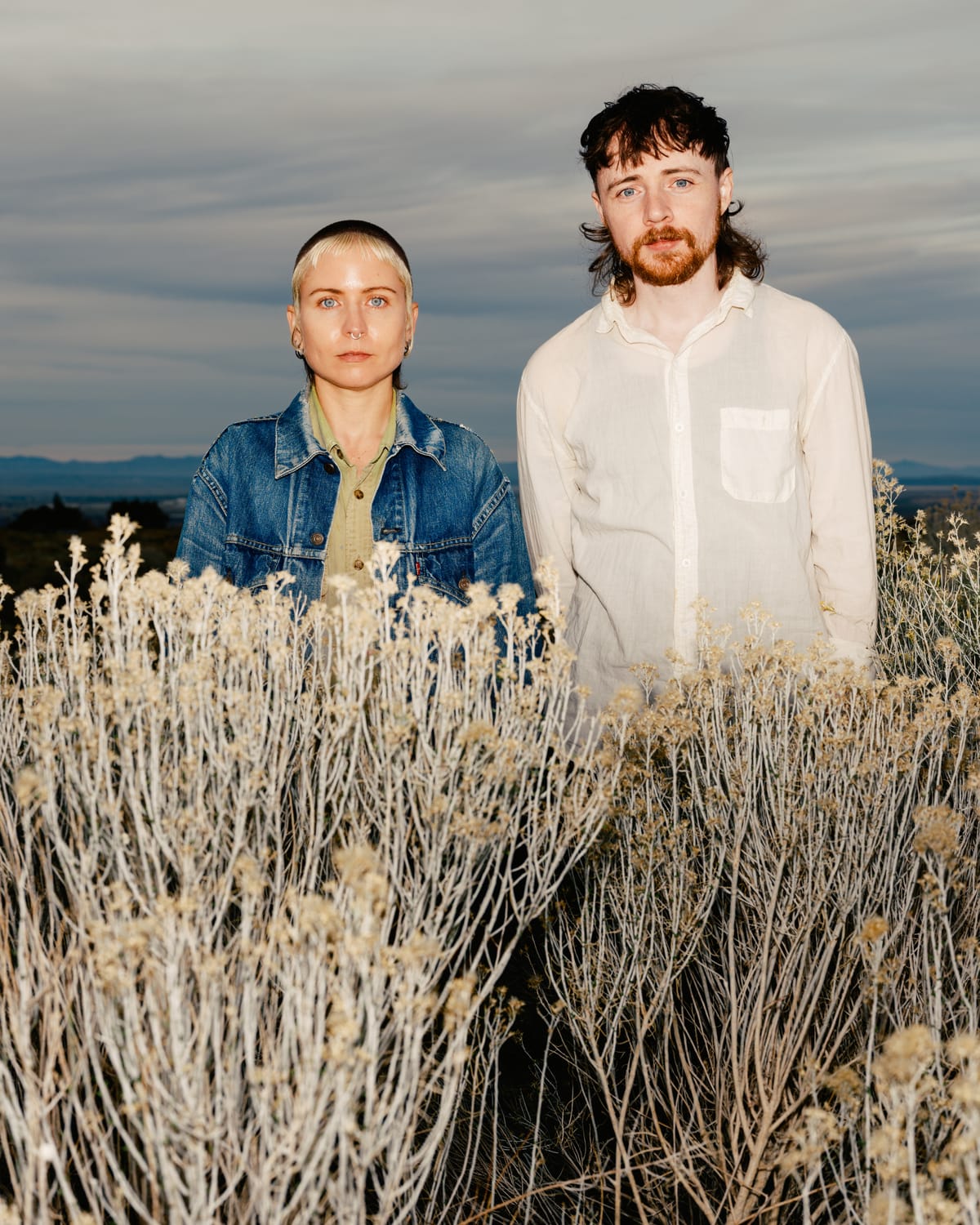
Today's installment: I've been a fan of Green-House since their Leaving Records days, and this week they return with a new album Hinterlands on new label home Ghostly that pushes their eco-electronic approach to new heights of bliss. I hopped on a call with Olive Ardizoni and Michael Cammarata last month to chat through this latest achievement and various matters regarding their career thus far, and it was an enlightening convo that I'm happy to present to you today. Check it out:
This is your first record with Ghostly. Talk to me about getting in the mix there.
Michael: We've been fans of Ghostly for a long time. They've put out a lot of great projects. It's a really interesting label that's managed to do the independent label thing while doing a lot of interesting things with a wide range of projects. They have a strong voice of their own, but it doesn't seem to overtake that of of the artists, which can happen sometimes with some of these boutique labels. We've just been lucky that they wanted to work with us on this.
You guys put out a few records on Leaving before then, which also has its own distinct reputation.
Olive: Leaving Records has been like a family to us for five years now. Even with putting stuff out on Ghostly, we're still very close with the label. It's been such a magical journey—it wasn't expected, just one of those right-place-right-time situations. I feel really grateful that I met Matthew and he was interested in what we were doing, and that from there we could collaborate on building some of the Leaving Records scene that exists today.
Michael: It's very tied to my sense of what living in Los Angeles is at this point. It's so integrated to what the community is here for me with music in particular. Matthew is very open to letting us do anything and try different things. He was happy for us to put stuff out with Ghostly as well, because it helps expand and bring new eyes on that community.
I'm curious to hear you guys talk about your general perception of the Los Angeles music scene. What it seems to me, from the outside, is that the most interesting things that are always happening in Los Angeles seem to be very much based around collectives and communities.
Olive: Yeah, there's the scene that we circle around, which is Leaving Records, DubLab Radio, and [Noah Klein], who does the Living Earth series. That's one larger community, and there's also a lot of jazz within that. It feels really big, expansive, welcoming, friendly, and happy—and I really appreciate it. It's also not the only things that are going on in L.A., which is so big. There's multiple communities that we flow in and out of a little bit—but it's not utopian. It's like any big city, it still has its limitations.
Somebody the other day at the gym asked me about Leaving. They were like, "You release music on Leaving, right? You make music that has that Leaving sound?" If you actually listen to the catalog, Leaving is pretty diverse, but there's an expectation that every artist on Leaving is this ambient synth thing. In interacting with other music scenes in other places, I feel very grateful that the community we're in is not super competitive and is pretty supportive of each other.
Talk to me about the nature element of L.A. and how that plays into your work.
Olive: There's the mountains, the ocean, the desert, and so much within proximity. That's beautiful. However, our project is centered around urban environments, because that's where we live. We don't live up in the hills and have those beautiful houses with all the trees and the landscape. We live in the thick of it.
When I think about my relationship to nature as an artist, I'm really trying to get away from sharing the notion that nature is this external thing—that it's this mountain view, this tree, or this landscape—so much as that it's me, you, and everything. I'm just kind of trying to write from a lens of direct experience rather than a fantastical notion of "back to the land." I want to be grounded in something that's less fantastical, in order to highlight how fantastic things are in my immediate reality—making my immediate reality magic, rather than trying to drum up some greater idea of a connection to nature.
Michael: You're also really good about going out to do outdoor climbing and stuff like that. I'm much more of an indoor, city person. I really love walking around the city and being a part of the landscape in that way—taking public transit wherever I can, that sort of stuff. But there's so much in LA that's really special. I live really close to Griffith Park, which is—you'll have to fact check me on this, but I want to say it's the biggest city park in the country. It's amazing, and it's really cool to be able to get out there in that space—and it's literally just a few blocks from my house.
Olive: And there's rare plants in the parks. There's all of that stuff to really geek out on without having to go out to some giant national park or go backpacking for 30 days or whatever.
What was the situation like for the two of you during the wildfires last year?
Michael: I was living closer to the fires—in the East Hollywood area—so there was a night where the fire got close to where I would've had to evacuate. Then it was just a really stressful couple of weeks staying glued to your phone, waiting for these alerts to come in. I really felt like I was like minutes from having to evacuate. You have to go through and decide, "What's all the stuff I'd take with me? What's the essential things?"
It's so frustrating, how much shit you accumulate as a musician—so much gear, all these synthesizers and other things. It's such a burden, and maybe that came over into some of the record. We were doing a lot of stuff that was just on a laptop, which is a progression I've had, artistically. It's about trying to remove barriers from work, and it's faster to write on it and follow that flow. Having things is a burden, and it's an odd relationship to have, with all these things.
Olive: A lot of people in our music community also got hit hard, because a lot of them live in Altadena. There were definitely some friends who lost their homes. It was intense. I was just in a preppers 101 group a couple months ago. That sounds intense, but it wasn't. We were all just a bunch of trans people, not even talking about what's happening with the government right now—we were like, "Let's be practical." There were some people in the group that lost their home in the fire, so let's just talk about what you'd need in the event of any sort of natural disaster, because we didn't have any preparation. "Here's what we wish we would've had." We were talking about water and first aid, things like that. It's definitely still on a lot of people's minds, and it definitely doesn't hurt to stay prepared without making it an everyday focus and letting it drive you crazy. Arguably, you prepare so that you don't have to think about it in your daily life.
Michael, you mentioned the gear aspect of what you guys do. As many musicians as you have who acquire gear for legitimate creative purposes, you also have this gear fetishization culture emerging as well.
Michael: Olive and I have different relationships with gear.
Olive: I'm not a gear head. I don't know anything about gear. I'm more interested in being able to utilize what's readily available to me to make the songs that I want to make. I'm lucky, because Michael does know a lot about gear and has a lot of nice synths, so it's easy to find the sound that I'm looking for. A lot of what I personally enjoy with sounds is plugins that mimick non-synth instruments, like Rhodes piano and Wurlitzer—and I'm a big flutes guy. Making electronic music ended up being a necessity for me, because I really enjoy the sound of synths a lot, but it wasn't my main focus. It was just, "This is available to me, and I want to see what I can do with it."
Michael has all the skill and knowledge with Ableton, and we have this beautiful writing relationship where I'm sometimes just singing the melodies, and he's amazing at sound design, so I can write something with the knowledge that he's gonna go in with me and help select some sounds that were closer to what I had in mind. It can be more like orchestration in that way.
Michael: I have a lot to say about the relationship between gear, influencers, and all this stuff online. It feels like the music industry, in some ways, is preying upon musicians more than it is helping musicians. The proliferation of a million music gear companies, the advertising, all the social media stuff showing off somebody's studio with all the LEDs everywhere—it'sso frustrating and disconnected from actually making music. It's just about consumption. But it becomes this addictive thing.
I'm at the point where I'm trying to get rid of a lot of gear. I'm selling off all my modular stuff. Once you understand sound design and synthesis, you can really do so much with a laptop. It can be nice to change it up the workflow, and it can feel more like an instrument to have something physical, but if you get the right thing with the correct knobs, you can arrange it the way that you want—there's so much to it. I just really want to pare back and not feel like I'm feeding into this consumption machine. I don't know Max MSP or anything, where I'm coding my own patches or stuff like that, but I'll definitely cobble together a lot of things using stock Ableton stuff in order to replicate what a plugin would be. Rather than spending money on something, I can figure out how to do this with the existing things I already have, and that's really fun.
Olive: Some people could argue that option paralysis is a real problem when you're using a lot of plugins or a laptop, so sometimes I get why people would want to have a set, small amount of analog synths so they could just focus on the writing rather than the selection, because that can be really hard. But we've gotten to a point where we've been doing it for so long that we've narrowed down the sounds that we really enjoy, and it's easier to navigate that in the writing process. But there have been times in the past where I've really dealt with the option paralysis of it, and ending up being like, "Let's just do the Juno-60 or the SH-101." We still definitely use those. But sometimes the limitations are good—but those synths that I just named, they're not even affordable anymore. Michael got those before things got crazy price-wise, so I lucked out with that.
Talk to me about what keeps the gears running in your creative relationship.
Olive: Michael's just a genius. He always pushes me in every way. I've learned so much about music theory through him. That's something that I'm not great with, so it's really nice to learn from him and ask questions. It's so continuous, the learning while making music—but Michael makes it so approachable. I can say that, as a non-male in music, I've been playing music most of my life now, and finding men that want to share things and teach you and not gatekeep is really special. I've grown so much as an artist by having Michael bridge that gap for me.
As far as writing goes, Michael is best at starting a song and sound design, and I'm really great at finishing a song. I'm a little bit more easy going and non-critical, so I can say, "That's great. It's done." That's a really important thing to have in a partnership. I'm really a melody-driven person. My background, I started with classical vocal training. So that might be why that my brain works that way. Michael's background is mostly in jazz guitar, so I really love how those things combine.
Michael: I'm good at starting a thing, but finishing is just so painful and awful. Coming from jazz is maybe part of this, but I really like working with people on a project. Music can be such a lonely thing if you're doing everything on your own, and it's so nice to be able to share that with somebody else. Things get vanilla if you have just one voice in a project—it becomes stagnant. There's only so many ways I'm going to make a melody sound. If Olive makes a melody, it's going to be completely different than anything I would do. I don't think you can teach that. That becomes a lifetime of collecting little fragments of a melody, and that becomes what you are as a person—and Olive is like an endless source of melodies and ideas.
It's just so important to work with other people. I'll do solo stuff here and there, but it's it's not nearly as fun as doing stuff with other people, because the other side of it is having another person alongside you for the journey. Your friends are supportive and you're happy about the music that you put out—but it's not the same thing as somebody being there with you the entire time that you're working on a track and seeing it develop. It's such a special process, having another person that's right there with you in it.
Olive: This has to be how professional athletes feel about their teammates, I swear to God. This is a psychological, emotional relationship, the creative relationship—it's very deep, because of how vulnerable it is to make art.
I was never good at sports, so I wouldn't know—but I definitely assume that's how it feels.
Olive: Well, listen, I watch sports-related anime, and in those storylines, the emotions are high. There's ups, downs, wins, losses. Because we've been making music together for so long, there's been so many ups and downs that we've shared that nobody else would understand. Well, some other musicians would, but it's specific to us as well. Actually, it's also nice when you're talking to another musician that's been through a lot of things that you've experienced. It feels nice to finally find somebody that knows what you're talking about.
I've talked to so many people for this newsletter, and I think you might be the first person to draw the professional athlete connection, which is kind of funny.
Olive: You know what it is? It's because my boyfriend actually watches football. I hate sports—and he's not, like, that kind of person, so I don't want to paint a bad picture of him, because that usually would be deal-breaker territory for me. But we were watching the Super Bowl, and at the end, they're having those emotional interviews, and that's why it was probably on my mind.
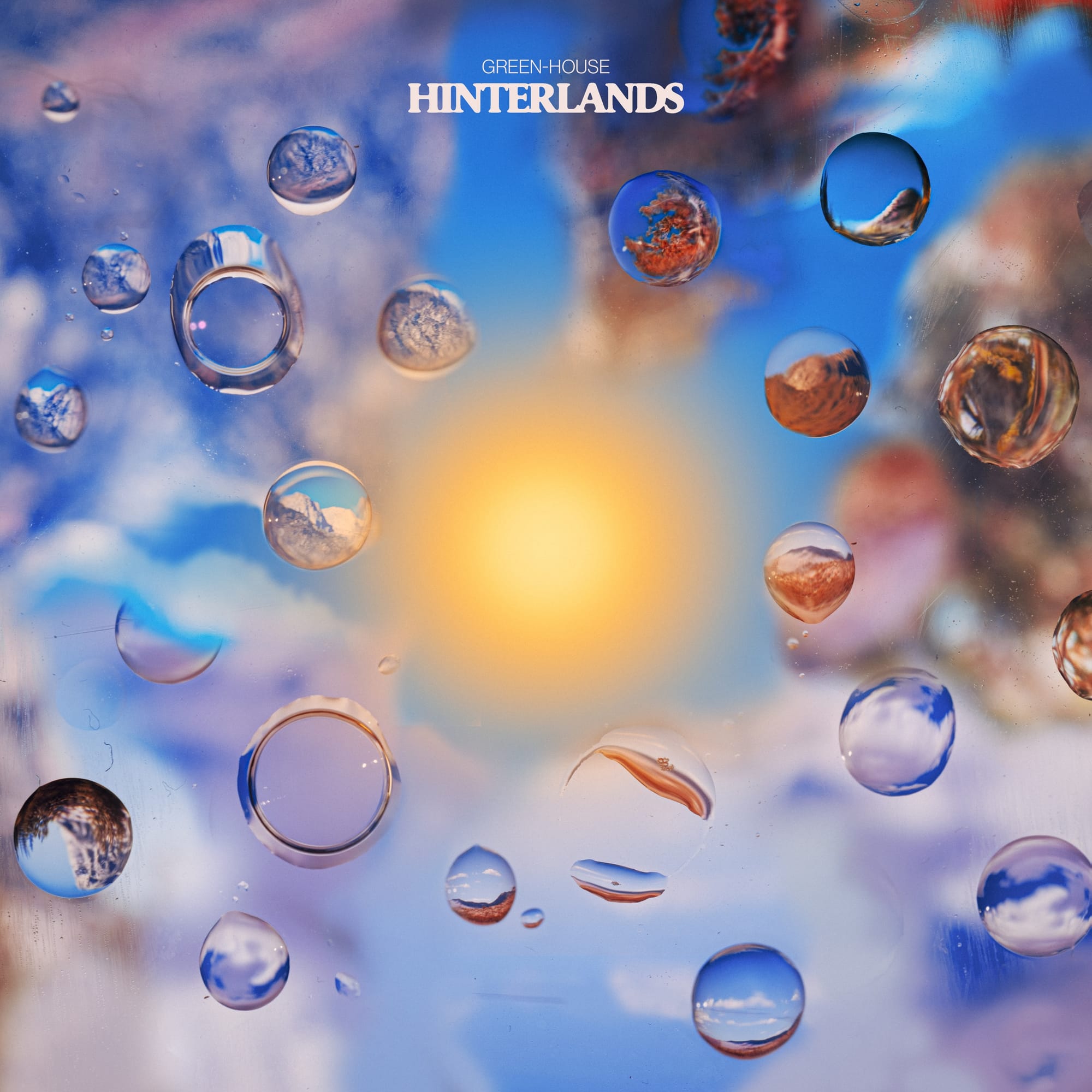
Tell me about putting the cover art together for this one. It's really striking.
Michael: Olive and their boyfriend went out to Yosemite and shot a couple hundred photos of stuff around there. They also shot at Inyo National Forest and the Ancient Bristlecone Pine Forest—those really old trees that are thousands of years old. We took a bunch of those photos and laid them out on an iPad, applied a panel of acrylic, put water droplets on it, and then shot it with a macro lens and got a refracted little bubble that felt like its own world. Then we collage'd it all together in Photoshop after the fact, which felt similar to making the album itself—taking something practical, sampling different things, and bringing it into the digital world to do something physical with it before bringing it back into digital again. It's layers of sampling and re-sampling, back and forth.
Olive, in the bio materials for this record you refer to yourself as "an anarchist and an artist." Unpack that one for me.
Olive: My hope as an anarchist and artist is that my art speaks for itself towards the vision that I see for humanity in the future, rather than me verbally articulating it. I mean, it's not lyric-based music, and I don't have a big social media presence in terms of me talking to people all the time. My role as an artist is more so to envision better futures and share that dream in the way that I uniquely can interpret it.
Anarchy sometimes feels more philosophical than political to me, even though those are both completely intertwined. I believe that humanity is capable of caring for each other through mutual aid and support, and the systems that are oppressing us right now are the greatest lie ever, because we've evolved to support each other. Not to say that bad things don't happen, but I'm a prison abolitionist, and we don't need these systems in order to function—and we prove that, circling back to the L.A. fires, anytime there's a community-wide natural disaster. That happened to our friends in Asheville a couple years ago too. You see people come together without internet. They have community boards, they have organizing. They immediately come to action to help each other and make sure that nobody is unmedicated or without water.
That stuff is on my mind a lot. In my personal life, it's always a major topic of discussion and anxiety—so, of course, it ends up being infused into the music. Green-House was my first project in a long time that wasn't a metal or punk band. The political ethos is almost the same, but it's a different expression of what music can do for our brains when we're dealing with such extreme strife and grief. It's not meant to be escapist, but something that can help nourish the mind and keep us grounded while we are doing the work that we need to do. That isn't fair, but we have to do it—because, fuck, we have to do it. We always make our art for ourselves primarily, and we're all human animals, so we connect, inevitably, with other people that are on the same wavelength.
"Valley of Blue" was originally called "Memory of a Chocobo." Let's talk about your guys' relationship to Final Fantasy and gaming more broadly.
Olive: So, I don't really play video games. I grew up never having a console, so if I ever tried a game, it was at a friend's house. I've never been good at it, so I avoided video games and was anti-technology—not intentionally, but for most of my life. Like, I didn't get a smartphone until 2015. What I love, though, is video game music. I find video game music playlists or listen to the video game music that people who play video games suggest to me, and I'm like, "This shit is so good." Some of these composers have no right making the best music I've ever heard. You listen to certain things like "Dire, Dire Docks" and you're like, "Stop. How is this possible?"
I was listening to somebody's NTS playlists—I think the channel is called Otaku—and they have a Final Fantasy one that I was listening to a lot. I was like, "Man, this slaps so hard." Who did the Final Fantasy music, Michael?
Michael: Nobuo Uematsu.
Olive: So good. I was listening to it a lot and ended up incorporating it into my consciousness in that way, without thinking about it. So when I was sitting down and writing, there was something where I was like, "This feels like my version of Final Fantasy music, vibes-wise." I wouldn't say that it sounds necessarily like that, but emotionally, I feel like this is my Final Fantasy music. I started picturing this Chocobo rider who lost his Chocobo, and he was looking over this field of blue flowers—a valley of blue, which is what it ended up being called. It was this melancholy moment about a Chocobo that passed away.
I really like cute creatures, so even though I never played Final Fantasy, I saw people playing it and was like, "What is that?" I have pictures of baby Chocobos saved on my phone so I can look upon their sweet faces in a moment of sadness.
I was talking to someone the other day about how a lot of people my age discovered electronic and dance music for the first time through video game soundtracks.
Olive: One that comes up a lot in regular conversation is Tony Hawk. So many people like came to all of these iconic rock bands through that game. I'll be playing a particular song and somebody will be like, "Oh, I know this song because of Tony Hawk." That's wild to me. One video game that I thought was the coolest in the early 2000s was SSX Tricky. Did you play that?
I was literally about to bring that one up as an example.
Olive: It was so sick—the character design, the music.
Michael: It was particularly good jungle stuff. That was probably my first experience with it. I definitely grew up playing a bunch of games, and I still play them. I'm going through Silent Hill 2 right now, which has an insane soundtrack. These days, I'm obviously a lot more music-focused, so it's interesting playing some of these old games. That series in particular is really interesting, because the soundtrack largely uses this library of music called Distorted Reality—these sample CDs that you could order in the mail with a ton of really cool, creepy sounds. The company that made that was Spectrasonics, who makes Omnisphere now, and those sounds are still available in Omnisphere to this day. So I've been messing around with Silent Hill sounds, making dumb jungle tracks.
It's such an interesting era of production for sound design. I think the new Oneohtrix album is using a lot of sample CDs. They're really interesting to dive into—this weird, '90s-modernized version of library music.
Olive: Which, that's the secret sauce to Green-House—we just love library music of all kinds.
Let's talk about the financial realities of being musicians.
Olive: It sucks. We deserve so much more. We deserve to be paid by these fucking billionaires who are streaming our music and stealing from us. I feel very stolen from, and I feel very resentful a lot of the time, which makes it hard to sit down and write music. I'm very grateful for the people that I've met through music and the labels that we've worked with. We haven't had a bad experience where we got screwed over by somebody in that way, so that's very amazing, because I've talked to so many musicians who have. We've never had a manager or an agent, so we've been able to keep things a little bit more financially tight that way—but then we're always teetering towards screwing ourselves by not having that support or not knowing if we're making the right decision—which, it can be hard to know. The industry feels like it's getting worse every day. We've got AI right now—which, like, if it was obvious, I'm very, very against AI.
I figured as much.
I think it should be obvious. There's not a lot of positive to say about the music industry at all whatsoever. It's very difficult to participate in the industry while still having the energy um to put forth music that feels authentic and healthy. It's a struggle.
Michael: Also, it takes so much work to be a musician. To want to do things the way that we want to do them, it's absolutely its own full-time job—but you need to have other income at the same time in order to support your music, which is kind of insane on its own. But it's also next-to-impossible to get a job while you're doing music, because you have to tour for so many weeks at a certain amount of time that you have to find these little pockets where you can work within it. I've been doing video and design stuff, and that helps, but it gets hard. It's hard to switch gears all the time, too. I'd love to just focus on one thing all the time rather than constantly jump around.
It's sad. I used to dream about going to grad school and becoming a professor at a college while also doing music—but that career path has really died off, because it's all adjuncts now and those positions don't pay anything. Even then, you're competing with people that have PhDs for an adjunct position, so you're never going to get that. All these little pieces that used to exist where you could cobble together a living as a musician, they're just so disparate now. You're constantly having to reset all the time.
Olive: I'd really like the public perception around music and art to change, because we are workers, and I don't appreciate people perceiving us as trust fund people with a hobby. "Well, you shouldn't have gone into music, the arts aren't important." Then stop playing my music at your funeral or your wedding! Music is so important to every single person's daily life—and I'm not saying that my music has to be, but we're essential in that.
We're workers, and we're working class people. I myself didn't even graduate from high school, let alone college. I don't even have a GED. I spent all of my life working so many jobs, and I've never had one of those jobs where you have to do a million emails. I don't even know what that world is like. What happened with me is that music became the thing—the path that I kept going down, because it's just what I do. And it's what I'm supposed to do, because it's so much a part of me that I'm not going to not do it. And I deserve to be able to live! I deserve to have health insurance and pay my rent.