Bing & Ruth's David Moore on Getting Married, Embroidery, and Ambient Americana
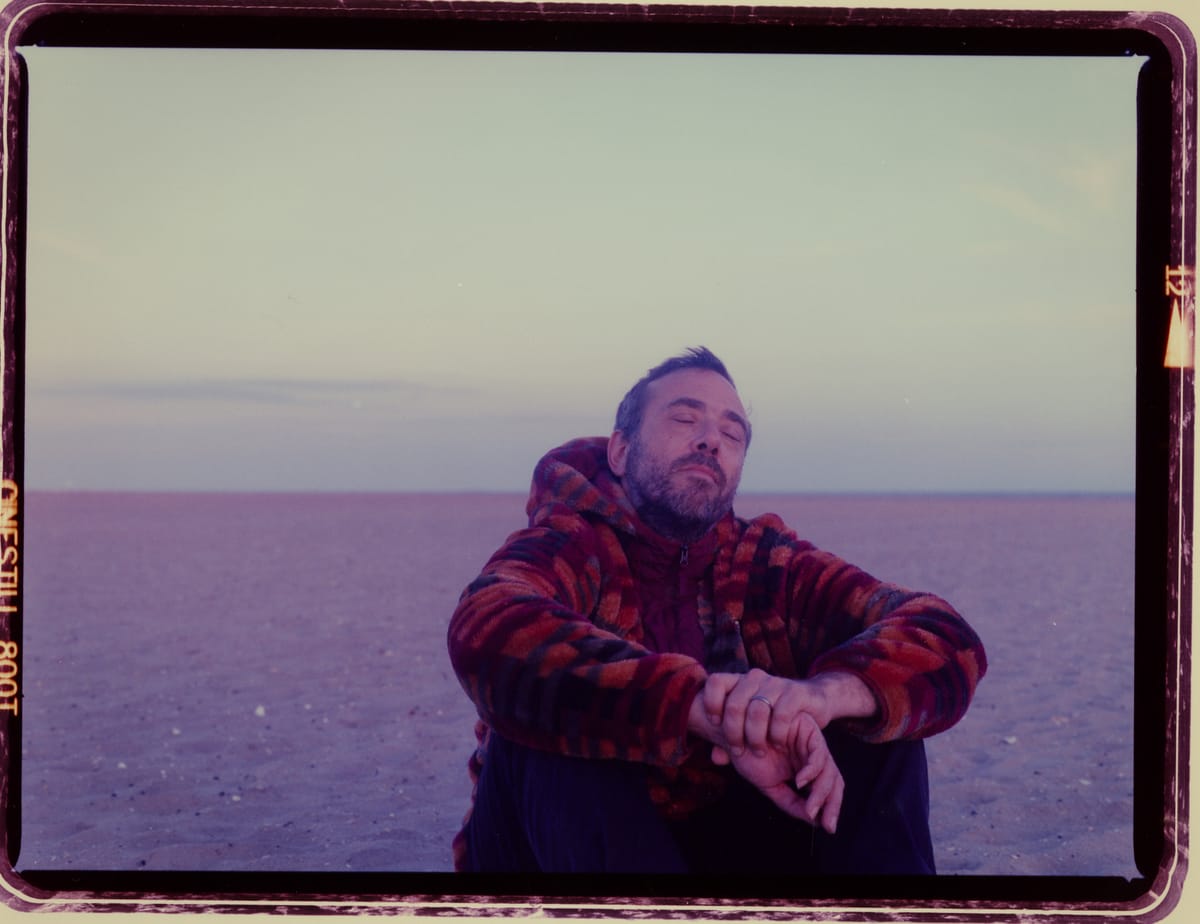
This is a free post from Larry Fitzmaurice's Last Donut of the Night newsletter. Paid subscribers get one or two email-only Baker's Dozens every week featuring music I've been listening to and some critical observations around it. Subscriptions currently run $3/month or $30/year, hit one of those little pink buttons on the right side of your screen to tap in, you won't regret it.
Today's installment: Back in 2014 I was entranced by Bing & Ruth's Tomorrow Was the Golden Age—so much so that I reviewed it for Pitchfork at the time. (If you already pay for the Pitchfork subscription, I encourage you to read it; if not, I encourage you to pay for a subscription to my newsletter instead. It's cheaper!) Since then, B&R mastermind David Moore has done a series of fascinating things in and out of that project, from working with Steve Gunn and throwing in as a part of Cowboy Sadness to his fantastic new solo album, Graze the Bell, which hits digital shelves today. I hopped on a call with David a few weeks ago to talk all things this latest chapter in his career as well as a host of other topics; it was a truly soul-nourishing convo that I think you'll enjoy reading as well. Check it out:
You lived in North Carolina for a few years before coming back to NYC. What were the ups and downs of that experience for you?
Man, I love North Carolina. I got married there. I didn't have a lot of history with the state before that, but it's such a special and unique place. It's everything I love about the South, combined with everything I love about nature, combined with everything I love about hippies—and even people that play golf all day. I mean, it has its problems, obviously. What place doesn't? But it was great. I wouldn't be surprised if we moved back someday.
This new album is the first widely released record under your own name.
It is. I dipped my toe in with those two albums I did with Steve Gunn. Using my own name felt more honest, more real. More than anything, it just felt like I got to get rid of my shadow. It provided a freedom that I got really addicted to, and then I just wanted to keep going.
Some of this record was initially meant for another Bing and Ruth record. I'm curious to hear you talk about what the point of separation is in terms of, "I'm going to work on this for other people" versus "This is more of my own thing."
For me, the actual material is independent of the presentation. If I create something, I'm always looking for the best expression of it. A lot of times, that's found through experimentation. I'll take a song that I write, I'll have it one way, and then I'll spend a couple of weeks deconstructing it, putting it back together, and thinking about it in different contexts. Sometimes I know right away when it's the right thing to go to, say, Bing and Ruth with—or when it's the right thing to hold on to myself. But sometimes it takes a lot of experimentation, and I've grown to really love that part of the process.
With this album, initially I'd just assumed I was writing a Bing and Ruth album. I don't even know that it was a choice that I made. I was like, "Well, it's been a couple years since the last one. It's time to write the next one." But it coincided with a period in my life where I was having some mental health struggles, and I ended up breaking myself down and putting myself back together. In the process of doing that, I realized that a lot of the music I've been writing, the moment I freed it from the context of Bing and Ruth, it grew wings and flew in a totally different direction—and, at this point, I really am only interested in following that.
I saw the bio for this record mentioned you dealing with bipolar disorder. Talk to me about what that entails for you. I talked with Ian from Nation of Language recently for the newsletter, and he was talking about how the notion of not doing well mentally could help one create better, and how that's a total fiction.
I agree with that, and I also disagree with it on a certain level. I've been alive for a while now—longer than I ever thought I would—but as we grow, our loyalties change. When I was younger, I was very much along for the ride with my bipolarness. I mean, it's the reason I started being drawn to slower, quieter music that focused on beauty, grace, and gestures—all of these words that people like to use when they describe my music. That came from being 16, 17 years old and having really bad depressive swings. I went to see a psychiatrist when I was 16, and they gave me medication. I tried taking it, and I stopped almost immediately, because I wanted to take the ride.
I'm older now, and my loyalty is to my work, of course—but it's also to my body, my family, and the life that I've created for myself. When you're in these cycles, you become very good at justifying them and saying, "Well, that's okay, because it's leading me to make all this great music." Well, you know what? I started treating my condition at the same time Bing and Ruth was getting off the ground. That's when I got serious about trying to take care of my mental health, and that's also when my art blossomed. So I do think it's a dead-end argument, that you have to be mentally ill to create powerful art. Maybe you do initially, but you don't owe a loyalty to that illness.
As far as how it affects my life, I take medication. My wife is very involved and observant, and we've grown to recognize when certain patterns might appear, and we change our lifestyle a little bit to accommodate those patterns. And, Larry, I am happier than I've ever been in my whole life right now. It's crazy. I want to cry, you know?
How long have you been married for?
That's a tricky question, because we got married in a spiritual fashion during the pandemic, but we didn't get the law involved. So she was my wife for a while, but the year before last, we just went down to the courthouse in Manhattan, signed the papers, did the thing, and threw a little party in Prospect Park on the cheap. It was so much fun.
Where did you throw the party in Prospect Park?
A little nook by the ball fields where there's some trees and open grass. We had it at night, there was no one in the park, and the weather was perfect. We couldn't have asked for a better experience.
So you've been with your wife for quite a while.
Yeah. We've been together for seven years at this point. We were really good friends for a long time—from a previous life, where I was a touring banjo player and she had no idea about any of my Bing and Ruth stuff. On a whim, I invited her to a show we did for the No Home of the Mind release party, and she was like, "Wait, what the hell—you do this? I had no idea." Then we ended up being single at the same time and just realized, "Holy shit, we're madly in love with each other"—and we've been madly in love with each other, openly, ever since.
An underrated thing about being in a relationship is that it's work. You have to really be able to hear the other person and grow with them, and that requires a lot of work on yourself as well. What have you learned about yourself and how you communicate with others as far as being in this relationship is concerned?
One thing I've learned to really value is honesty. It's not that I was a dishonest person before she came into my life. But she showed me the liberation one can feel when they're honest and real about how they feel and who they are—about their faults, the things they like and hate about themselves. Very early on in our marriage, we ended up establishing a radical honesty between us, as much as I don't really like putting the word "radical" before other words. It's been a really liberating way to live.
As far as what I've learned from my wife specifically, when Bing and Ruth got a lot of eyeballs, that thrust me into a world in a whirlwind. I was trying to keep sight on everything I could, but I felt like I got shuffled into this high art mindset—black turtlenecks and whatnot—and I never felt comfortable there, at all. I'm from Kansas, and I go camping, and I listen to bluegrass music. I watch basketball games. I play Sega Genesis. That's never been who I am, but I was in this world.
When I started getting together with my wife, she was the first person that was like, "You know you don't have to do that, right? You can just be yourself and engage with the things in the art that resonate with you." And she's one of the most brilliant artists I know, but you'll never see or hear any of her stuff, because she doesn't feel a need to share it. For her, creating it is more than enough. That's been such an influence on me, because it brings you back to, "What am I creating? What am I putting of myself into this work?" And at the end of the day, that's what I'm here to do.
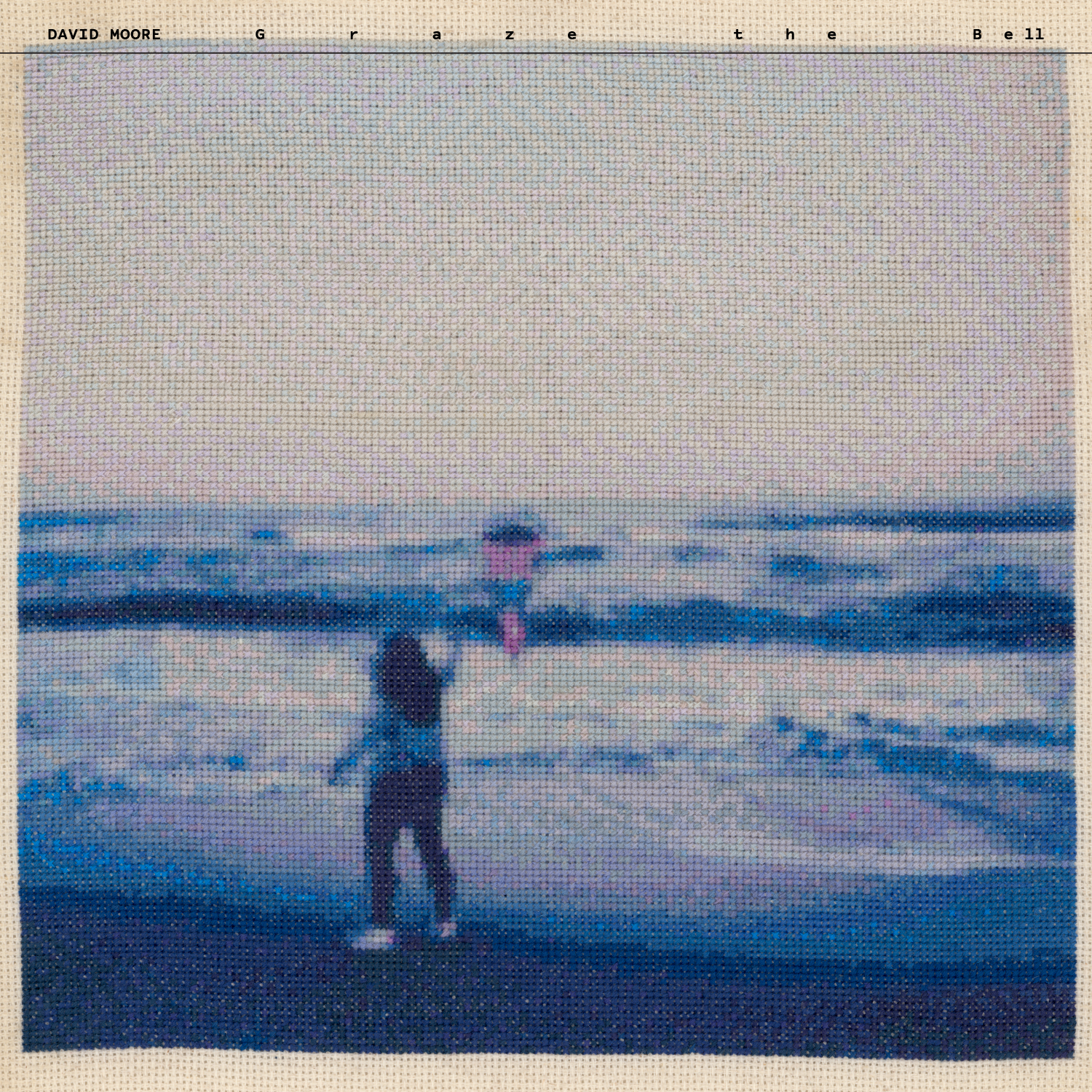
Your wife is also on the cover of the record, the art of which you embroidered yourself.
I did, yeah. It took a little over 10 months.
Talk to me about getting into embroidery and what that does for you. Bro, I will talk to you about embroidery all damn day. I've made visual art for my whole life, but I've never been particularly good at it from a technical perspective. I'm one of those annoying people that does believe that, if you want to follow a medium into the arms of God, you must focus on foundational technique before anything. I never really focused on foundational technique with visual art, so I never felt like anything I did was accomplishing the things that I was with music.
I was having this manic episode a few years ago that culminated in the birth of this album, but also the death of the album. What I knew was that I needed to not look at screens so much—and I know that's a bit of a boring answer, but I felt it in my heart. I was looking for things I could do to be outside, and I just happened to be in a pharmacy where they had a little cross-stitching kit. I was like, "Let's see what this is about," and I just fell in love with it. You sit on a blanket for hours, and one stitch at a time, you just follow your pattern. You don't have to think—it's like a Zen thing.
If I get into something, I'll go all the way in. I started designing patterns and I did a bunch of smaller pieces where I wanted to figure out the proper number of colors. I finished recording the album, and I was like, "I need a cover for this, I want to stitch something." So I spent a while figuring out what I wanted, made the pattern, got the materials, and for one to three hours every day I'd sit there and work on it slowly.
I've always been somebody that has a hard time quieting their mind. As you get older, you can't do the drugs you used to do that helped you do that, so you've got to find other ways—and this has been something for me that has been very therapeutic. And then I have a beautiful piece at the end of it to share and use.
Talk to me about playing around with pitch-correcting software on this record. Obviously, you've experimented with tape-delay techniques in the past as well. When it comes to bringing in new techniques like that, do you go full bore or is it about treating it like a spice?
The sound of this album is the brainchild of Ben Kane, who's my neighbor and very longtime friend. He also happens to be an absolutely mind-blowing engineer. He has worked very close, up until recently, with D'Angelo. Ben is a beast, and when the time came to make a solo piano album, I knew it needed to feel really big, so Ben was like, "Send me some references." I couldn't find any references for the sound I wanted, so I started describing it to him, and we shot these ideas around about how to capture it.
The funny thing is, we had this plan where we went in and set up all these microphones at different distances. But once we actually made the album and got back into the studio to mix, we realized it was only two microphones we were interested in. So the idea then became, "Well, let's mix it like a band record. ow do we split it up?" I talked to the folks at iZotope, and they didn't really have a solution for it—but around that time, Ben had his assistant start messing around with Melodyne, which is pitch-correction software. We used it to isolate the low end of the instrument so Ben could treat it separately from everything else, and we could have this really expansive low end underneath everything that wasn't affecting the higher registers of the piano.
It took a lot of wrangling and experimenting—rejected masters, rejected mixes—but we finally got to a place where the piano, when it wants to sound massive, just takes over your brain. I could not be happier with with how he did all that.
Talk to me more about the trial-and-error aspect of experimenting with new techniques. Is there a point, while you're throwing new elements into the mix, where you start to second guess yourself?
If I start second-guessing myself, that's indicative of of a loss of context. What that usually means for me is I need to back up and start over.
I'll give you an example: We're very close to finishing the new Cowboy Sadness album. Everything is recorded and we're starting the mixing process. There's this one song we did that I really fucked me up. I can't describe the feelings I would have listening to this, but they were totally unique to anything I'd ever heard. But it was unfinished, so I was struck with this dilemma. The thing that I have is affecting me in a deep way, but it's not presentable. So I need to find a way to preserve that while finishing it. Usually, what that takes is, "I'm gonna try this. Do I still feel it? No? Okay, I need to go a different way."
With that song in particular, I ended up doing a bunch of work on it and then said to [band member Nicholas Principe], who's mixing the album, "Delete everything I did." It just didn't work. He did, and it's way better now. But experimentation is the most important part of my process. For a long time, I was afraid of making something bad. Now, when I make something bad, I'm psyched, because I'm closer to the thing I want to be closer to by knowing the thing I don't want to be close to. If I do get to a place where I can't wrap my head around what I need to do, 100% of the time, if possible, I put my headphones down and go for a walk. It always fixes it every time.
I actually wanted to talk to you a little bit about Cowboy Sadness specifically. That record arrived at a time in which—you know, how fickle and annoying people who talk about experimental music can be— Oh, I hadn't noticed. [Laughs]
There was some festival with a panel about the notion of "cosmic Americana." I saw a lot of people grumbling about for various reasons. Obviously, when you put a label on something, it's going to irritate somebody in general. I'm curious if that discourse reached your ears.
Well, we live in a capitalistic society, and capitalism generally requires predictability—and predictability is accomplished most efficiently through batching. We want to group as many things together into one thing. That lets the engine run how it needs to run.
I rode the Americana wave in the early 2010s as a member of Langhorne Slim, and that was very unexpected. Then, I rode the ambient wave—a label that I'd never given myself, heard of, or really knew anything about. The thing I always like to tell people is I'd never heard the music of Brian Eno until I'd already started Bing and Ruth. That just wasn't on my radar. But there's this wave, you get caught up in it, and it's like, "Well, I guess I'm a part of this now. Every time that happens, I'm one of those annoying one-foot-in, one-foot-out guys. I've never fully embraced the term ambient. Even records I put out that, I'd think, are pretty ambient—I put out a little release earlier last year called Butterfly Gardens, which is very ambient, probably the most ambient thing I've ever done—but even then, it's ambient-leaning.
They're just words. Right now, the grouping that's helpful is "ambient Americana," which is something I feel I've been doing for 25 years. I mean, I have recordings from when I was 18 of doing long-form acoustic guitar, because my father is a bluegrass musician, so these things have just been in my blood forever. I've never thought twice about it. But now it's kind of having a moment—and to be honest, I'm cool with it. I always felt that the function of ambient music, or whatever you want to call it, was so much wider than the palette we gave it. I did what I could do to steer us away from synthesizers and electronics, into more of an acoustic realm within the context of that sound. So I'm always really psyched when other people are taking that philosophy of sound, structure, and song and applying it to new instrumentations.
Of course, with country music, we have a very wide but very predetermined palette. We have guitars, banjos, fiddles—these things that are very evocative of the genre and bring in outside feelings of nostalgia. When you hear a guitar, you're not just hearing that guitar. You're hearing every guitar you've heard before that. So it provides a container for us to really explore. With Cowboy Sadness, we never set out to be a part of this "ambient Americana" movement. The band name was given to us by a friend 10 or 15 years ago, and we made this album outside of the context of any of that.
But because of the name and a few choice champions that we've had from early on—Bob Holmes, specifically, who has the Across the Horizon podcast. He started really pushing us and exposed us to that world. I'm gonna be really honest with you, when we set out to make the second album, we really were very clear that we did not want to make an "ambient country western americana" type of album. But we ended up doing something on a level that I don't think any of us were expecting, because that's just what the music ended up wanting to be. And I'm here for it1 I don't like genre names, but I'm here for the team.
Not to generalize, but whenever I see people complain about stuff like genre names, it's quite frequently people who don't make music. The people who make music are like, "Hey, if calling it some weird shit is going to help you listen to it, whatever fucking works, you know?"
Whatever works! But in our trying to run away from that genre signifier, we ended up going full-circle and running completely into the arms of it.
Obviously, genres can be reductive in ways as well. I know William Tyler is getting hit with that tag a lot these days because of this shift he's made this decade with his own sound—but, he's also been incorporating electronic elements into his music for a while now. It's always more complicated than the shorthand makes it seem, to say the least.
It absolutely is. And, I mean, William's brilliant. We actually did a show together at Big Ears last year. Nice. That was, like, the "Ambient Americana Showcase" or whatever. But the thing to remember is, almost all of us have been doing this since before there was a name for it. We're getting grouped, and it's a package deal now. There's an Instagram infographic for "ambient Americana" now, so I guess we're official.
Soon you guys will be able to go on a Monsters of Ambient Americana tour together!
Oh, God.
You mentioned your work with Steve Gunn before. He's somebody who's very interesting to me, because I feel like 10 years ago, I had a pretty good idea of what to expect when I put on a Steve Gunn record. He's proven himself to be someone where you're going to get something different every time. I love when that happens with an artist. I'm really curious to hear you talk about working with him.
Steve is one of the most curious musical minds I've ever spent significant time with. His knowledge of rock, experimental music, jazz—all of it—is really something to behold, and that's just an extension of his curiosity. Steve and I both found each other at a very interesting place in our artistic lives, because we were both coming off of big label deals where we were expected to show up and do the thing that we do—and I think both of us really were wanting to do something else, but it's hard when there's expectation on you.
I don't want to speak for him, but I observed that we were both in a similar place and wanting to break outside of these molds—but these molds were also our job, you know? It's how we made a living, so it's complicated. Anybody who's wanted to take a leave of absence or quit a job knows that feeling. I feel like we used each other to push, prod, and experiment, but I don't know how conscious we were of that dynamic at the time. We were literally just strangers getting each other through the pandemic in 2020 by sending tracks to each other and playing each other.
I didn't know him at all. We were put together by our publisher, who was looking to keep the artists busy during COVID, when nobody had anything to do and all the tours were canceled. We had the same publishing rep and he wrote us an email and was like, "Hey, would you guys ever want to make a song [together]?" I think he wanted us to make a song for a commercial or something, but we misunderstood the assignment and ended up making a whole album, because it was just so fun. The funny part is, when we made the record and put it out, that's when we got to actually play together for the first time in the same room.
I just really admire him in a lot of ways, and that curiosity really comes through in those records from him. He got a classical guitar for the record, so he was already pushing himself in that direction. He's just a really cool guy to work with.