Bedouine on the Internet, Motherhood, and Blowing All the Horns
This is a free post from Larry Fitzmaurice's Last Donut of the Night newsletter. Paid subscribers get one or two email-only Baker's Dozens every week featuring music I've been listening to and some critical observations around it.
And if you're still catching up from the time-consuming task of keeping extremely close tabs on my personal life, I'm currently running a paid subscription sale in honor of my birthday and losing my job. People love this sale, and why wouldn't they? We're talking 39% off the first six months of a monthly subscription, or the same discount off of a year of the annual subscription. You can grab the monthly sale ($1.83/month) here, and the annual sale ($18.30) here. You won't regret it, and you'll be keeping this 100% independent publication alive and well, too.
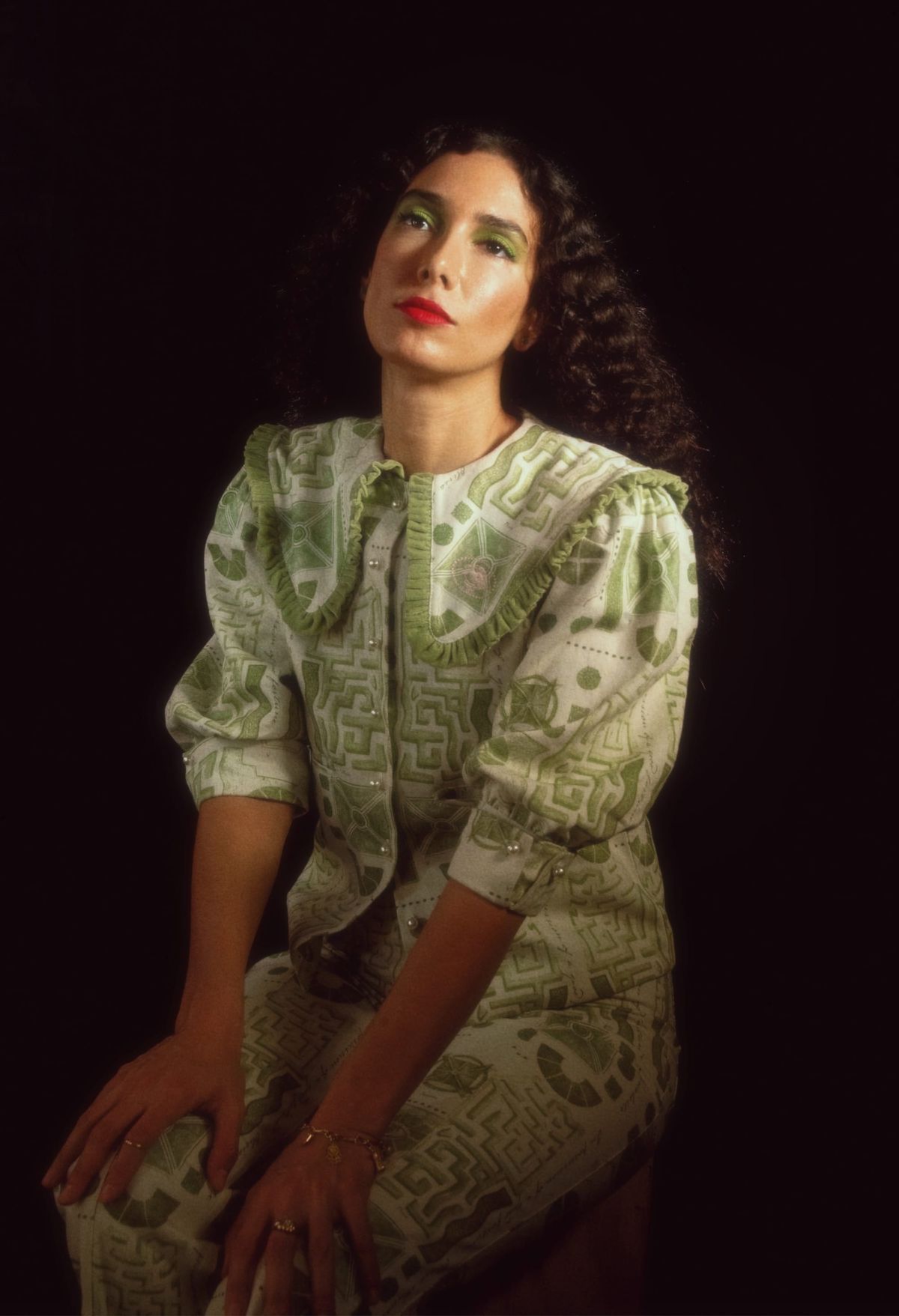
OK, here's what I'm serving up today: I've been a huge fan of Azniv Korkejian's music as Bedouine since her self-titled debut dropped in 2017; the follow-up, 2019's Bird Songs of a Killjoy, features some of my favorite songs from the 2010s period. After the equally entrancing sorta-odds-and-sods collection Waysides in 2021, Azniv returned earlier this summer with a brand new record Neon Summer Skin, and it's every bit as entrancing as what's come before it. I was very pleased to hop on a call with her last month and chat through the genesis of this latest worm, as well as a variety of topics regarding to her creative and personal life. Check it out:
This is your first record of newly written material since 2019.
Yeah—and even in 2019, it felt like there was some spillover from the first record because there was just such a wealth of material.
Talk to me about putting this one together.
A lot of it is a reaction to my last visit to my parents in Saudi Arabia. They were getting ready to retire and gradually making a move to Armenia, where a lot of my family ended up. It was a little bit of a delayed reaction, but I just couldn't stop thinking about how I probably would never go back to Saudi Arabia in the same way, if ever. I was dwelling on that thought a lot, and it made me really sad. I was coming to all kinds of realizations—like a later coming of age, or somewhere between a quarter and midlife crisis. I was really struggling with it emotionally, how life moves in one way.
With the countries that I feel a relationship to, it's been especially difficult to go back to visit those places for various reasons. I was feeling really sad and frustrated about it, and I realized that I needed to work through it. I more or less formally made a decision that I'd write my way through it to try to sit down with it. The rest of the record was written in that framework, and I had a lot of time to work on it because the pandemic had interrupted a lot of my last record, so a lot of things had gotten canceled.
What was the pandemic like for you?
It was a lot of things. At first, as horrible as it was, I thought, "Okay, we're just gonna have to get through this together. I don't think there's any shortcuts. We're just gonna have to settle in, and everyone's gonna have to take precautions." It was easy for me, because I'm a homebody, so I don't think I experienced it socially as hard as people that really depended on their community outside of their home. That just varies from personality to personality. What was more difficult for me was, as more and more things were getting canceled, I was struggling with identity stuff. I had bad luck with the touring side of things—like, my first show back in a while would've been right when the Delta variant came back.
So I went long stretches without doing much, and I poured myself into the idea of a B-sides record, which ended up as Waysides. I had so much time that I kept throwing stuff at it, and my partner Gus helped me fully realize it. It was just supposed to be these sketches of songs on Bandcamp, but it evolved into this full-blown album—which was also confusing for me, because I was like, "Well, I do love these songs, I want to share them, but they weren't really meant to be an album." Now, it's my third album. But I just had to stop analyzing stuff like that. It was a way for me to keep moving forward and expressing myself.
I've talked to some artists who, during that time, were sometimes like, "Is this it? Am I done with making art?" Did you have that moment of fear at any point?
I don't think I had that kind of crisis, because my project has always been a smaller scale. I mean, I want it to be heard, but it's still about my expression rather than how it's received. I'd like to think that, even when I feel like little-to-no one is listening, I'll still be writing songs. Even if you don't consider yourself a creative type, I think it's really important that everyone finds a way to express themselves. It's just mandatory human stuff. Even if it's really long stretches between—which, this last stretch was pretty long—I'm always going to be tinkering at something.
You talked earlier about processing some personal feelings and revelations on this record. Were there any moments where you felt like pulling back in terms of vulnerability?
I didn't think about that much, to be honest. I don't think anything I say on this record is very shocking. I guess, every once in a while, it occurs to me that my upbringing is pretty different than everybody else's—but it was so normal to me that it felt really cathartic.
I'm so fascinated with the way that people grew up, and how they live their lives. What foods do you eat? What books do you read? Of the things that we do in the privacy of our own homes, we can be so isolated from each other, and the way that we present ourselves on the internet is so curated. So I get really curious about really random things, like "When do you brush your teeth?" I ask people a lot of questions, probably to an annoying degree—and it always fascinates me when people don't ask questions and aren't curious about each other. It's really confusing to me. Aren't you curious about the way that other people do things that are considered really normal to you that might be very different?
Because this record is so personal, it feels like I have a confidence and a conviction about it. Nobody can tell me I was wrong, or that something didn't happen, because nobody knows better than me—although, I guess I'm not the perfect storyteller. I guess everyone's biased. But, if anything, it just makes me more curious to know what other people's childhoods are like, and how they're similar and different to mine.
You mentioned before the notion of how people present themselves online. What's your relationship to the internet at this point as both an artist and a person?
Oh man, I've been thinking about that a lot. Having been five years since I released a record, the landscape and engagement has changed so much, and it's kind of a bummer. It's always been really anxiety-inducing for me, and it's been concerning to a degree, because as much as I love that people are disengaging from online platforms—well, actually, I don't know whether they're disengaging or getting desensitized—but it was alarming to me at first, numbers-and-stats-wise. I've never bought followers or anything like that, and I've never strategized that much online, but the engagement is so different.
But then I had this pretty quick counter-reaction, where all of a sudden it felt liberating. I was like, "Well, even if no one's paying attention, there's still some things I really want to share about this record that I've always planned on sharing"—what these songs are about, why I wrote them, how I came to write them. I've never been so intentional about my songwriting, so whether or not I feel like people are reacting to it, I still really want to share these things. At a certain point, you have to take stock of what you do have control over, and share what you want to share. I personally like thinking of it as a bulletin board: These are the things coming up, sign up for these things, with some storytelling in between.
I think it's really nice when people have the choice not to do those things. There's also a negotiation you make when you're trying to promote something and need to put yourself out there. It's a constant negotiation for me.
Your mother appears on "Canopies," which is a really striking moment on the record. Talk to me about getting her involved.
Part of the evolution of the record was getting more curious about my parents, their retirement, and their lives. Every kid, at a certain point, understands better that their parents are just people with a history and complicated feelings of their own. They're not just one-dimensional people that are there for your convenience, and I slowed down enough to be more curious about that. I found myself asking my mom more about her childhood, because she had a really unique one. Both of my parents did, and she was more talkative about it than my dad. My dad was kind of dismissive, and every time I asked her, she'd open up more.
I was failing to remember the minute details, so it occurred to me to just use my phone to record it—just for posterity, if nothing else. She said something so striking to me about what her mom said to her when she was missing her after she'd placed her in that orphanage, and eventually it became clear that I'd write a song based on that—and I wrote it from the perspective of her mother. I've also been influenced by a few songs that had live recordings in them. I was listening to Rosalía's record a lot, and she had a really beautiful insert with talking in it.
One thing that piqued my interest in the press materials is that trumpet is your second instrument, and that you used your trumpet knowledge to play some other valve instruments on this record. Talk to me about your history with the trumpet and throwing new instrumentation into the mix as well.
Because I'd cleared the slate with my reservoir of songs, I wanted to try different approaches to songwriting, which is why I tried starting on the piano. Because it was my first instrument, I felt like I should at least try to give it a go. I learned piano classically and I learned trumpet in a band setting, so I had no reason to feel confident to be writing songs or improvising on those instruments. But because I was so curious about approaching songwriting differently I wanted to shake up the process see how it changed the songs.
Another thing that came with having so much time was really digging into the pre-production side of songwriting. I was doing more with overdubbing, and I created this little writing corner where I had a keyboard, a trumpet, valved instruments, and guitars. Even after a song was written and I put down the bare bones of it, I kept writing parts on top of it. That was just a fun use of time that I had, but there was also something about revisiting instruments in my childhood on a record that was largely about my childhood. It felt meta in a way that made sense—neatly packaged.
I'd love to hear you talk about the creative side of your relationship with Gus. How do you complement, and how is conflict managed?
The first record was largely him producing. As a songwriter, of course I was pretty involved, but he shaped the sound of the project—the tones and the approach—and kept it pretty simple and true to the live performance of the material. He definitely shaped the project, and I was more of a passenger. The second album was kind of the same, but I was feeling antsy to be more involved with the production and trying different tempos. By the third record, the process showed him that I was very curious and ready to be an equal partner in production. That set a new groundwork for the way that we would collaborate. By the time the fourth record came along, it was clear that we'd be even, handing things back and forth—that I wasn't just going to be reacting to things. I had a lot of opinions about how things should be recorded, the instrumentation, who should be involved.
It's definitely been bumpy, and there were a lot of growing pains with it for both of us. But there's a mutual respect, and care for the music. There are tough times when we're both fighting for an idea—but I also like that, because each of us has a responsibility for making a case for our idea, and we care deeply. It would freak me out if I always got my way and there was no resistance to it. I value that he's very passionate and heavy-handed when it comes to his opinions.
Do you do music full time now?
Pretty much. I'm also a parent now.
How old is your child?
Two.
How's it been being the parent of a two-year-old child?
It's so awesome. I love it so much. But it is really tricky when things get busy—and they've been busy in a way that I've never known. It feels like I have two full-time jobs right now, and every minute is spoken for. It's been challenging in that way, but so cool in every other way.