Avery Tucker on Going It Alone, Growing Up, and Wrestling With His Dog
This is a free post from Larry Fitzmaurice's Last Donut of the Night newsletter. Paid subscribers get one or two email-only Baker's Dozens every week featuring music I've been listening to and some critical observations around it.
Aaaaaand we're at the halfway point through the holiday subscription sale, which will play out right up through New Years Day. It's 50% off monthly and annual subscriptions, as good of a deal as any. You can grab the monthly sale here, and the annual sale here. It's a great way to support a 100% independent publication.
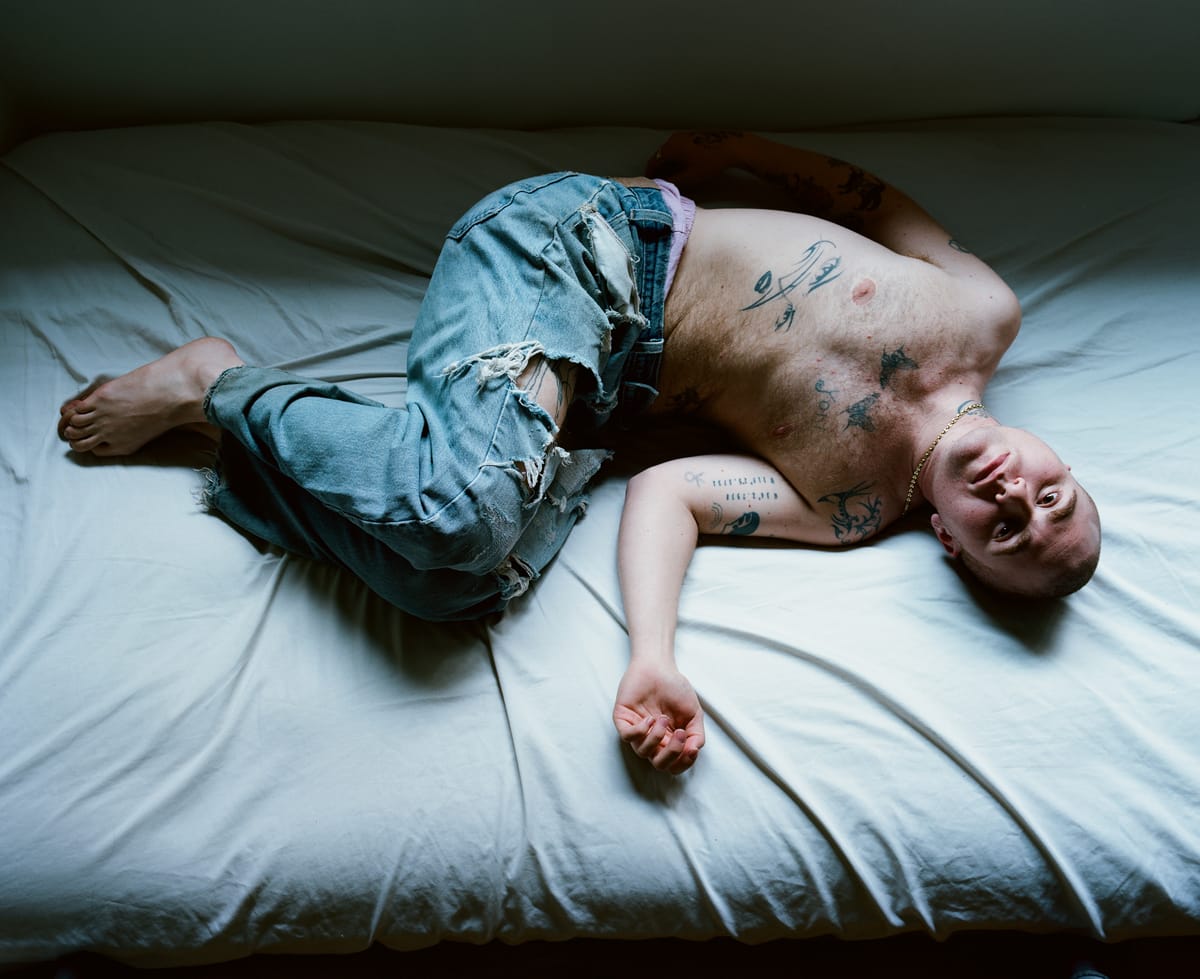
On with today's installment—I was a huge Girlpool fan, I'm not currently wearing my Girlpool T-shirt but I do wear it often...I was disappointed when the group split but I really enjoy Avery Tucker's solo debut Paw, which digs deeper into the grungier side that Girlpool was exploring in their final two records to very satisfying effect. I was very pleased to hop on a call with Avery recently to chat through his burgeoning solo career, life post-Girlpool, and much more. Check it out:
How have you been feeling with this record out in the wild?
It feels good. I've been done with it for so long that there's almost a classic disconnect thing, where I'm already working on new stuff. But every time I put out music, there's a spiritual release—a chapter in my life—that's been encapsulated in that album, and it's a portal opening when you let go of stuff.
Talk to me about what went into putting it together.
I was going rogue, in a way, and taking a leap of faith when it came to starting my own solo career—not signed, not with a record advance, just teaming up with a producer in a studio. I was pretty experimental for a while, and once I crossed paths with [producer Alaska Reid] and we locked in on we wrote together, we recorded it for fun at a friend's house and then we co-piloted the whole thing. It was a pretty DIY setup at my house, and at her house in Montana—a couple little studio sessions here and there. It was mostly from the ground floor, which was a pretty cool place to return to after Girlpool, where we had a lot of musicians play on the last couple of records. Except for a couple drummers here and there and some pedal steel, mostly this record was just me.
It was really fun, and it felt like I went back to my roots when I was in high school and would come home and record a song in my room with one mic, and I'd put it up that night. I wanted to get back into the spirit of not overthinking the production process. That was the goal, and there were definitely challenges for sure. In the last decade of being in Girlpool and making albums, I got wrapped up in a different rhythm of album cycles and production. So it was a lot of unwinding of how I thought things needed to be.
I definitely hit some really challenging walls. I was exiting a lot of comfort zones— and I wanted to, because I felt like they were stifling me and I'd entered a codependent vibe with having a partner-songwriter. I was also [previously] in my comfort zone of, "Let's make an album, get session players, and make it sound quote-unquote good"—but I didn't want it to sound good, I wanted it to sound real, and to get closer to the energy that originally got me into music. I started so young, and I lost certain parts of me—they got washed away for various reasons. But the unwinding was really freeing, and also totally scary, vulnerable, and weird.
Talk to me more about the act of collaboration for this record.
I feel so grateful. So many friends of mine are my biggest inspirations. I can get on the phone with them, and we can talk about a song, a concept, or a feeling, and we get locked in and I can really fly with them. I'm so grateful for having people in my life like that. Alaska was super on the ground with me, and it was fun to travel to Montana and do it here. Her old friend [Quint Bishop] engineered the album, so we were a little pack and we'd get our hands really dirty. A.G. Cook was with us a lot of the time too, and inserting him in the mix was pretty interesting.
I sing on "Angel" with Katie Gavin, who's such an incredible and inspiring friend of mine. I love her so much. She released her first solo album before mine, but we bonded a lot in the making of both of them. Aaron Maine of Porches, who's an old friend, is on the song "Baby Broke" with me. He's literally one of my favorite songwriters. We go back, we used to tour a lot together and he's so inspiring to me. I'm really grateful for all the energy that they brought to the record.
Talk to me a little more about recording in Montana. That's not always a place that I hear referenced when it comes to recording.
Alaska was born in Montana and her family has a home out there, so we went out there in the winter, camped out in her living room, and recorded the album there with Quint. It was magical—it was snowing and cold, with a big quiet sky. It was a really cool place to go away and dive into the record. I'd never gone to a different location to make an album, and I really enjoyed it, because I've always fantasized about it. I mean, I guess Harmony and I did that on our first-ever album—we moved to Philly and we recorded it there, but we were moving there, so it was really cool to go on an intentional trip and dive into recording.
With Paw being about my paw print—the vulnerability in a paw, the intensity and strength and power, the claws of the paw, and the extremity of that—it really felt like that was in the environment of Montana. The weather was intense, with beautiful pink and purple dark skies. That energy informed the album in a really cool way.
Talk to me about the emotional quotient of what you were expressing on this record.
It's funny—a year ago, someone asked me about a song I wrote, and I said, "It's just a tantrum." A lot of the songs I write are me needing to go away and have a tantrum about this feeling, and really just pour and stretch it out and turn over every stone. That's a big part of songwriting for me—that catharsis of boundlessly turning over the stones of a experience I'm having. A lot of these songs are spirited in a emotionally charged, frustrated, stressed state. It's intense. "Sunkiss" is about just really wanting someone to feel their higher power to feel connected to themselves—to know their knowingness—and me feeling like I can give them that.
How's it felt to perform these songs live?
I love every part of creation and music, and the live element is so huge for me.It takes me, and I want to be taken. Whether I'm writing or recording, as long as I'm being taken somewhere and get that injection—that high, that feeling of arrival—that's a huge success, and playing live is a great avenue to get that feeling for me. I love it so much. I've been playing a lot and it's great. Even if I'm in my house and playing a bunch of songs live with a couple friends accompanying me, or just alone, it's a huge release and a reminder that if I go too long without being reminded of this frequency of feeling, I start drifting and struggle to exist.
Any particularly disastrous gigs across your career that come to mind?
In the early Girlpool days, we played some funky shit for sure. We were doing the DIY rounds, and we'd rarely say no to a show. Sometimes we'd play multiple times a week when I was in high school. That got funky, and we were definitely in some gnarly environments when it comes to cleanliness.
I went on vacation with my family in Iceland a few years ago, right after Girlpool had broken up. I had a friend out there and I thought it would be really fun to just play at a bar in Iceland. He booked this little show, and it was super small and it was freezing out. I played a lot of the Paw songs that I'd just written, and it was a really emotional time for me because the band had just split. I was taking the leap of faith—I didn't know what was going to happen or what the process was going to be. I was walking away from a career that I started when I was 16—that was my livelihood. So it was a vulnerable time, and playing at that bar was really important for me, because I was extraordinarily far from my home and it was random and last-minute.
No one was there, really. It was cool, and kind of sparse. I had some really magical experiences at that show, and I really loved and connected with the person who opened. I made some cool friends out there, and it was really fun, but I was in my height of vulnerability and I was really in my feelings about a lot of the songs at the time. It brought things up in a confrontational way.
Tell me about what your experience has been across the last decade when it comes to being a public-facing musician.
It's almost a blur. It's like when someone's going into fourth grade and you're like, "Can you believe you're in fourth grade? This is crazy!" And the kid's like, "Well, I went to first, second, and third." I came out of high school and didn't realize that it was kind of rare for your your high school band to get signed and tour the world. I knew it was really cool, and I was super excited about it, but I just thought, "Sick, this is it." At the time, with DIY and stuff, we had so many bands around us that were the same age, playing the same shows, sharing bills and co-headlining tours. There was such an amazing community, and instead of going to college I was touring the country—and the world—with other bands that were a similar age, gaining traction.
It was totally incredible, and hilarious too, because I was so young and exploring creativity with my new-ish friend. I'd just only met Harmony—people thought, "Oh my God, you guys have been best friends since childhood," but we literally met less than a year before Girlpool started. We were getting to know each other, and then suddenly we were in the car together, driving all over the country and opening for Wilco. It was a trip. What a blessing. I learned so much from being in Girlpool and touring. I can't obviously imagine it any other way. because it's part of my experience.
Do you and Harmony still keep in touch in general?
Yeah, totally. We're super close. We talk almost every day. We're like family, and we see each other all the time. We have a really unique bond that's unlike any other friendship of mine, because there's a partnership element to us. We're not romantic—we've never been romantic—but we run very deep.
How old are you, by the way?
I'm 29.
You're on the cusp of 30.
Yeah, man. Crazy.
How does that feel?
I'm down with it. I'm down with all of it. I had a dream, years ago, of me in my late sixties, early seventies, living in a little brick apartment somewhere. I saw it really clearly—I was making music, and I was so blissed out. I'm down to get up there.
What have you observed in yourself when it comes to how you've changed as you've gotten older?
A lot of my like early adult life, I was touring non-stop. I haven't had a life that isn't hitting the road every few months and going out and da da da da da. The last few years—getting a job, working on my record, playing shows, staying more local, doing some gigs here and there—has really allowed me to do more conscious self-work and descend a bit more. We were so on the move—and I love being on the move. I love touring, I'd love to just be on the road all the time. But I've had more time to ground at home than I did in my early twenties and late teens, when I was gone all the time.
Your dog's paw is on the cover of the record. Talk to me about that.
I've been obsessed with those dogs—bull terriers—since I was super young. You can kind of wrestle with them, and she's really tough. Her paw looks crazy, and I was taking photos with my friend [Abdul Kircher] for the cover, and he started taking these crazy photos of Dizzy's paw. It's crazy that we didn't even think about doing that, because the record was already called Paw. We didn't even think about it. Dizzy was here for a lot of the recording and stuff, but the record isn't about my dog at all. I just loved how grotesque and tough the image was. I rescued her, like, five years ago. She's got a whole life history. What that image reflected—the calluses, the chipping, plus the sweetness of the fact that it's how this animal touches the earth—it's intense and =heavy, but also really vulnerable and open. It felt like that juxtaposition was reflected in the image of her paw.